
Crop Production

On March 31, the US Department of Agriculture National Agricultural Statistics Service (USDA NASS) released its Prospective Plantings report, which forecasts row-crop acreage for the coming marketing year. The report uses data from a survey of farmers’ planting intentions and marks the first official estimate of area planted to various crops in 2026. Future estimates will come from the Acreage report released in June. This will then be substantiated by USDA Farm Service Agency (FSA) data in the September and October Crop Production reports before the estimate is finalized in the Crop Production Annual Summary report next January. These reports are important because they provide critical information on crop production throughout the growing season, which is an important determinant of crop prices. As a result, crop markets often react following the release of each report, depending on how the results compare to expectations. The following information outlines the current acreage projections for 2026 and provides a historical context on how accurate farmers can expect these forecasts to be.
2026 Highlights
- The United States is expected to increase soybean and cotton acres but decrease corn, peanut, and wheat acres.
- Corn is expected to be the most widely planted crop in Alabama. Unlike the United States, Alabama producers are not projected to switch from corn to soybeans.
- Peanuts are the most predictable crop for Alabama, while corn is the most predictable for the United States.
- The intended plantings numbers are useful projections, even if they are not always precise.
Projected Planted Acres
Cotton & Peanuts
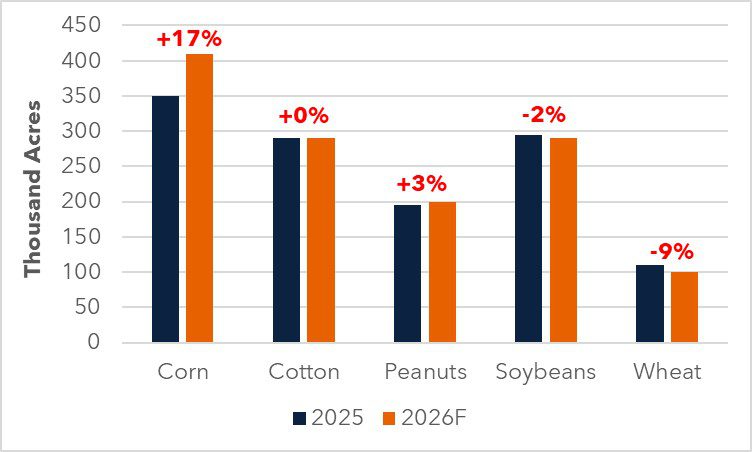
Figure 1: Alabama Planted Crop Area: 2025 Final Value vs. 2026 Planting Intentions
Data Source: USDA-NASS Prospective Planting, March 2026
The cotton planted area is expected to reach 9.6 million acres in the United States this year. That would mark a 3.9 percent increase compared to what was planted in 2025. In Alabama, 290,000 acres of cotton are expected, which would be identical to last year (figure 1).
Peanut plantings are forecast at 1.67 million acres nationwide, which would mark a 14 percent decline from 2025. Yet in Alabama, peanut acreage is projected to increase by 5,000 acres to 200,000 acres. If realized, this would be the largest peanut area planted in the state since 2015.
Grain Crops
There is expected to be a shift from corn to soybeans in the United States this year. Corn acreage is forecast to decrease by 3.5 percent to 95.3 million acres. Soybean acreage is forecast to increase by 4.2 percent to 81.2 million acres. This contrasts with Alabama, which expects to see a 17 percent increase in corn area to 410,000 acres and a 1.7 percent decrease in soybean area to 290,000 acres.
In Alabama, wheat acres are down 9 percent to 100,000 acres. This is similar to the 3 percent projected decline nationwide. This decrease in Alabama is likely due to lower prices driven by wheat basis in the Tennessee Valley becoming negative over the past few years. This year, there has been increased competition from canola—another winter crop—which could push wheat acreage even lower across north Alabama.
How Accurate is the Prospective Plantings Report?
Over the past 10 years, the Prevented Planting report has done well in forecasting peanut acreage in Alabama, underpredicting the planted area by 1.2 percent (3,636 acres). This is not surprising, due to peanut rotations being stable. During this period, the report overpredicted peanut acreage three times and underpredicted it six times. On the other hand, the report has overpredicted wheat acreage eight times, averaging an 8.5 percent miss.
For the United States, corn predictions have missed by 0.2 percent on average, while soybeans have been off by 2.0 percent, or more than 1.6 million acres. Corn has missed high three times over the past decade, but those were substantial overestimations, leading to the average being an overprediction. On average over the past 10 years, the report has overpredicted the number of corn, cotton, soybean, and wheat acres and underpredicted peanut acres both in the United States and Alabama.
Many factors can affect the accuracy of the report. For example, 2025 cotton area was overestimated by 70,000 acres in Alabama—a 24 percent miss. This was because of a record 62,000-acre prevented planting for cotton due to the wettest spring on record. In addition, price changes may have an effect. March surveys for corn have tended to yield conservative estimates, with acres added back later if corn prices strengthen. Soybeans acres have often scaled back by planting time, as corn or cotton become more attractive options.
Table 1. Alabama Prospective Plantings Report's Performance Compared to Final Estimate*
Data Source: USDA-NASS Prospective Planting Report, March 2026
| Crop | Average Error (acres) | Average Error (%) | Years Projected Too High | Years Projected Too Low |
|---|---|---|---|---|
| Corn | 6,818 | 2.1 | 5 | 3 |
| Cotton | 10,455 | 4.1 | 5 | 5 |
| Peanuts | -3,636 | -1.2 | 3 | 6 |
| Soybeans | 10,455 | 3.4 | 6 | 4 |
| Wheat | 4,545 | 8.5 | 8 | 1 |
Table 2. United States Prospective Plantings Report's Performance Compared to Final Estimate*
Data Source: USDA-NASS Prospective Planting Report, March 2026
| Crop | Average Error (acres) | Average Error (%) | Years Projected Too High | Years Projected Too Low |
|---|---|---|---|---|
| Corn | 216,545 | 0.2 | 3 | 7 |
| Cotton | 131,773 | 0.9 | 5 | 5 |
| Peanuts | -48,536 | -1.9 | 4 | 6 |
| Soybeans | 1,628,273 | 2.0 | 6 | 4 |
| Wheat | 230,636 | 0.5 | 7 | 3 |
Looking Ahead
As farmers look into 2026, a few factors could affect the reliability of this year’s report estimates. First, the surveys for the report were conducted the first two weeks of March, during a period of increasing fertilizer prices. With this recent increase in fertilizer costs, the swing between corn and soybeans acres could look drastically different, if farmers switch to lower-input soybeans. For more information on crop production costs, check out the Alabama Extension row-crop enterprise budgets at aces.edu.