
Crop Production

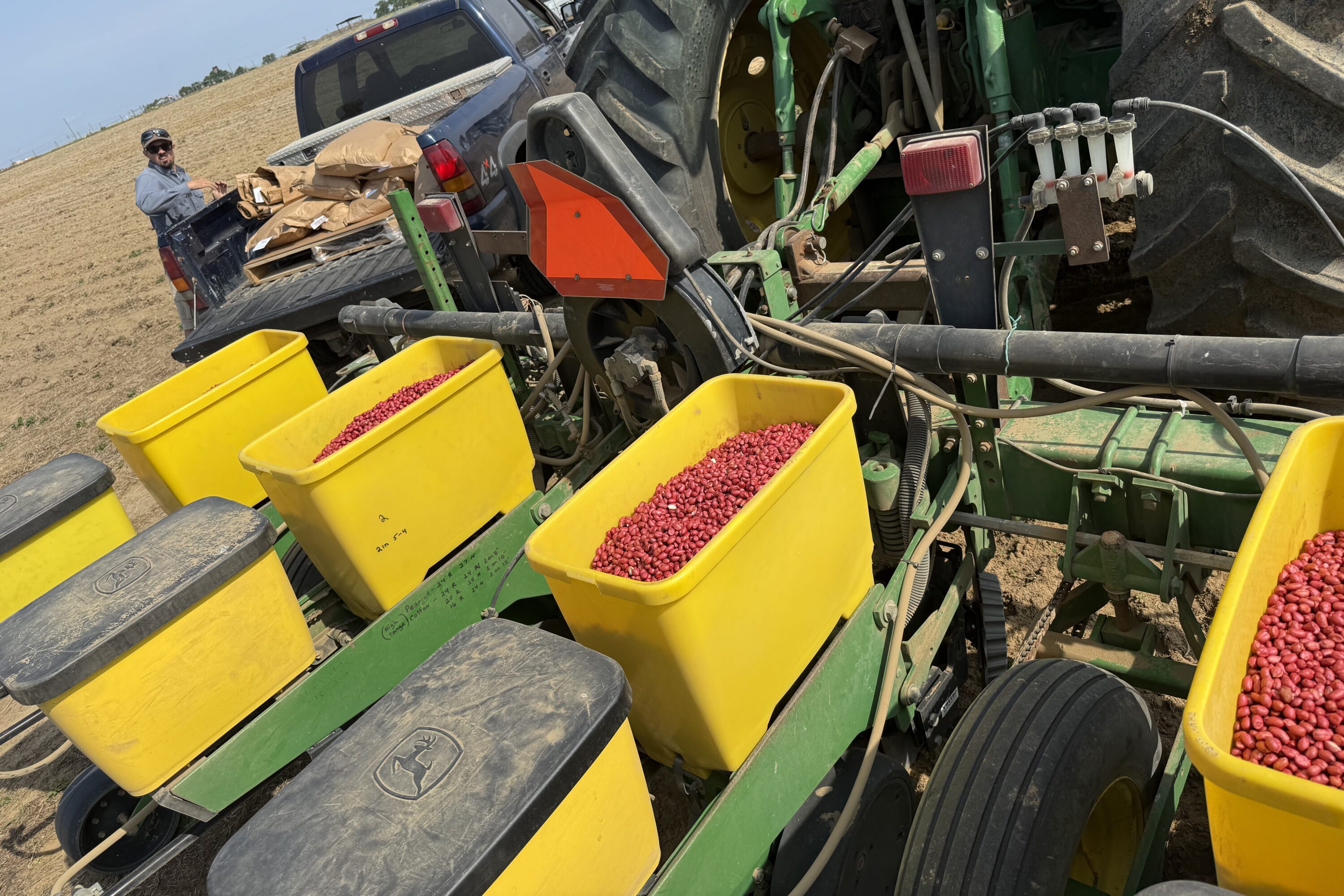
Peanut planting is underway across the state, with most growers hoping to wrap up the planting season within the next few weeks. As with other row crops, planter issues are common when planting peanuts.
Planter Seeding Rate Issues
One of the most common issues is the planter putting out either too much seed or not enough. Part of this is due to the traditionally higher seeding rates for peanuts compared to other crops such as corn and cotton. Peanuts are nominally planted at a seeding rate of 6 to 10 seeds per foot of row length.
Regardless, both under- and over-seeding translate directly into money lost due to either reduced yield or extra seed in the furrow. This can be quite significant. Table 1 shows that, on average, every extra seed per foot of row length costs growers $18 to $19 per acre. These numbers are calculated to show how each additional seed beyond the desired rate in the furrow affects the final planted population and the associated cost. The total number related to over-seeding can be quite large when calculated across the total peanut acreage on each farm. For that reason, one of the most important considerations when planting peanuts is dialing in the planter to achieve the desired seeding rate and minimize seeding rate errors.
Table 1. Cost of extra seeds
| Seeds per ft. of row length | Population (seeds/ac) with 36" rows | Population (seeds/ac) with 38" rows | Cost ($/ac) with 36" rows | Cost ($/ac) with 38" rows |
|---|---|---|---|---|
| 1 | 14,520 | 13,756 | 19 | 18 |
| 2 | 29,040 | 27,512 | 38 | 36 |
| 3 | 43,560 | 41,267 | 57 | 54 |
| 4 | 58,080 | 55,023 | 76 | 72 |
Ways to Achieve Target Seeding Rate
Besides ensuring a proper seed meter setup, there are a couple of things growers can pay attention to and adjust to ensure the planter is putting out the desired number of seeds per foot or per acre.
Vacuum Pressure
While even seed spacing would be ideal when planting peanuts, generally the main goal is to achieve the desired number of seeds per foot within each row. Increasing or decreasing the vacuum pressure to achieve the target seeding rate is often one of the best ways to do so.
Generally, the vacuum recommendations in the planter operator’s manual or seeding rate charts offer a good starting point but usually need to be adjusted based on the peanut variety due to varying seed size. Additionally, vacuum requirements for some seed meters–especially standard John Deere models–vary with seeding rate, as higher seeding rates typically require increased vacuum to maintain the target seed output.
Graph 1 illustrates this, showing that the vacuum pressure needed to be increased considerably–up to 16–for the planter to achieve the desired seeding rate of 116,000 seeds per acre. Similarly, reducing the vacuum pressure can help when a planter is putting out more seed than desired due to a high number of multiples.
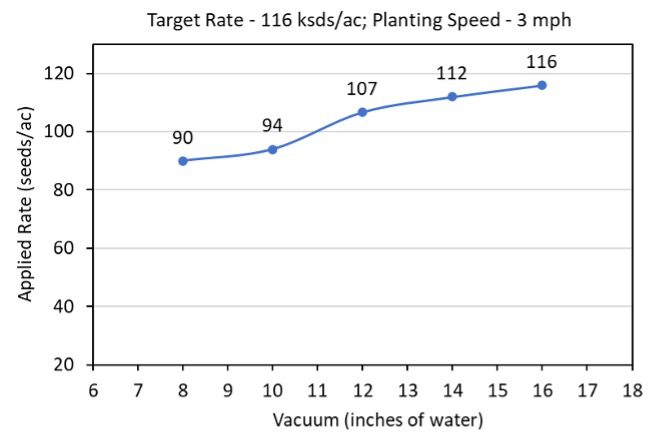
Graph 1.
Planting Speed
Typically, peanuts are planted at speeds of 3 to 4 miles per hour, which is usually slower than other row crops. However, adjusting planting speed by slowing down is another important consideration to help achieve the desired seeding rate.
Most seed meters cannot meter accurately at higher planting speeds due to high rotational speeds (rpm). By reducing the planting speed, the seed meter slows down so it can maintain the desired seed output.
When adjusting planting speed, it is recommended to decrease by 0.1 to 0.2 miles per hour at a time to see the effect on the planted population. Generally, there is an optimal planting speed for each target seeding rate, beyond which seed meter performance degrades rapidly. Graph 2 illustrates this by showing a rapid decline in planter performance at planting speeds above 3.5 miles per hour, at a target seeding rate of 116,000 seeds per acre.
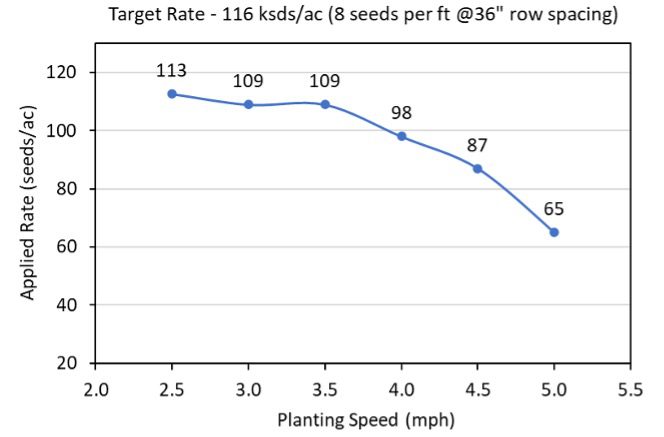
Graph 2.
Key Takeaway
Overall, both vacuum pressure and planting speed are valuable tools that can be used together for achieving the target peanut seeding rate. For peanut planters equipped with seed-monitoring capabilities, these adjustments can be made in real time to visualize changes and dial in the planted population. For planters without seed monitoring, growers should consider digging behind multiple rows after each adjustment to vacuum or planting speed. While troubleshooting planter issues is often time consuming and frustrating, it is important to remember that this investment goes a long way in minimizing additional seed costs. This is especially important now as seed prices are higher than ever, and peanut prices are low.