
Fruits & Vegetables

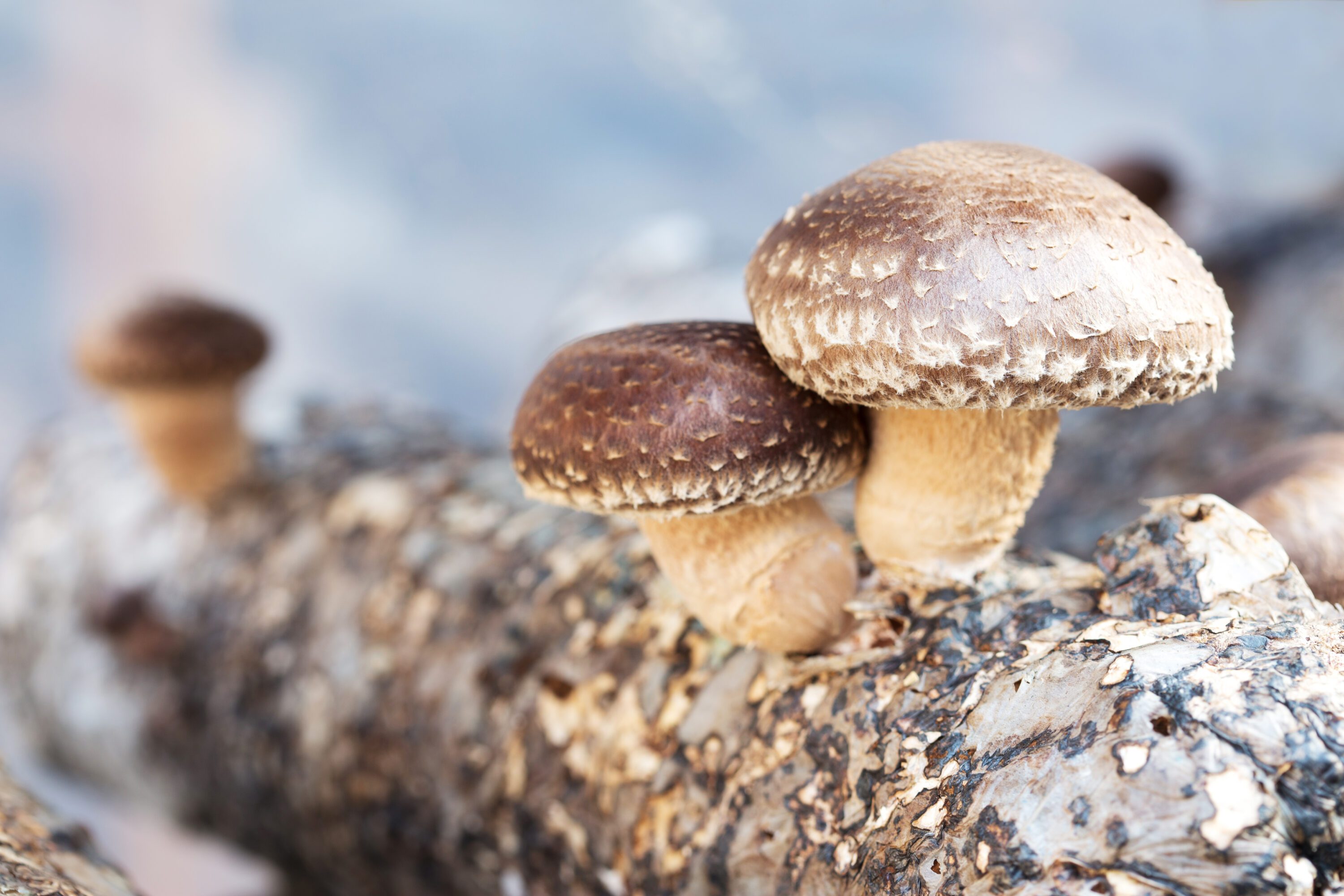
Shiitake mushrooms are a nutritious, low-calorie food that’s easy to store and enjoy fresh or dried. They can be grown year-round using methods that range from simple indoor setups to more traditional outdoor log cultivation.
Home production of shiitake (she-TAH-kee) mushrooms can be a rewarding and delectable hobby. These mushrooms can be grown casually or with a concerted effort year-round, indoors, outdoors, on hardwood logs, or in blocks of sawdust.
Shiitake mushrooms are good to eat. They are an excellent source of protein with trace minerals, B and D vitamins, and are low in both fat and calories. In addition, they have been proven to reduce cholesterol.
Shiitake mushrooms do not bruise easily and can be stored for up to a month if harvested at the right time and refrigerated in vegetable or green bags. They can also be dried and stored in sealed plastic bags for up to 2 years.
Growing shiitake mushrooms on logs requires patience. You can establish a shiitake garden by purchasing or cutting your own logs in the dormant season and inoculating them yourself. It will take 6 to 12 months for these logs to produce mushrooms. For those with less patience, you can buy pre-inoculated sawdust blocks. You should be able to fruit the mushrooms right away.
Preparing for Inoculation
What is inoculum or spawn?
Most cultivated mushrooms are propagated from mycelium. Mycelium is the vegetative part of the mushroom that consists of a network of fine white filaments or hyphae. The mycelium is what grows in and runs through the log or sawdust. Specially cultivated mycelium is placed in a rich sawdust mixture and is allowed to run through the sawdust. When it turns white, and the sawdust is a solid mass of mycelium, it is then ready to use as spawn or inoculum.
Where plants have cultivars or varieties, shiitake mushrooms have strains. Like plant varieties or cultivars, mushroom strains are named and have specific characteristics, such as the temperature at which they fruit best or the appearance of the cap, the fruiting body, or the mushroom. Be sure to read the descriptions before making your strain selection.
Picking the right shiitake strain
There are many strains of shiitake mushrooms, so be sure to read the strain descriptions carefully. The most important characteristics are fruiting temperature requirements, cap appearance, spawn run time (time it takes to fruit), and productivity on logs or in sawdust. Be sure to take into consideration the weather fluctuations of your local area when choosing the strain.
Fruiting temperature requirements
Shiitake strains are commonly categorized by fruiting temperature requirements. Shiitake will generally fruit, forming the edible mushrooms at log temperatures between 41°F to 86°F. Strains are generally divided into three categories: Cool-season strains fruit at 41°F to 68°F. Wide range strains fruit at 50°F to 80°F. Warm-season strains fruit between 50°F to 86°F. It is generally recommended to select several different strains so that you can fruit your logs or blocks at different times of the year. Strains may also vary in productivity, appearance, mushroom size, and the length of time it takes to fruit.
Environment
Select strains that will fruit in the environment where you plan to develop your shiitake garden. Inoculate logs with a warm-season strain for summer fruiting if you plan to grow under the shade of a tree. Inoculate logs with a cool-season strain if you want to harvest mushrooms in winter. A wide range strain, such as WR46, can be used for spring and fall production, and it is a good starting point for beginners.

Figure 1. Sawdust spawn (a) and dowel spawn (b). Photo Credit: A. Shabel
Condition and Appearance of Spawn
Most strains can be purchased as sawdust spawn or dowel (sometimes called plug) spawn (see Figure 1). Your spawn should be white and fluffy when you receive it with little or no liquid at the bottom of the bag. If there are green patches, such as the weed fungi Trichoderma, contact the vendor and ask for new spawn.
If the spawn is brown and loose, the mycelium is not well-knit, and it was sent to you before it was ready to use. You can store unknitted spawn at about 65°F to 70°F in a humid environment for a few weeks, letting the mycelium develop until the entire block turns white. Alternatively, you can return the unknitted spawn, asking for a replacement with a well-developed white bag of spawn.
If you receive your spawn more than a few days before you plan to inoculate, you should place it in the refrigerator or a very cool basement. Move the spawn to room temperature about 24 hours before you plan to inoculate.
Selecting the Best Trees
Type
When growing shiitake on logs, not all trees are created equally. Some tree species will grow shiitake well, while others are not suitable for production at all. White oak group species are the most productive and are bothered the least by invasions of foreign or weed fungi. But white oaks require the most patience, taking up to 8 to 12 months from inoculation before the mushrooms first begin to fruit.
Red oak group species and sweetgum (Liquidambar styracifula) have softer wood and will produce mushrooms in 6 to 8 months. They also require more careful management, as they are more susceptible to weed fungi, bark peeling, and rapid water loss.
Shiitake mushrooms also grow on American Hophornbeam (Carpinus caroliniana), sugar maple (Acer saccharum), ironwood (Ostrya virginiana), and American Beech (Fagus grandifolia). How well shiitake mushrooms grow on logs from these trees will depend on how much care you give the logs and how well you control moisture, temperature, and exposure to other fungi. Other types of trees can be used for growing shiitake mushrooms, but even under the best conditions, you will only harvest a few mushrooms per log.
The actual location of the growing tree is also important. More fertile soil will produce trees with more nutrients and sugars. Trees located on rocky hillsides or under drought conditions will be less nutrient-rich.
Additionally, trees used for shiitake log production should be visibly healthy and free of any other existing pathogens. Choose trees that have no signs of disease, including leaf spots, shelf mushrooms, dead scaffold branches, or those that are in decline. A tree that is already colonized with a bacterial or fungal pathogen will produce an inferior shiitake crop.
Sapwood area
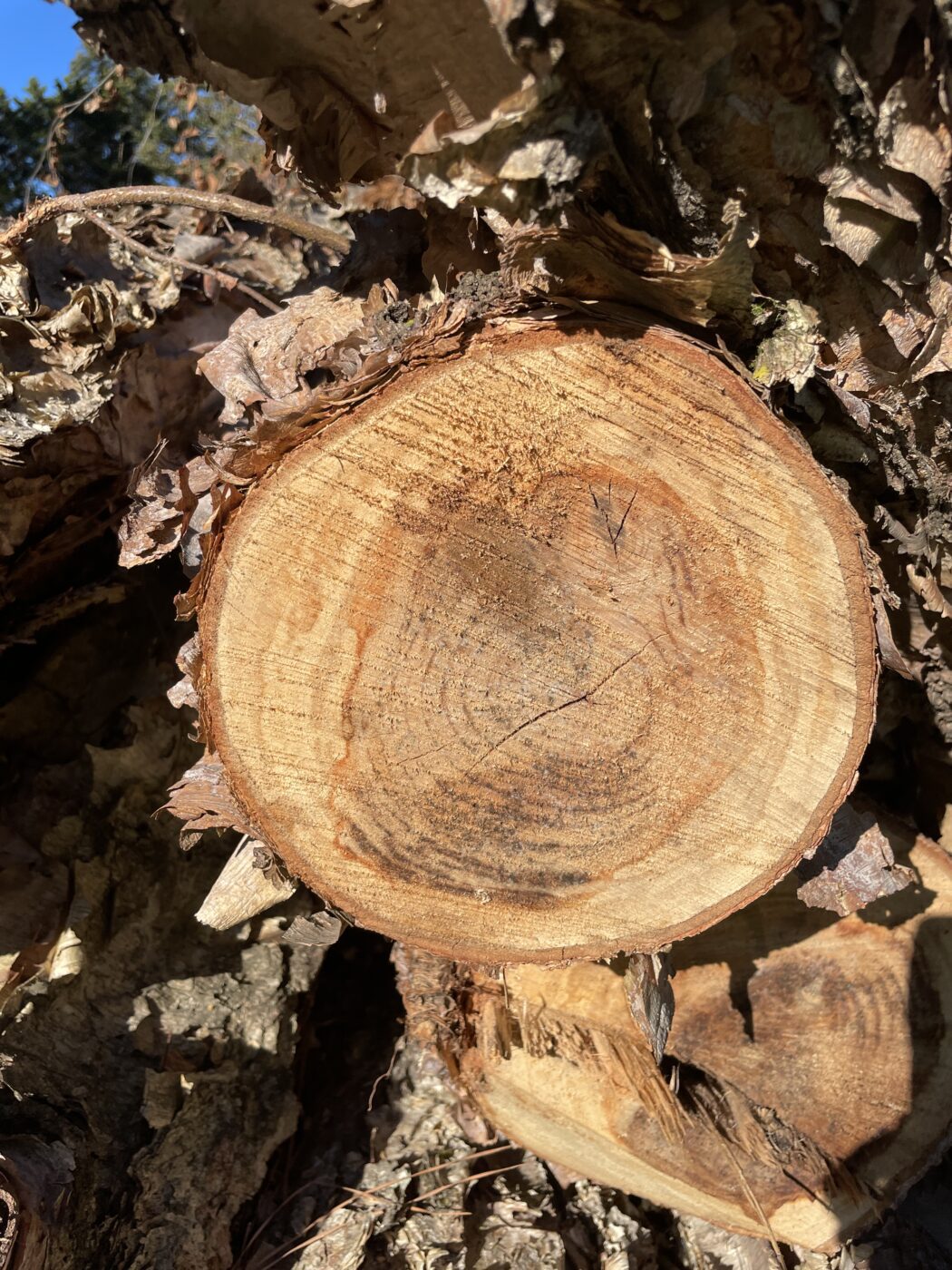
Figure 2. The lighter, outermost wood is the sapwood, and the darker inner wood is the heartwood. Photo Credit: A. Shabel
Since shiitake mushrooms feed primarily on sapwood, trees selected for inoculation should have a large sapwood area. You can determine the ratio of sapwood to heartwood by looking at the end of a log after the tree has been cut. Most trees in a particular region will have similar sapwood to heartwood ratios. The lighter or outermost wood is the sapwood, and the darker or inner wood is the heartwood (see Figure 2).
A small amount of sapwood means the log will probably produce mushrooms for less than 2 years. The cambium area, just under the bark, is green and probably provides the most nutrients. The bark covering the cambium must remain intact and free of damage to avoid competing fungi invasion and loss of moisture.
Cutting shiitake logs
Logs should be harvested during the dormant season from live, healthy trees. If you can, cut the tree down 7 days before you plan to inoculate. Logs can then be cut to size and moved to the inoculation site immediately. Another option is to cut the logs and immediately soak them for 3 days and inoculate them within 24 hours of removal from the soaking liquid. This would be the preferred method if conditions are dry.
If you cannot fell the trees and cut them up in the same day, you can leave the whole trees in the woods uncut and untrimmed for up to 7 to 10 days. Then, cut them to size and inoculate within a few days. You can also soak these logs prior to inoculation to ensure good log moisture.
The diameter and length of the log will depend on how heavy you want your logs to be. A 40-inch log, 8 inches in diameter, will weigh about 60 lbs. A 40-inch log, 4 inches in diameter, will weigh about 25 lbs. Logs 4-5 inches in diameter produce the most mushrooms. The length of the log is up to the grower, but it should be consistent for easier handling and stacking.
Equipment and Supplies
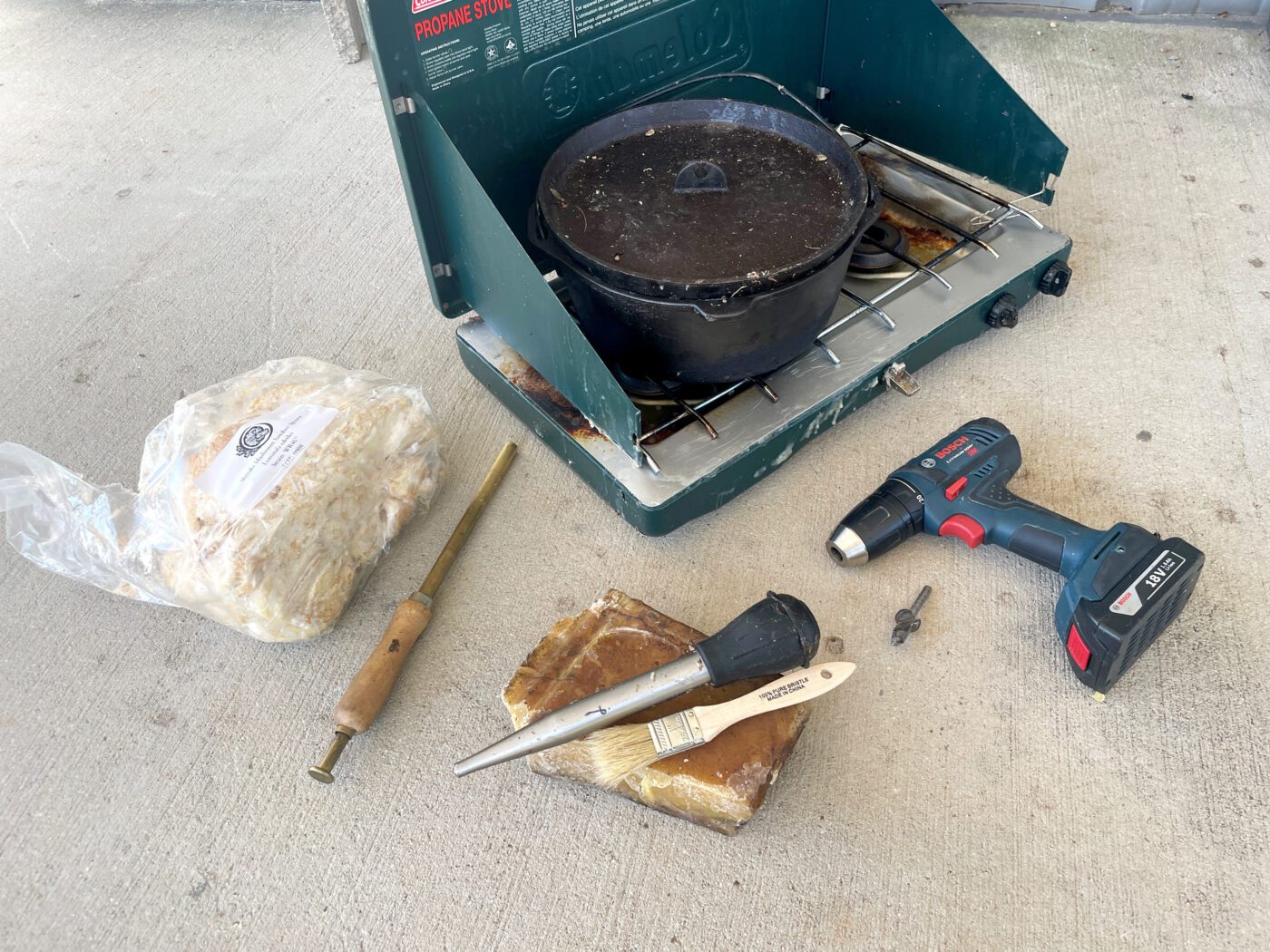
Figure 3. Equipment and supplies used for log inoculation. Photo Credit: A. Shabel
There are several tools necessary for inoculation, and there are some that just make inoculation easier. Where possible, several options for equipment or supplies have been given (see Figure 3). Consider using the following:
- High-speed drill or angle grinder with an adaptor to drill.
- 5/16-inch bit for dowel spawn or a 7/16-inch bit for sawdust spawn. Using a bit with a 1-inch stop collar will save time and produce more uniform results.
- Spawn inoculation tool for sawdust spawn or a hammer for dowel spawn.
- Cheese, paraffin, bee or candle wax; an option is foam plugs.
- Pot or kettle for wax.
- Propane stove or an electric burner to melt wax.
- Metal turkey baster for wax since a plastic baster will melt. You can also opt to use a natural fiber brush.
- Bathroom scales to weigh some of the logs.
Inoculating the Logs
Drill 1-inch-deep holes into the log in a diamond pattern: 7/16-inch diameter for sawdust spawn, 5/16 inch for dowel. The first row of holes is drilled down the length of the log; each hole should be 4 to 6 inches apart (see Figure 4). The second row of holes should be staggered two inches below or above the first row. Continue this pattern around the log (see Figures 4 and 5).
Inoculate the logs immediately after the holes are drilled. The inoculation tool will fill the holes to the bark level with sawdust spawn (see Figure 5). For dowel spawn, use a hammer to insert one dowel into each hole securely. Be sure the dowel or sawdust does not extend above the bark.
Once a log has been inoculated, it should fruit for 2 to 3 years. Re-inoculation is unnecessary because the mycelium grows throughout the log like roots in soil. The mushroom develops when the mycelium has accumulated sufficient nutrients, and the temperature and moisture requirements are met.
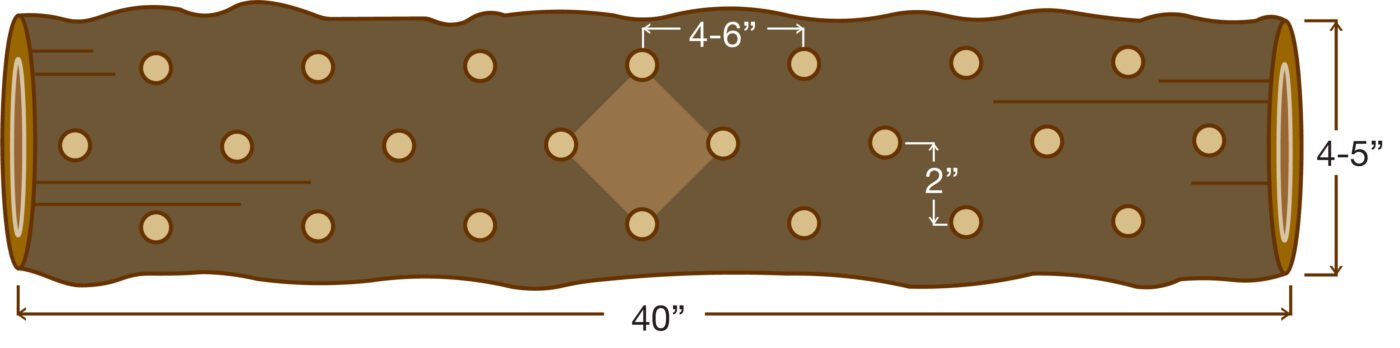
Figure 4. Row and hole spacing for inoculating shiitake logs. Diagram Credit: Shannon Schmalfeldt
Waxing the logs
- The inoculation sites and the ends of the logs are generally coated with wax. This reduces moisture loss and keeps the spawn or dowels securely in the hole. Seal sites with wax immediately after inoculation.
- Heat wax to about 260 degrees F, or until it begins to smoke slightly.
- Squeeze a light coat of wax using a baster over the inoculation sites to cover the inoculation sites (see Figure 5). You can also use a natural fiber brush to wax the inoculation sites.
- Dip the ends of the logs into the wax or brush them with wax to seal them. This will also slow down the invasion of foreign fungi through the cut ends. The logs must have sufficient moisture when waxing the ends.

Figure 5. Drilling, filling, and waxing shiitake log inoculation sites. Photo Credit: A. Shabel
Log Moisture
Monitoring moisture
To determine if your logs are losing too much water, weigh at least one average-sized log immediately after inoculation.
- Mark that log with paint or a tag.
- Weigh the log and record the weight.
- Reweigh the marked log(s) every few weeks.
Use this formula to determine weight loss:
(Original log weight – Current log weight)/ (Original log weight) x 100 = % moisture lost
If “% moisture loss” is greater than 10 percent, you will need to mist or water your logs more often. The log will naturally lose weight as the mycelium grows and uses up the nutrients.
Reweigh your log every 6 months to re-establish a new base weight or to replace the original log weight after inoculation.
- Soak the log for 24 hours.
- Remove it from the water and allow it to drain for 24 hours.
- Weigh the log. This weight will be your new base weight.
Many shiitake gardeners learn to “feel” the moisture in their logs just by picking them up. If they seem light, then they know they have not applied enough water.
Unless you plan to fruit your logs, it is best not to soak the logs to restore moisture. Soaking the logs at the wrong time can cause a break in the mycelium growth cycle and prolong the time from inoculation to fruiting or between fruiting.
Keeping the logs moist
A good rule of thumb is, if your garden needs water, your logs probably do too. There is no need to water or mist your logs if they are outdoors and it is raining. When they do need watering, use lawn sprinklers, misters, a drip irrigation system, or a greenhouse mist system to keep the logs moist. Logs should be given a fine mist for about 30 minutes in the morning. If you are using a lawn sprinkler, water for about an hour.
During spring and fall, when the temperatures are below 80°F, you can water less often. If you plan to fruit logs in the winter and rainfall is sufficient, you will not need to water.
Shiitake logs should be kept in full shade to conserve moisture and reduce bark shrinkage. If full shade is not available, consider adding a shade cloth above the mushroom fruiting area. The irrigation system can be placed along the shade cloth overhead. Alternatively, consider covering the logs in partial shade with burlap or landscape fabric to reduce moisture loss.
Mycelia Run
The waiting period
Once a log is inoculated, the root-like structures called mycelia must become organized and grow to take up nutrients and carbohydrates or sugars. Like roots, mycelia need plenty of moisture and a compatible temperature. Logs can remain outside in the winter.
Weigh your control log every few weeks. If it loses more than 10 percent of its weight, sprinkle or mist all the logs for short intervals of 30 to 60 minutes for several days, until the original weight is restored.
Stacking logs
Logs can be stacked several ways during the mycelia run. The most important factors are good aeration, moisture, and temperature. If logs are leaned against a tree or “A-frame” stacked, they will tend to lose moisture rapidly (see Figure 6).
“Lean-to” and “crisscross” are the best stacking methods for mycelium run (see Figure 7). If logs are stacked like firewood (see figure 8), they receive little aeration, and the mycelium in the bark knits the logs together. When you unstack them later, it causes the bark to pull off the logs. Also, bare spots will appear on the log where moisture can be lost.
Consider raising logs off the ground with pallets or bricks to reduce competing fungi from entering the logs. Weed fungi contamination can be a problem and contact with the ground increases the chances of contamination. One of the worst contaminants is Trichoderma. In its fruiting stage, you will see a green furry patch on the log or sawdust block. Trichoderma competes with shiitake for nutrients, thereby reducing productivity.
Logs will begin to show signs of mycelia run or mushroom activity in about 3 months. The inoculation sites will turn whitish first, and then the logs will have white “V-shaped” markings at the ends (see Figure 9). Fruiting will generally not begin for 6 to 9 months after inoculation, depending on the type of wood and the strain of shiitake mushroom you used.
-
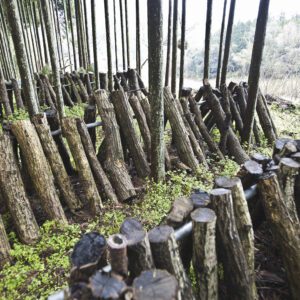
- Figure 6. An A-Frame stack can lead to rapid moisture loss. Photo Credit: Gyro, Stock photo ID:1369098114, istockphoto.com
-
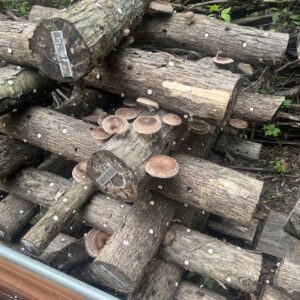
- Figure 7. Use a crisscross stack or a lean to stack to conserve space during mycelium run. Photo Credit: B. Lubresky
-
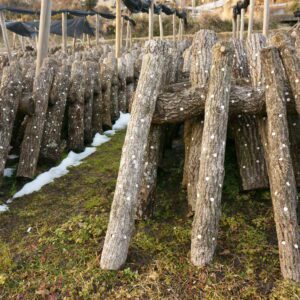
- Figure 8. A lean to stack. Photo Credit: ittiototama, Stock photo ID:499889885, istockphoto.com
-
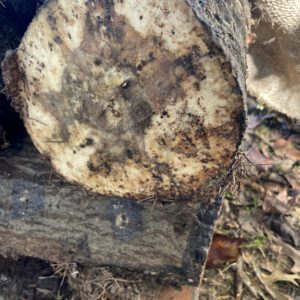
- Figure 9. As mycelia runs through log, the ends will begin showing white patches. Photo Credit: A. Shabel
Fruiting the Logs
When the mycelium is established in the logs, and the temperature and moisture conditions are appropriate, the logs will fruit on their own. First, small “pins” or primordia will appear and rapidly develop into capped mushrooms.
Wide range strains
If you keep your logs outside, the natural fruiting seasons are spring and fall. When the weather changes during these seasons, there is typically plenty of moisture. However, to ensure that the log has sufficient moisture to support quality mushroom growth, soak the logs inoculated with wide range strains in March and September for 24 hours, preferably with rainwater. Any large vessel will do for soaking: a wheelbarrow, a large trash can, an animal watering tank, or whatever is on hand. Lean the logs against a tree or fence in a well-shaded area after removing from the soaking water.
Warm-season strains
Outdoor logs inoculated with warm-season strains can be fruited in the spring and fall using the technique above and again in mid-summer by soaking them in very cold water—keep the logs moist or misted until pins appear.
Cool-season strains
Logs with cool-season strains should be brought indoors during cooler months to a warm location, such as a garage, for 1 to 2 weeks and then soaked for 48 hours. After soaking, locate these logs where air temperatures will always remain above 40°F. Fruiting will be slower in winter, but mushroom quality is excellent. These strains will also fruit naturally in early spring and late fall.
Pinning & Fruiting
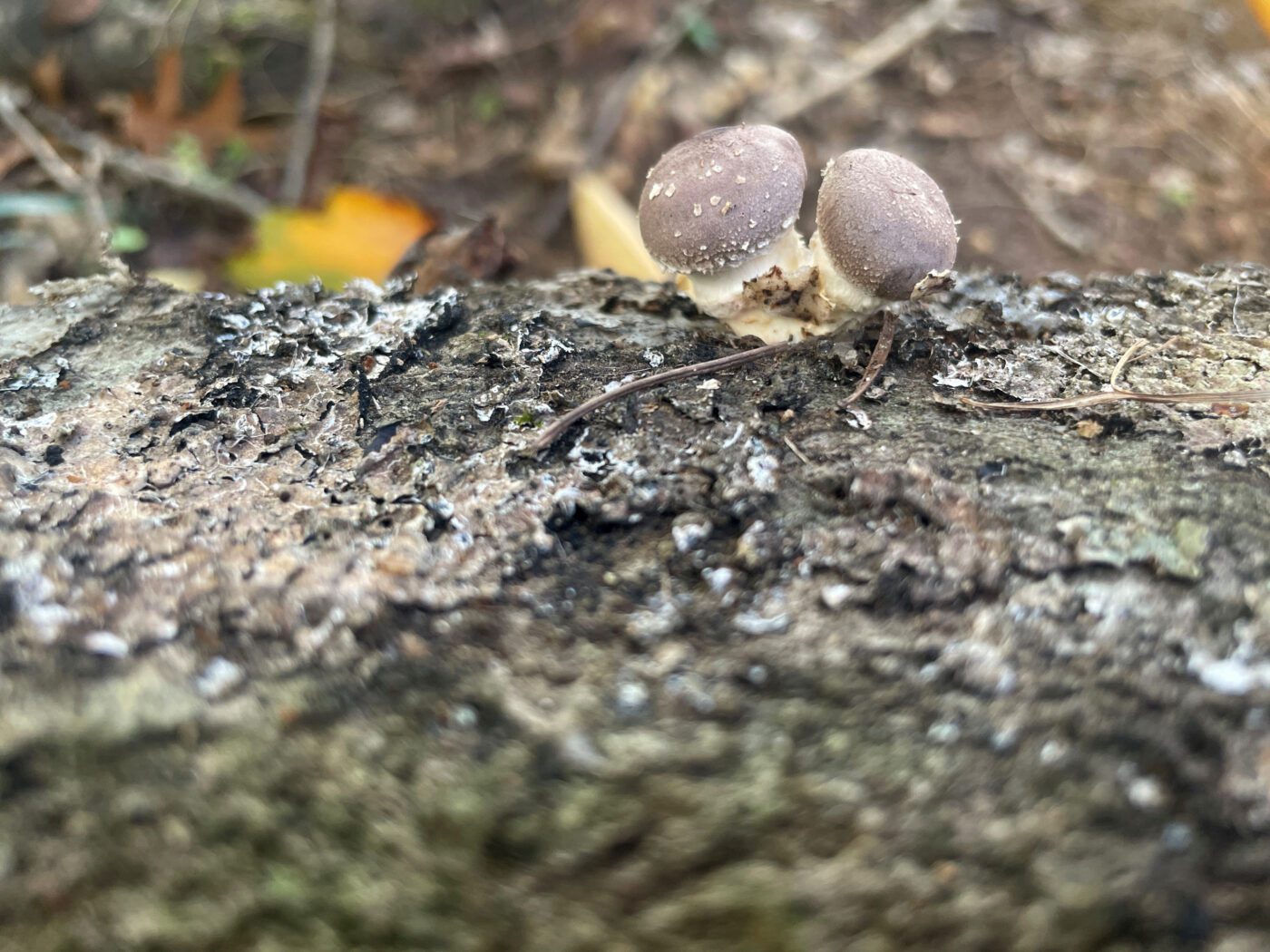
Figure 10. Shiitake mushrooms pinning from the inoculation sites. Photo Credit: A. Shabel
When the logs begin to fruit, you will first see a small whitish knob emerging from the inoculation sites (see Figure 10). These little knobs or “pins” will develop into mushrooms if the log and air temperature and moisture are favorable for fruiting.
Place the logs in a heavily shaded and wind-protected area so that the newly formed mushrooms will not dry out. Do not apply water to the mushrooms during development or expose the logs to rain or excess moisture. This will create oversaturated mushrooms with diminished shelf life.
Pre-inoculated logs
If time, equipment, and cost are of concern, pre-inoculated logs may be available locally. Check with your local farmers’ market or Cooperative Extension office to locate local or regional mushroom producers. They may be willing to sell pre-inoculated logs that will be fruitful that same year.
Ready-to-fruit blocks
For the less patient gardener, ready-to-fruit sawdust blocks can be ordered from a shiitake spawn vendor or from numerous online sites. They are made from hardwood sawdust grains and other additives necessary for mycelia growth. Producing these ready-to-fruit blocks on your own may not be a project for a beginner, as they require very sterile conditions and are easily contaminated. It is best to buy them as finished blocks that are already at the fruiting stage.
The ingredients are placed in a heat-resistant bag and are then autoclaved, which is similar to pressure cooking. After the ingredients cool, shiitake spawn is added to the bag mixture and the bag is sealed. Each bag has a small breathing patch for air exchange. As the mycelia grows, the sawdust mixture turns white. When the entire mixture is coated white, this is called a “white block.” A white block is not ready to fruit.
During the next 2 months, the white block will gradually turn into a “brown block.” The brown coating is a hardened shell that helps prevent moisture loss and contamination. When the block is completely brown, you can remove it from the bag, and it will usually fruit without soaking. In most cases, you can buy the blocks at either stage. Be sure the brown color is not the sawdust, but rather slick mycelium growth.
After the block is removed from the plastic bag, keep it in a humid location where it is exposed to outdoor or fluorescent light. Fruiting should begin within a few days (see Figure 11). The block will enter a resting state after all the mushrooms are harvested. During the fruiting process, sawdust blocks should be covered loosely with a clear plastic bag to keep humidity high.
You will be able to fruit your block again in 3 to 4 weeks by soaking for 12 to 24 hours. Alternatively, fruiting blocks that have fruited one or two times can then be used to inoculate logs after soaking the mycelium. The mycelium is still able to colonize woody materials after initial fruiting.
Blocks often become contaminated and can only be fruited a few times. You can harvest up to 2 pounds of shiitake mushrooms from each block. The first two harvests will produce more mushrooms than later harvests.
Harvest
The mushrooms can be harvested at any time by cutting or twisting the stem off the log. Be sure not to leave pieces of the stem sticking out past the bark. Mushrooms are best if harvested shortly after the gills are exposed or while the cap edge is still curled (see Figure 12). While a fully expanded shiitake cap is considered over-ripe, it is still edible (Figure 13). Refrigerate mushrooms within one hour after harvesting.
-
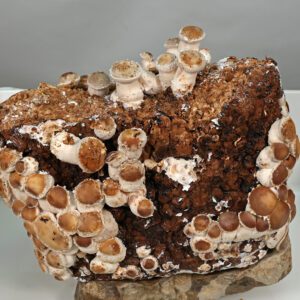
- Figure 11. A shiitake block beginning to produce mushroom. Photo Credit: Leo Malsam, Stock photo ID:1362435864, istockphoto.com
-
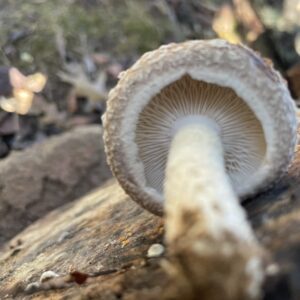
- Figure 12. Harvest just after gills are exposed, but while cap edge is still curled under. Photo Credit: A. Shabel
-
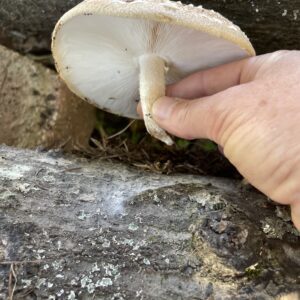
- Figure 13. An over-ripe, but still edible shiitake. Photo Credit: A. Shabel
Storage
Mushrooms can be used fresh or refrigerated for a short time. If you store your fresh mushrooms in the refrigerator in vegetable bags, they will last up to a month. If you refrigerate them in paper bags, they will dry out quickly.
For longer-term storage, consider dehydration. Research has shown that solar dehydration increases Vitamin D levels in mushrooms. This adds to the nutritional complexity of the mushroom. To dry mushrooms using a food dehydrator:
- Cut off the mushroom stems before dehydration.
- Remove dried individual mushrooms as they become just barely flexible, but before they are crisp.
- Store dried mushrooms in a sealed plastic bag in a dry location
Rehydration
To rehydrate shiitake mushrooms, soak them in water or a seasoned liquid, such as broth, for at least 30 minutes. Shiitake mushrooms absorb the flavors of seasonings. They taste best when cooked with onion, leek, or garlic, and are excellent in sauces, stews, or rice, and with steak or eggs.
Glossary
Dormant: Season when hardwood trees lose their leaves. This is generally from mid-October to mid-March.
Inoculation: The introduction of spawn into a medium: logs, sawdust, etc.
Mycelia: The plural of mycelium.
Mycelium: The vegetative part of a fungus made of a mass or network of threadlike tubes.
Spawn: The vegetative growth or pure culture mushroom mycelia on a suitable sterilized substrate such as various agars, grains, or wood chips.
Substrate: The material in which the shiitake mycelia grows. This includes logs, sawdust, grain, etc.
Weed fungi: Fungi other than shiitake that invade a log inoculated with shiitake spawn
Learn More
Learn More about shiitake mushroom production.
Best Management Practices for Log-Based Shiitake Cultivation for Log-Based Shiitake Cultivation in the Northeastern United States by Northeast Sustainable Agriculture Research and Education. https://smallfarms.cornell.edu/wp-content/uploads/2020/01/Shiitake-Cultivation-BMP.pdf
Growing Shiitake Mushrooms in an Agroforestry Practice. https://centerforagroforestry.org/wp-content/uploads/2023/01/Growing-Shiitake-in-an-Agroforestry-Practice.pdf
Shiitake Mushroom Production: Steps to Cultivation and Considerations for Production. https://ohioline.osu.edu/factsheet/f-0039
References
- Bruhn, Johann, and Michelle Hall. Growing Shiitake Mushrooms in an Agroforestry Practice. 2022. https://centerforagroforestry.org/wp-content/uploads/2023/01/Growing-Shiitake-in-an-Agroforestry-Practice.pdf.
- Crosby, Willie. Shiitake Mushroom Cultivation in the Northeast United States. Fungi Ally LLC, 2019. https://projects.sare.org/media/pdf/F/u/n/FungiAlly_Shiitake_booklet_324191.pdf.
- Miles, Phillip G., and Shu‑Ting Chang. Mushrooms: Cultivation, Nutritional Value, Medicinal Effect, and Environmental Impact. 2nd ed. Boca Raton, FL: CRC Press, 2004.
- Northeast Sustainable Agriculture Research and Education. Best Management Practices for Log-Based Shiitake Cultivation in the Northeastern United States. 2013. https://smallfarms.cornell.edu/wp-content/uploads/2020/01/Shiitake-Cultivation-BMP.pdf.
- Sabota, Cathy. Strain of Shiitake Mushroom [Lentinula edodes (Berk.) Pegler] and Wood Species Affect the Yield of Shiitake Mushrooms. HortTechnology 6, no. 4 (1995): 388–393. https://doi.org/10.21273/HORTTECH.6.4.388. Accessed April 21, 2026.

Allyson Shabel and Bronson Lubresky, Urban Regional Extension Agents, Home Horticulture, and Catherine Sabota, Ph.D., Retired Horticulture Specialist, Alabama A&M University
Revised May 2026, Shiitake Mushroom Gardening, UNP-0027
For more information, contact your county Extension office. Visit aces.edu/directory.
Trade and brand names used in this publication are given for information purposes only. No guarantee, endorsement, or discrimination among comparable products is intended or implied by the Alabama Cooperative Extension System.