
Forestry & Wildlife

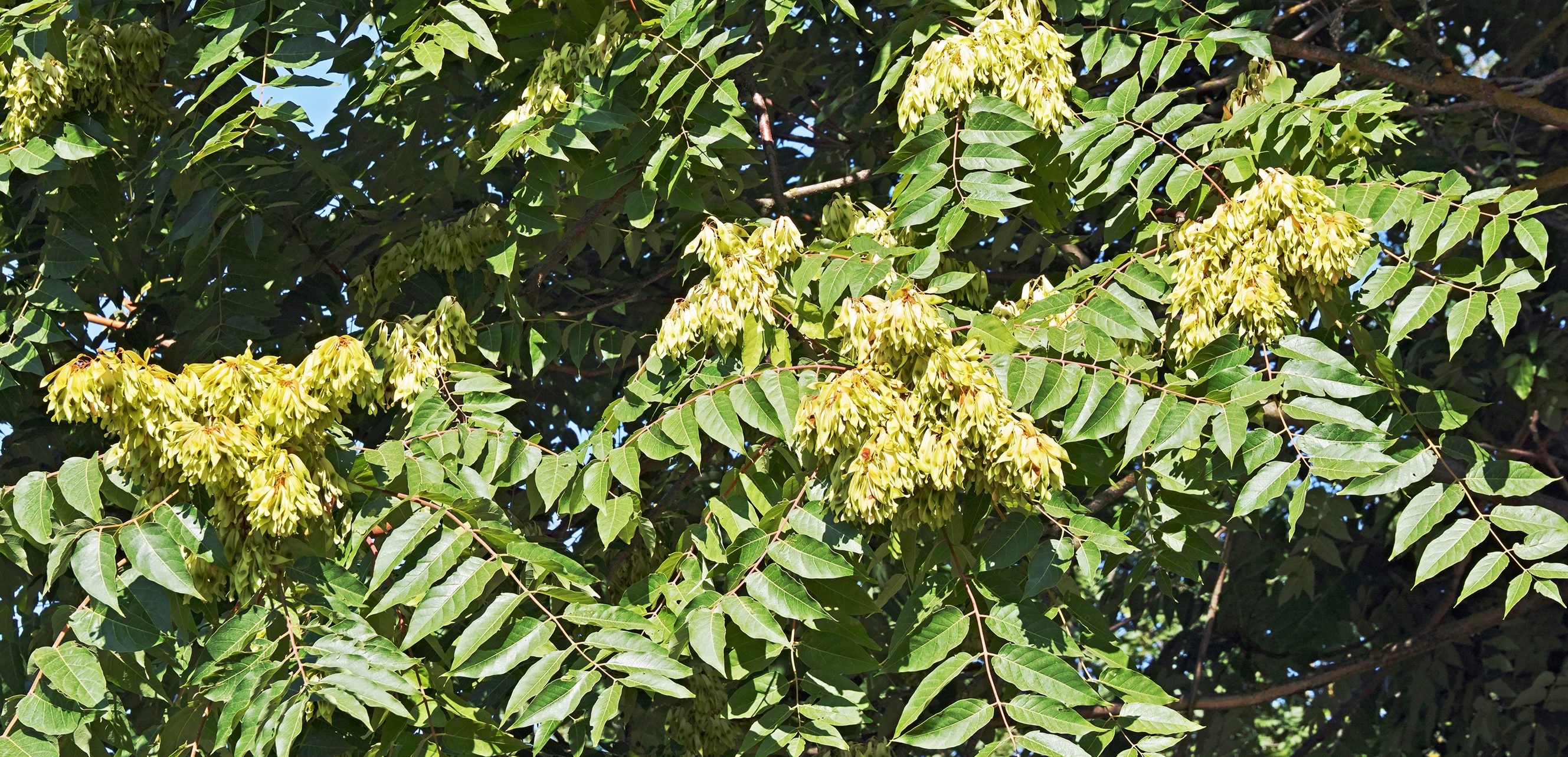
Tree-of-heaven (Ailanthus altissima) is an invasive tree with the potential for rapid growth and dispersal, endangering ecosystems by displacing native plants, altering habitat, and disrupting ecological processes.
Native to east Asia, tree-of-heaven is considered to be invasive in several parts of the world, including most of the eastern United States. It was originally introduced to North America as an ornamental plant in the 1780s. Populations exist throughout Alabama, especially in the northern part of the state and in urban areas. It is problematic in the state because it decreases biodiversity by replacing native vegetation, altering soil properties, and releasing the allelopathic chemical known as ailanthone, which harms the growth of desirable species.
Identification
Tree-of-heaven is a deciduous tree with long, compound leaves that are up to 3 feet long (figure 1). Each compound leaf has 10 to 40 leaflets that are 3 to 7 inches long and almost oppositely arranged (figure 2). The lanceolate leaflets have smooth margins except for one to four teeth at the rounded base of each leaflet. There are small glands on the underside of the teeth at the base of each leaflet.
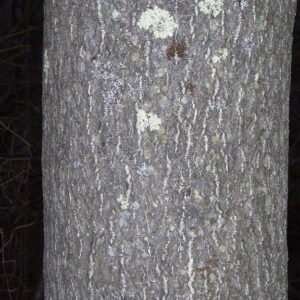
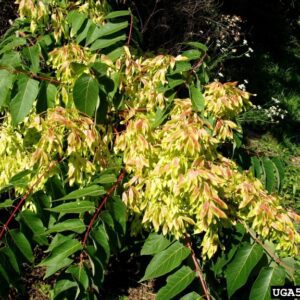
Tree-of-heaven can grow up to 80 feet tall. It has gray bark, often with white spots or stripes (figure 4). The bark of young trees is smooth, and older trees develop some texture on the bark. Tree-of-heaven is dioecious, so each tree is either male (pollen producing) or female (seed producing). This species spreads through wind-driven seed dispersal and root sprouts. Seeds are dispersed in winged fruits, which develop in clusters. Tree-of-heaven has a distinct odor when crushed, smelling like peanut butter to some people.
-
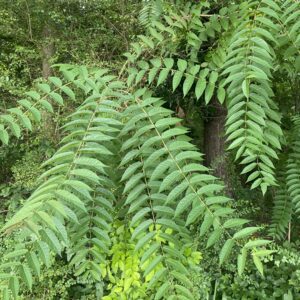
- Figure 1. Tree-of-heaven leaf structure
-
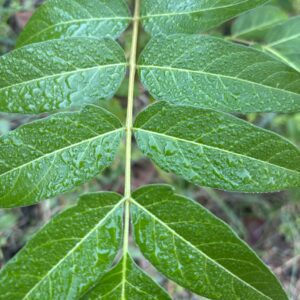
- Figure 2. Tree-of-heaven leaflets oppositely arranged with smooth margins
-
-
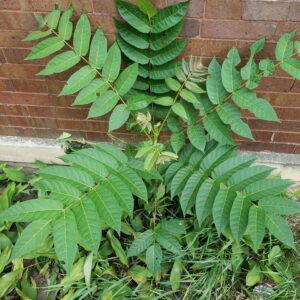
Figure 3. Young tree-of-heaven
Photo credit: © Erin Haase, iNaturalist.org (CC BY-NC) some rights reserved
-
-
Figure 4. Tree-of-heaven bark
Photo credit: Leslie J. Mehrhoff, University of Connecticut, Bugwood.org
-
-
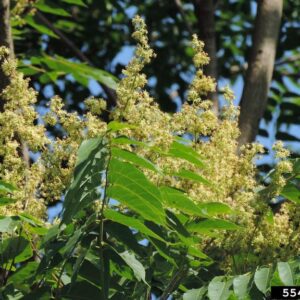
Figure 5. Tree-of-heaven flowers
Photo credit: Richard Gardner, Bugwood.org
-
-
Figure 6. Tree-of-heaven fruit
Photo credit: Jan Samanek, Phytosanitary Administration, Bugwood.org
Look-Alikes
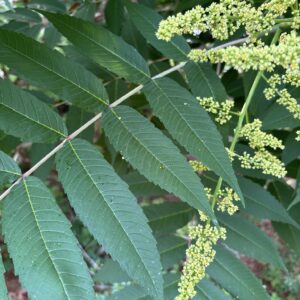
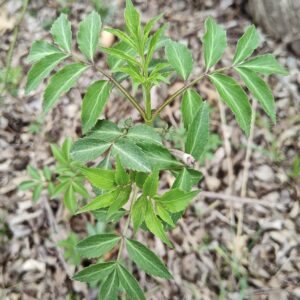
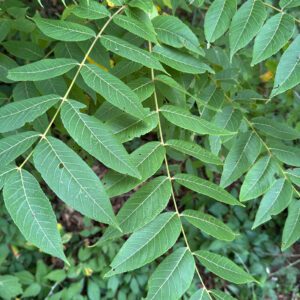
Tree-of-heaven may be confused with other trees or shrubs that have long, compound leaves—especially sumac (figures 7 and 8), elderberry (figures 9 and 10), and black walnut (figures 11 and 12). Black walnut and smooth sumac have more numerous serrations (teeth) along each leaflet edge, whereas tree-of-heaven leaflets have smooth edges other than one to four coarse teeth at the base. Winged sumac has a characteristic winged leaf axis.
-
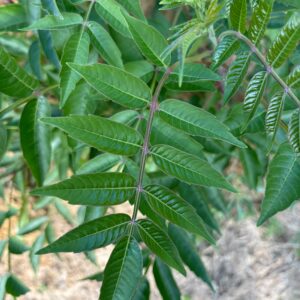
- Figure 7. Winged sumac (Rhus copallinum) has a winged leaf axis.
-
-
Figure 8. Smooth sumac (Rhus glabra) has serrations along the length of each leaflet.
Photo credit: © W. Thompson, iNaturalist.org (CC BY-NC) some rights reserved
-
-
Figure 9. American elderberry (Sambucus canadensis) has oppositely arranged compound leaves.
Photo credit: © Rick Travis, iNaturalist.org (CC BY-NC) some rights reserved
-
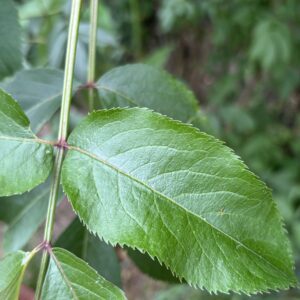
- Figure 10. American elderberry has leaflets with small serrations along the entire leaf margin.
-
-
Figure 11. Black walnut (Juglans nigra) also has compound leaves with many, opposite leaflets but sometimes no terminal leaflet.
Photo credit: © Sarah Kadel, iNaturalist.org (CC BY-NC) some rights reserved
-
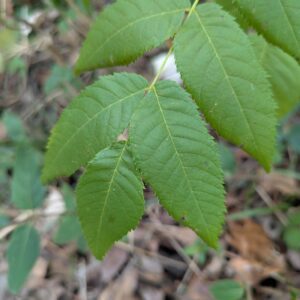
-
Figure 12. Black walnut leaflets have many, small serrations along the leaflet margin.
Photo credit: © megaminxing, iNaturalist.org (CC BY-NC) some rights reserved
Spotted Lanternfly
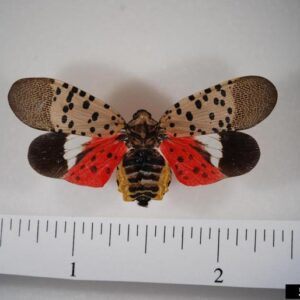
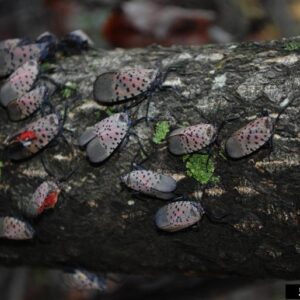
In east Asia, tree-of-heaven is the primary host plant of spotted lanternfly, where the two organisms coevolved. Spotted lanternfly (Lycorma delicatula) is an invasive insect first reported in the United States in 2014. As of April 2026, it has been confirmed in Georgia and Tennessee but not in Alabama. Spotted lanternfly can feed on many species in the United States, including fruit trees, maple, walnut, and poplar species. They can cause significant agricultural losses, especially in grapes. Stopping the spread of tree-of-heaven is a management tactic to reduce infestations of spotted lanternfly and prevent its spread into Alabama.
-
-
Figure 13. Spotted lanternfly with spread wings
Photo credit: Pennsylvania Department of Agriculture, Bugwood.org
-
-
Figure 14. Spotted lanternflies
Photo credit: Lawrence Barringer, Pennsylvania Department of Agriculture, Bugwood.org
Control
Tree-of-heaven is difficult to control because of its capacity to vigorously regrow shoots from cut stumps and roots. Young trees in moist soil can be pulled by hand if the entire root system is removed. Keep in mind that tree-of-heaven can have numerous root suckers, which are hard to remove.
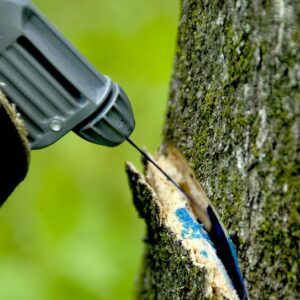
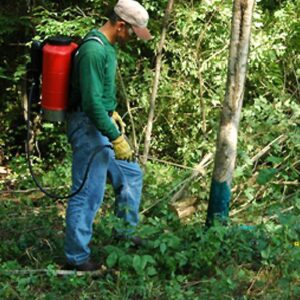
Because of its ability to vigorously resprout from roots, tree-of-heaven is best controlled with a systemic herbicide application in the late summer through fall, as the tree moves photosynthetic sugars down to the roots. Use the hack-and-squirt method (stem injection) for larger-diameter trees (figure 15) and the basal-bark method for saplings (figure 16). Choose a concentrated herbicide containing the active ingredients triclopyr, glyphosate, or a mixture of the two. Well-established stands will require multiple rounds of treatment. If the trees need to be cut to a stump, treat with herbicide 1 month prior to cutting to reduce resprouting. Foliar applications may be used for young stands.
Methods of biological control of tree-of-heaven using a native verticillium fungus are under evaluation.
-
-
Figure 15. Hack-and-squirt herbicide treatment method
Photo credit: Steve Manning, Invasive Plant Control, Bugwood.org
-
-
Figure 16. Basal bark herbicide treatment method
Photo credit: Steve Manning, Invasive Plant Control, Bugwood.org
More Information
- Basal Bark Herbicide Treatment for Invasive Plants in Pastures, Natural Areas & Forests—Alabama Cooperative Extension System
- Invasive Plant Series: Tree of Heaven, Ailanthus altissima—Purdue University Extension
- Tree-of-Heaven—Penn State Extension
- Tree of Heaven: Control Strategies—Penn State Extension
- Spotted Lanternfly Management Guide—Penn State Extension
- List of Alabama’s Invasive Plants by Land-Use and Water-Use Categories—Alabama Invasive Plant Council
- The Invasive Ailanthus altissima: A Biology, Ecology, and Control Review—Polytechnic University of Catalonia
- Review on Invasive Tree of Heaven (Ailanthus altissima (Mill.) Swingle) Conflicting Values: Assessment of Its Ecosystem Services and Potential Biological Threat—Barbara Sladonja, Marta Sušek, and Julia Guillermic