
Forestry & Wildlife

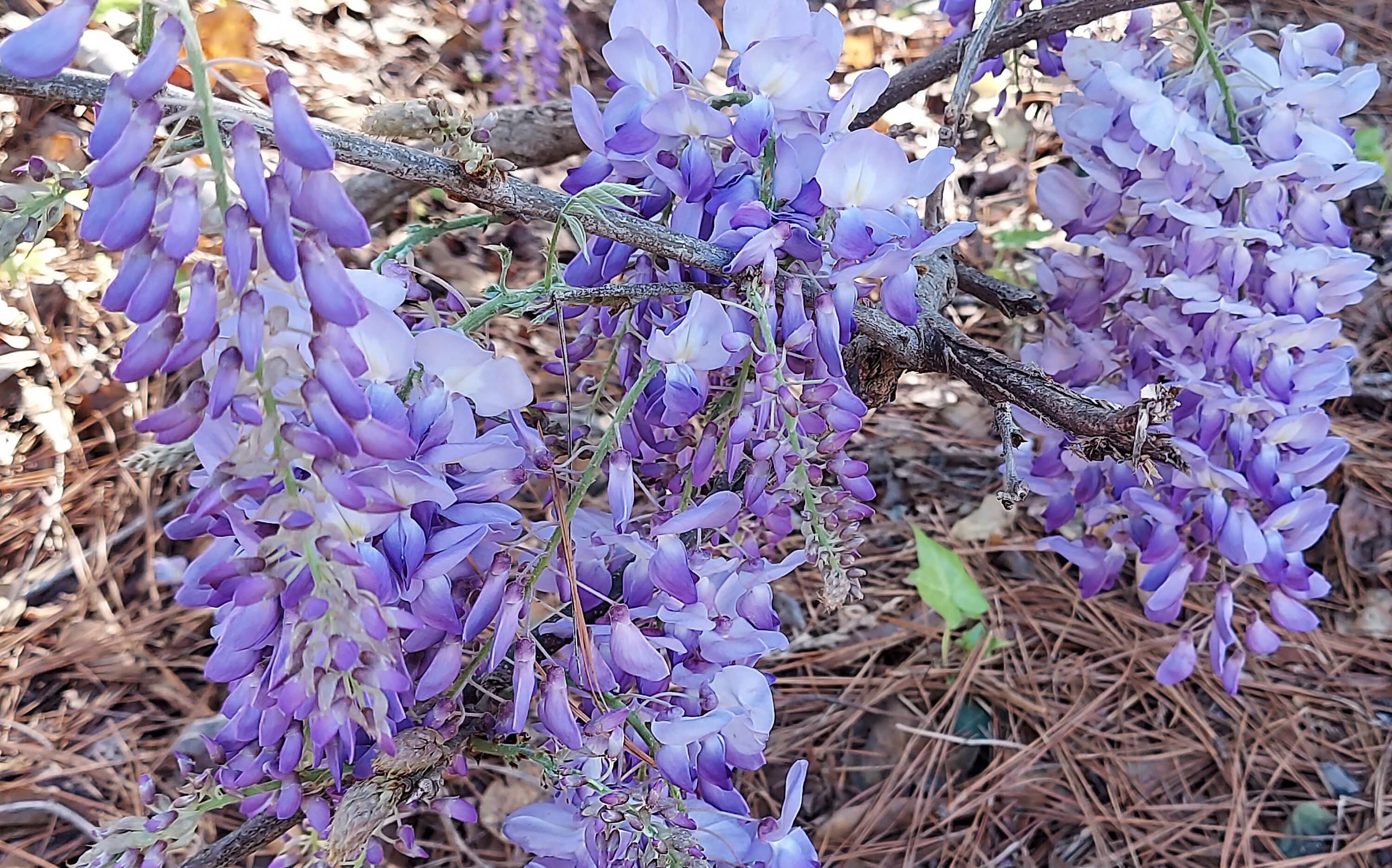
Asian wisterias—Chinese (Wisteria sinensis), Japanese (Wisteria floribunda), and hybrids (Wisteria x formosa)—are invasive plants in the United States, originally introduced for their showy purple flowers and ornamental use. It is difficult to tell the difference between the Chinese and Japanese species because of natural hybridization. All further information is common to all non-native wisteria species. Their aggressive climbing vines can girdle and damage trees, creating a threat to landscapes and woodlands. With diligent management, invasive wisteria can be reduced or eliminated and replaced with native options.
Spread
As a climbing vine, Asian wisteria has spread beyond the boundaries of curated landscapes and is found in woodlands across the Southeast and much of the eastern United States. Adaptable to both wet and dry sites, wisteria is known to climb trees to heights of 70 feet or more, causing ecological damage by girdling trees, even mature hardwood trees (figure 1). The dense growth of wisteria can also shade out native plants growing in the understory. Identification and control are essential.
Identification
Wisteria species are in the legume family and have characteristics similar to those of other pea-family plants:
- Stems: light brown to gray, up to 10 inches in diameter, often twisting around one another as they grow
- Leaves: alternate; odd pinnately compound up to 16 inches long; 7 to 13 leaflets on Chinese and 13 to 19 leaflets on Japanese; leaflets 1 to 1½ inches long, oval, tapered tip entire margins (smooth edges); light green pubescent (hairy) new growth (figure 2)
- Flowers: bloom March through May, before or as leaves emerge; lavender raceme (hanging cluster of flowers) 5 to 20 inches long, pealike flowers; fragrant (figure 3)
-
Fruit/seeds: July to November; flat legume pod, pubescent, up to 6 inches long; 1-inch-long brown seeds
-
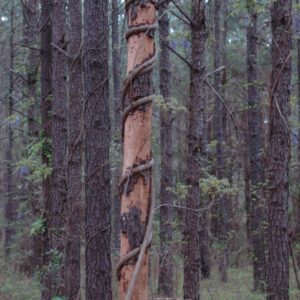
- Figure 1. Invasive wisteria vine girdling a pine tree. (Photo credit: Chris Evans, University of Illinois, Bugwood.org)
-
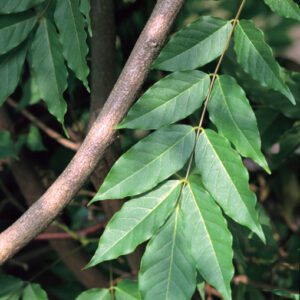
- Figure 2. Compound leaf of Chinese wisteria. (Photo credit: Chris Evans, University of Illinois, Bugwood.org)
-
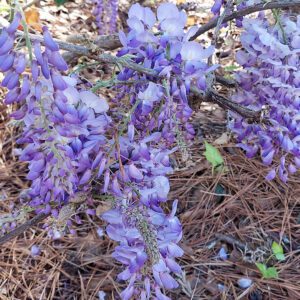
- Figure 3. Invasive wisteria flowers bloom light purple March through May.
Control in Residential Areas
Remove any cultivated non-native wisteria plants in the landscape to prevent escape. Plant native alternatives that are ecologically beneficial for wildlife and other plants:
- American wisteria (Wisteria frutescens)
- Carolina jessamine (Gelsemium sempervirens)
- Coral honeysuckle (Lonicera sempervirens)
- Crossvine (Bignonia capreolata)
Non-native wisterias are difficult to control, but diligent management techniques can reduce or eliminate the population from a given area. Small wisteria vines may be hand pulled. In areas with large populations or large vines of wisteria, chemical control is most effective. Herbicide applications can be made by basal bark sprays, cut stump treatment, or foliar sprays depending on the product. Foliar sprays are applied to the leaves but not allowed to run off, generally noted as “spray to wet.” This is most efficient from late summer to early fall. Cut stump and basal bark methods work anytime of the year, except during spring sap flow. See table 1 for products and rates for residential area control. Read and follow all herbicide label directions For more information on applying herbicides, see Alabama Extension publications “Basal Bark Herbicide Treatment for Invasive Plants in Pastures, Natural Areas, and Forests,” or “Cut Stump Treatments for Woody Plant Control” online at aces.edu.
Table 1. Recommended Herbicide Rates for Residential Landscaping Use
bDo not allow herbicide solution to run off.
| Herbicide Active Ingredient | Herbicide Trade Name | Application Method | Rate |
|---|---|---|---|
| Glyphosate | Roundup or generics (41% active ingredient) | Cut stump | 50%–100% v/va, spray to wetb |
| Triclopyr ester | Pathfinder II or generics (13.6% active ingredient) | Basal bark | Spray to wetb with undiluted solution |
| Triclopyr ester | Pathfinder II or generics (13.6% active ingredient) | Cut stump | Spray to wetb with undiluted solution |
| Glyphosate | Roundup or generics (41% active ingredient) | Foliar spray | 2% v/va (2.5 fl oz/gal), spray to wetb |
Control in Nonresidential Areas
Control of non-native wisteria vines in forests and non-cropland sites is most effective through herbicide applications. Methods include foliar sprays, cut stump, frill (girdle), and hack-and-squirt. The frill (or girdle) method requires making continuous cuts around the trunk of the tree or large vine. The hack-and-squirt method refers to a single cut or multiple cuts spaced around the tree trunk or large vine. The number of cuts depends on the size of the stem and herbicide being used. All these methods can be used throughout the year except during spring sap flow or in drought conditions. See table 2 for products and rates for nonresidential area control. Read and follow all herbicide label directions.
Table 2. Recommended Herbicide Rates and Uses for Nonresidential Sites
bMode of action
cClopyralid can stay active in the soil and may cause damage to nontarget plants. It also leaches easily and is not recommended for use on sandy soils.
dRestricted Use Pesticide
eDo not allow herbicide solution to run off.
fDiameter at breast height
gVolume to volume
| Herbicide Active Ingredient | Herbicide Trade Name | Application Method | Rate | Site |
|---|---|---|---|---|
| Piclorama + 2,4-D (MOAb 4) | Tordon 101d | Cut stump | Spray to wete with undiluted or diluted (1:1 with water) solution | Forests and non-cropland (fencerows, roadsides, ROW) |
| Piclorama + 2,4-D (MOAb 4) | Tordon 101d | Frill or girdle | Spray to wete with diluted (1:1 with water) solution | Forests and non-cropland (fencerows, roadsides, ROW) |
| Clopyralidc (MOAb 4) | Transline | Hack-and-squirt | ½ mil undiluted or 1 mil diluted (1:1 with water) into each cut | Forests and non-cropland (fencerows, roadsides, ROW) |
| Clopyralidc (MOAb 4) | Transline | Cut stump | Immediately after cut, spray to wete with diluted (1:1 with water) solution | Forests and non-cropland (fencerows, roadsides, ROW) |
| Glyphosate (MOAb 9) | Roundup Pro Max or generic (41% or more active ingredient) | Frill or girdle | 1 mil / 2″ of trunk at DBHf | Forests and non-cropland |
| Glyphosate (MOAb 9) | Roundup Pro Max or generic (41% or more active ingredient) | Cut stump | Apply immediately after cut; 50%–100% v/vg solution | Forests and non-cropland |
| Triclopyr amine (MOAb 4) | Garlon 3A | Hack and squirt | ½ mil undiluted or 1 mil diluted (1:1 with water) into each cut | Forests, pasture, non-cropland |
| Triclopyr amine (MOAb 4) | Garlon 3A | Frill or girdle | Wet cut with undiluted or diluted (1:1 with water) solution | Forests, pasture, non-cropland |
| Triclopyr amine (MOAb 4) | Garlon 3A | Cut stump | Spray to wete with undiluted solution | Forests, pasture, non-cropland |
| Triclopyr ester (MOAb 4) | Garlon XRT | Cut stump | Spray to wete with undiluted solution on cut surface and stump sides | Forests, rangeland, non-cropland |
Works Cited
- Miller, J. Nonnative Invasive Plants of Southern Forests: A Field Guide for Identification and Control. US Forest Service. 2007.
- Swearingen, J., and Remaley T. Chinese Wisteria Fact Sheet. Plant Conservation Alliance, Alien Plant Working Group. 2010 Apr. 19.
- Akers-Campbell, H., and K. Steedley. Native Replacements for Commonly Sold Invasive Plants. Alabama Cooperative Extension. 2025 Aug.
- Pathfinder II herbicide label. Corteva Agriscience. Indianapolis, IN. [Updated 2023 Aug 3.]
- Fellers, J. Using Hack-and-Squirt Method to Control Undesirable Vegetation. Clemson University. 2020 [accessed 2026 Jan].
- Tordon 101 herbicide label. Dow AgroScience. Indianapolis, IN. [Updated 2009 Nov 23.]
- Transline herbicide label. Corteva Agriscience. Indianapolis, IN. [Updated 2022 Nov 7.]
- Roundup Pro Max herbicide label. Bayer CropScience. St. Louis, MO. [Updated 2020 Dec.]
- Garlon 3A herbicide label. Corteva Agriscience. Indianapolis, IN. [Updated 2025 Mar 18.]
- Garlon XRT herbicide label. Corteva Agriscience. Indianapolis, IN. [Updated 2024 Jun 12.]
 Kira Sims, County Extension Director, Auburn University
New May 2026, Control of Invasive Wisteria, ANR-3257