
Farming


Wolftail sedge (Carex cherokeensis), also known as Cherokee sedge, is a perennial weed that can be mistaken for desirable pasture grass in both cool- and warm-season forage systems. But it can crowd out desirable species, reducing pasture productivity. Successful management includes an early-spring herbicide program.
Permanent pastures and hayfields across the Southeast rely on a small group of perennial grasses: bahiagrass, bermudagrass, dallisgrass, and tall fescue for livestock production. Mixed into many of those stands is a look-alike that is not grass at all. Wolftail sedge, also called Cherokee sedge, is a perennial native of the Southeastern United States and one of more than 200 Carex species in the region. It competes directly with desirable forages, reducing yield quality, and proving difficult to control.
Identification
Wolftail sedge is a cool-season perennial in the family Cyperaceae. A few identifying features include the following:
- Form. Clump-forming, 1 to 2 feet tall and wide, and spreads outward from a central base by dense rhizomes (figure 1). Plants are generally less than 12 inches tall in grazing pastures.
- Leaves. Slender, arching, grasslike, semievergreen; folded in a V-shape and originating from the plant base. No true stem. Turns yellowish-green in summer.
- Flowers and seed heads. April to May; small inconspicuous spikes that mature into drooping clusters resembling a wolf’s tail (figures 2 and 3).
- Where it grows. Fine-textured soils, woodland edges, low-lying calcareous soils, and moist areas of unimproved fields. Plants are most often observed in permanent pastures across the Black Belt region and in the clay-to-silt loam soils of the Piedmont and Appalachian Plateau.
- Identification cues. Active growth in late winter and early spring; turns a pale, yellow-green color as spring progresses into the heat of summer, while bermudagrass and tall fescue forages remain dark green (figure 4).
-
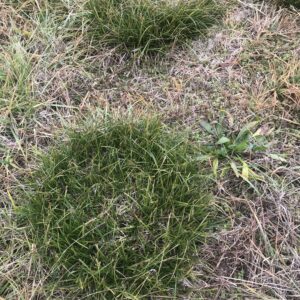
- Figure 1. Established plants begin spreading from individual circular clumps.
-

- Figure 2. A colony of wolftail sedge during early seed head development in March.
-
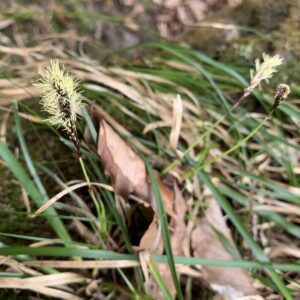
- Figure 3. Close-up of wolftail sedge seed head showing the wheatlike, drooping clusters that give the plant its common name.
-
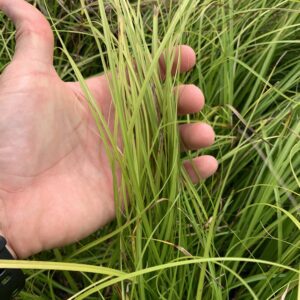
- Figure 4. Wolftail sedge turns pale green between hay cuttings in late summer, contrasting with darker warm-season grasses.
The Problem

Figure 5. Wolftail sedge colony established in a tall fescue hayfield in Limestone County, Alabama. Dense infestations can displace desirable forage across large areas of a field.
Wolftail sedge is easy to overlook in spring because the leaf shape and color closely resemble pasture grass. It is also competitive: the plant grows actively when most perennial summer forages are dormant or still building leaf area, and excessive spring biomass may hinder the early growth of warm-season forages (figure 5). Forage analysis of established stands collected in autumn returned 10.8 percent crude protein and 56 percent total digestible nutrients, which puts the plant in the mid-quality hay range for a dry cow. Unfortunately, every square foot of wolftail sedge takes water, fertilizer, and sunlight away from higher-quality forage that could grow in its place. Mowing alone does not control it.
Management
A two-year Auburn research trial in a tall fescue–dominant hayfield in Limestone County, Alabama, compared spring and fall applications of 12 herbicide treatment combinations to evaluate wolftail sedge control. Approximately 70 percent control was achieved with spring applications, compared to about 40 percent with fall applications.
The two most effective treatments were tank-mixes of 1 pound acid equivalent (ae) per acre 2,4-D ester paired with either halosulfuron (Sandea) at 1 ounce per acre or imazethapyr (Pursuit) at 4 fluid ounces per acre, applied in early to mid-March. Both herbicide combinations reduced sedge coverage and provided better visible control compared to the nontreated check. NovaGraz at 48 fluid ounces per acre proved equally effective at reducing sedge coverage. This rate of NovaGraz contains 1 pound acid equivalent 2,4-D and has the additional florpyrauxifen-benzyl (Rinskor) to aid in control. Research conducted by Burns and Buchanan (1967) reached similar conclusions about using auxin herbicides—higher rates of 2,4-D alone (2 pounds ae per acre) in early spring provided the best control of wolftail sedge.
Notes: ae = acid equivalent. Always read and follow herbicide product labels. Product mention is not an endorsement of a specific brand; recommendations are based on replicated research.
Crop-Specific Restrictions
Imazethapyr is not safe in every forage system. Pursuit is labeled for use in alfalfa and clover grown for forage, hay, or seed, but grasses may be injured. These Pursuit rates will cause seed head suppression in tall fescue; therefore, they are not endorsed as a management option for grass forage. Most 2,4-D amine or ester products may be applied alone at rates up to 2 pounds ae per acre (approximately 2 quarts per acre of a 3.8 pound ae/gal formulation) (table 1). This is the reliable fallback and also picks up buttercup, some thistle rosettes, and dandelion (table 1).
Table 1. Recommended Herbicide Treatments for Wolftail Sedge in Forage Systems
| Trade Name | Active Ingredient | Suitable Forage System | Application Timing | Rate Per Acre |
|---|---|---|---|---|
| Various 2,4-D ester + Sandea | 2,4-D ester + halosulfuron | Established cool- and warm-season forage | Late February to mid-March | 1 lb. ae 2,4-D (1 qt of a 3.8 lb ae/gal product) + 1 oz. Sandea |
| NovaGraz | 2,4-D + florpyrauxifen-benzyl | Established cool- and warm-season forage | Late February to mid-March | 48 fl. oz. NovaGraz |
| Multiple | 2,4-D ester or amine, alone | Established cool- and warm-season forage | Late February to mid-March | 2 lb. ae (2 qt. of a 3.8 lb. ae/gal. product) |
Practical Summary
Treat early, from late February through mid-March, while the wolftail sedge is actively growing. In established grass forage, a tank-mix of 1 pound ae per acre 2,4-D ester with halosulfuron provides the strongest activity. Alternatively, 2,4-D alone at 1 to 2 pounds ae per acre or 48 fluid ounces per acre NovaGraz is a reliable option that will also provide control of broadleaf weeds such as thistle or buttercup. A single year of treatment is rarely enough; therefore, repeated spring applications across two or three seasons, combined with sound forage management, are usually required to bring wolftail sedge to a manageable level. Remember to calibrate spray equipment and carefully read and follow all label requirements for safe and effective applications.

David Russell, Associate Extension Professor, Crop, Soil, and Environmental Sciences; Gourav Chahal, Graduate Research Assistant, Crop, Soil, and Environmental Sciences; and Gerry Thompson, Technician, Animal Sciences, all with Auburn University
New July 2026, Wolftail Sedge: Identification & Management in Forage Systems, ANR-3282
For more information, contact your county Extension office. Visit aces.edu/directory.
Trade and brand names used in this publication are given for information purposes only. No guarantee, endorsement, or discrimination among comparable products is intended or implied by the Alabama Cooperative Extension System.