
Crop Production

The US Department of Agriculture (USDA)’s June 30 planted acreage report shows several important shifts in 2026 crop acreage for both Alabama and the United States. In Alabama, the most notable changes from 2025 are higher cotton acreage, slightly higher soybean acreage, and lower corn and peanut acreage, as shown in the figure below.
2026 Alabama Crop Acreage Information
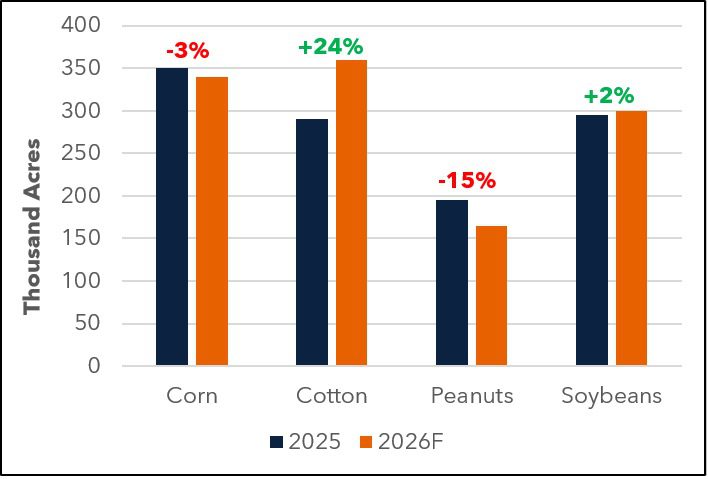
Figure 1. Alabama crop acres planted (2025 vs. 2026)
Data source: USDA-NASS
Alabama farmers planted 340,000 acres of corn in 2026, down 10,000 acres, or 2.9 percent, from 2025. Cotton acreage increased sharply to 360,000 acres, up 70,000 acres, or 24.1 percent. Peanut acreage declined to 165,000 acres, down 30,000 acres, or 15.4 percent. Soybean acreage increased slightly to 300,000 acres, up 5,000 acres, or 1.7 percent.
Combined acreage for these four major Alabama crops totaled 1.165 million acres in 2026, compared to 1.130 million acres in 2025. That is an increase of 35,000 acres, or about 3.1 percent.
Nationally, the acreage picture was somewhat different. US corn acreage was estimated at 95.343 million acres, down 3.445 million acres, or 3.5 percent, from 2025. Upland cotton acreage was estimated at 9.141 million acres, down 559,000 acres, or 5.8 percent. Peanut acreage declined to 1.528 million acres, down 425,000 acres, or 21.8 percent. Soybean acreage increased to 85.365 million acres, up 4.150 million acres, or 5.1 percent.
Comparing June Report to March 2026 Prospective Plantings Estimates
Compared to the March 2026 prospective plantings estimates, Alabama corn acreage fell sharply. March intentions had corn at 410,000 acres, but the June report lowered that estimate to 340,000 acres, a decline of 70,000 acres, or 17.1 percent. Cotton moved the opposite direction, increasing from 290,000 acres in March to 360,000 acres in June, a gain of 70,000 acres, or 24.1 percent. Peanuts declined from 200,000 acres to 165,000 acres, while soybeans increased from 290,000 acres to 300,000 acres. The shift to more cotton acres than intended may be partially explained by increasing cotton prices this past spring, as cotton futures prices increased by 15 cents per pound between early March and mid-May.
For the United States, changes from March to June were smaller for corn and soybeans but more notable for cotton and peanuts. Corn acreage was essentially unchanged, increasing by only 5,000 acres from the March estimate. Soybean acreage increased by 665,000 acres, or 0.8 percent. Upland cotton acreage declined by 369,000 acres, or 3.9 percent, while peanut acreage declined by 146,000 acres, or 8.7 percent.
Takeaways
Overall, the June report suggests Alabama producers adjusted acreage away from corn and peanuts and toward cotton and soybeans compared with March planting intentions. Nationally, the report shows fewer acres of corn, cotton, and peanuts compared to 2025, while soybean acreage increased. These acreage shifts will be important to watch as markets respond to expected production, weather conditions, and demand during the remainder of the growing season.