
Crop Production

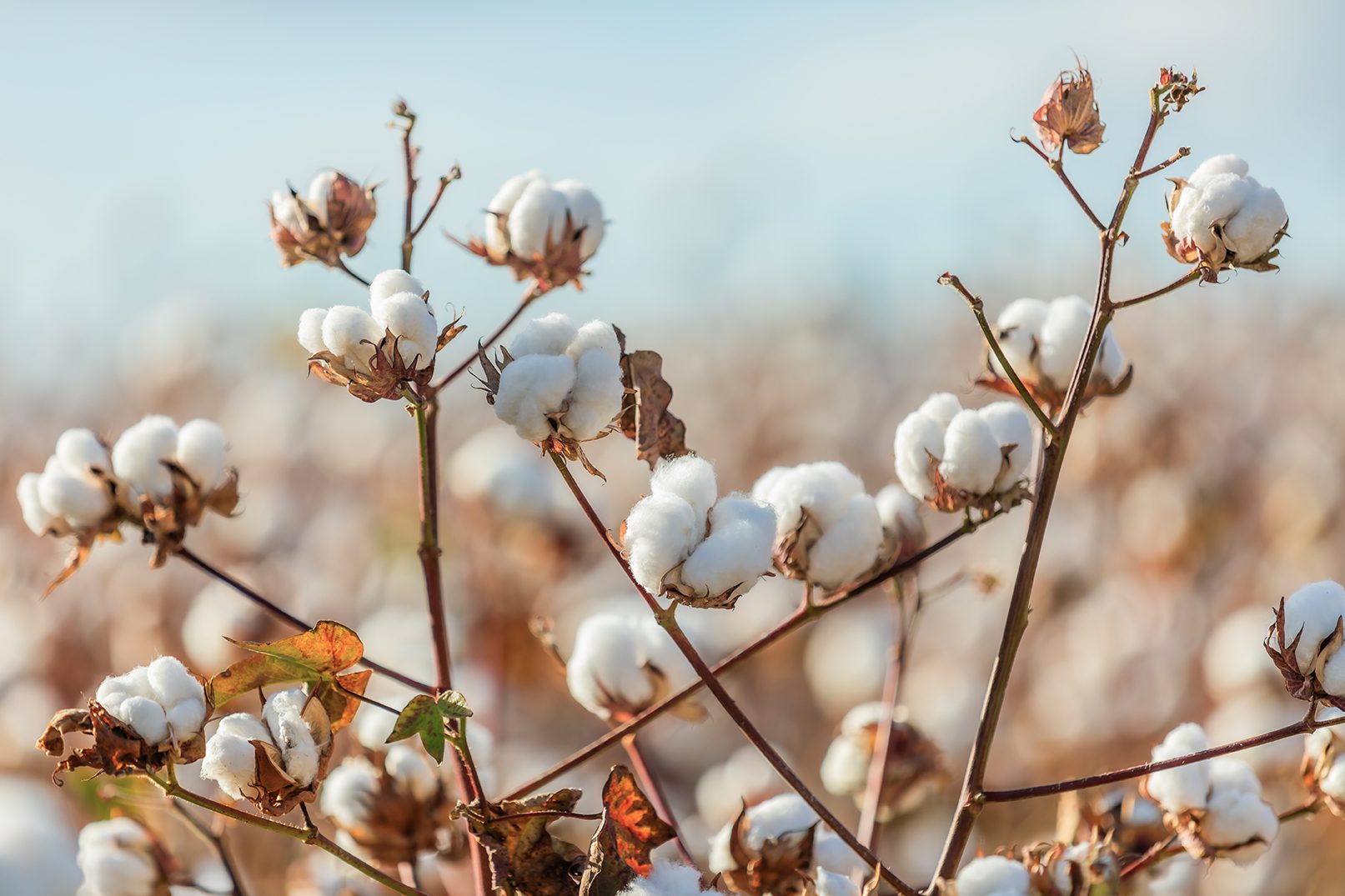
Know the conditions under which bacterial blight of cotton occurs and the signs and symptoms to look for. More importantly, learn disease prevention and proven strategies to prevent the occurrence in your crop.
Bacterial blight is caused by the bacterial plant pathogen Xanthomonas citri subsp. malvacearum. It is also known as seedling blight, angular leaf spot, blackarm, or bacterial boll rot of cotton (Gossypium L.). The first United States report of the disease was in Alabama in 1891 and was initially referred to as “black rust.”
Bacterial blight can affect cotton at all growth stages. It is a seedborne pathogen but can also overwinter on infected crop debris from a previous season and infect leaves through stomata or wounds. Prior to the widespread adoption of resistant cotton varieties and the routine use of acid‑delinted seed, bacterial blight was capable of causing severe yield losses in heavily affected fields, in some cases exceeding 50 percent under favorable environmental conditions.
Today, overall losses attributable to bacterial blight across the US Cotton Belt have been greatly reduced and are generally considered minimal in most years. However, substantial yield losses can still occur in warm, humid conditions in individual fields planted with susceptible varieties. Recent reports document losses of approximately 20 percent during isolated outbreaks. In rare, uncontrolled epidemics, yield loss may approach 50 to 70 percent.
Distribution
Bacterial blight of cotton occurs sporadically in Alabama and is not considered a widespread disease in the state. Since 2019, confirmed observations have been limited to isolated fields in Lee, Baldwin, and Autauga Counties, with no evidence of sustained spread or recurring annual outbreaks.
In Alabama, outbreaks are most likely to occur during seasons characterized by prolonged warm, humid conditions combined with frequent rainfall or storm events, particularly in fields planted with susceptible or moderately susceptible varieties. As a result, the highest risk is generally associated with southern and central production areas where humidity is consistently high and early season canopy development is rapid. However, localized outbreaks may occur elsewhere when environmental conditions are conducive. In most years, bacterial blight remains absent or limited to low incidence.
Sign and Symptoms
Bacterial blight is caused by a seedborne pathogen that can infect cotton at any growth stage, resulting in seedling blight, leaf spots, symptoms on stems and petioles, and boll rot. On seedlings, symptoms first appear on the cotyledons as small, water soaked, circular or irregular spots. These lesions initially have a deep green color and then turn brown. Black, elongated cankers can develop and often girdle the hypocotyls, resulting in seedling death.
The foliar phase of the disease is commonly referred to as “angular leaf spot” because lesions appear angular in shape on the leaves. Lesions initially develop as small, water soaked or “greasy” spots on the underside of the leaves (figure 1). As they expand, lesions become more angular on the upper leaf surface due to restriction by leaf veins (figure 2).
Lesions also may be surrounded by a yellow ring or “halo.” As lesions age, they turn black and become necrotic, causing leaves to develop a tattered appearance and defoliate prematurely. Systemic infections may occur along the main leaf veins, producing black streaks commonly described as lightning bolts (figure 3). In more severe cases, leaf petioles and stems become infected and exhibit dark lesions referred to as blackarm.
As plants mature, symptoms also can develop on bracts and bolls. Boll blight initially appears as round, water soaked, sunken lesions (figures 4 and 5) that turn black as they age (figure 6). Boll blight lesions are often observed near the base of the boll beneath leafy bracts, where moisture accumulates, and along boll sutures. Infected bolls may open prematurely, produce discolored lint, and contain seed contaminated with X. citri subsp. malvacearum. Secondary infections by other saprophytic microorganisms may also occur, resulting in boll rot (figure 6). Consequently, it may be difficult to determine whether bolls were initially infected by X. citri subsp. malvacearum or another pathogen once fungal organisms colonize the lesions.
-
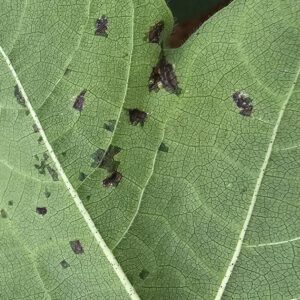
- Figure 1. Small, water-soaked or “greasy” bacterial blight appear lesions on the underside of the leaves.
-
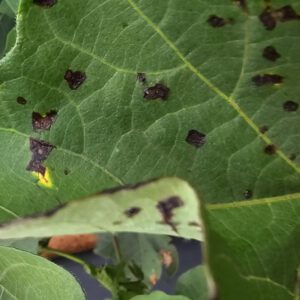
- Figure 2. Bacterial blight lesions are evident on the upper side of the leaf.
-
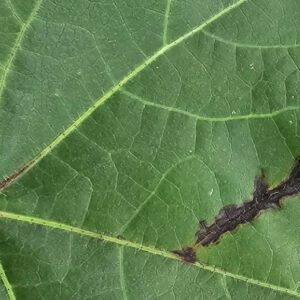
- Figure 3. Black streaks or “lightning bolts” are due to systemic bacterial blight infections.
-
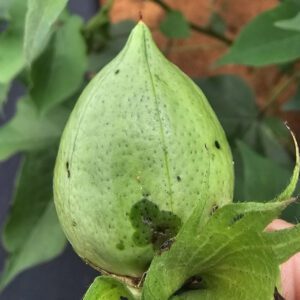
- Figure 4. Early stages of boll blight are demonstrated by the water-soaked, sunken lesions near the base of the boll.
-
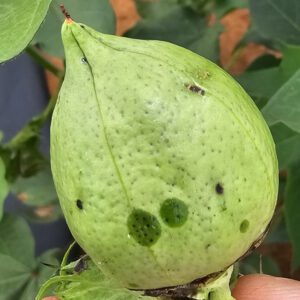
- Figure 5. Early stages of boll blight are demonstrated by the water-soaked, sunken lesions near the base of the boll.
-
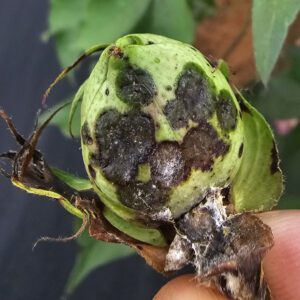
- Figure 6. Older boll blight lesions will turn black as they age and secondary infections from other saprophytic fungi can also be present.
Disease Cycle and Epidemiology
The primary inoculum sources for bacterial blight are contaminated seed and infected crop residue from previous seasons. X. citri subsp. malvacearum can overwinter on infested field debris and crop residue in the soil. Survival duration is not fully understood, however, and may depend on environmental conditions, such as the pathogen being isolated for at least 5 months from dry, undecomposed cotton leaves remaining in the field. In addition, X. citri subsp. malvacearum can survive both internally and externally (on the seed coat and embryo) on cottonseed for at least 22 months and on seed lint for at least 4 months.
Previous research demonstrated that as few as one infected seed per 6,000 can initiate a bacterial blight epidemic under favorable conditions. Following canopy closure, periods of heavy rainfall combined with warm temperatures (daytime temperatures of 90 to 100 degrees F and nighttime temperatures of 62 to 68 degrees F) and high humidity (greater than 85 percent) favor disease development and spread. Infections are disseminated from infected plants or residue by wind‑driven rain, irrigation, insects, or contaminated farming equipment (e.g., tools and tractors). The pathogen enters the plant through open stomata, leaf wounds, or natural cracks and openings along boll sutures. Infected bolls can subsequently produce contaminated seed.
Management Practices
Once bacterial blight is present in a field, no management tactic can completely halt disease development during the growing season, and the field should be harvested as soon as possible. The following management recommendations emphasize disease prevention and strategies to reduce incidence:
Rotate to a nonhost. To minimize inoculum carryover, rotate away from cotton to nonhost crops, such as peanut, corn, or soybean, for at least 1 year. Although the pathogen name malvacearum may be misleading, X. citri pv. malvacearum has a highly restricted host range and is considered economically important only on cotton (Gossypium spp.).
Plant a resistant variety. Bacterial blight occurs sporadically in Alabama and rarely causes yield loss unless susceptible varieties are grown under favorable environmental conditions. For this reason, selecting a resistant variety is the most practical and economical disease management strategy, particularly in fields with a history of bacterial blight. To evaluate cotton variety performance in your region, consult the Auburn University’s Variety Selection platform at auburn.medius.re. A list of bacterial blight‑resistant varieties available as of 2026 is provided in table 1.
Table 1. Commercially Available Cotton Varieties with Bacterial Blight Resistance
| Company Name | Variety Name | Recommended Growing Region |
|---|---|---|
| BASF (Stoneville) | ST 4215 AXTP | North and south delta and mid-Atlantic |
| BASF (Stoneville) | ST 4650 AXTP | Far west, north and south delta, mid-Atlantic, and Southeast |
| BASF (Stoneville) | ST 4833 AXTP | Far west, north and south delta, mid-Atlantic, and Southeast |
| BASF (Stoneville) | ST 5260 AXTP | Far west, north and south delta, mid-Atlantic, and Southeast |
| BASF (Stoneville) | ST 5855 AXTP | Far west, rolling plains, Oklahoma, east and south Texas, south delta, mid-Atlantic, and Southeast |
| BASF (Stoneville) | ST 5931 AXTP | Far west, southern high plains, rolling plains, Oklahoma, east and south Texas, south delta, mid-Atlantic, and Southeast |
| BASF (Stoneville) | ST 6000 AXTP | Far west, southern high plains, rolling plains, Oklahoma, east and south Texas, north and south delta, mid-Atlantic, and Southeast |
| BASF (FiberMax) | FM 757 AXTP | Far west, southern high plains, northern high plains, far northern high plains, rolling plains, Oklahoma, and south and east Texas |
| BASF (FiberMax) | FM 765 AX | Far west, southern high plains, northern high plains, far northern high plains, rolling plains, and Oklahoma |
| BASF (FiberMax) | FM 814 AXTP | Far west, southern high plains, northern high plains, far northern high plains, rolling plains, and Oklahoma |
| BASF (FiberMax) | FM 823 AXTP | Far west, southern high plains, northern high plains, rolling plains, and Oklahoma |
| BASF (FiberMax) | FM 2498 GLT | Southern and northern high plains |
| Bayer (Deltapine) | DP 1820 B3XF | Far west and west Texas |
| Bayer (Deltapine) | DP 1822 XF | East and west Texas |
| Bayer (Deltapine) | DP 2012 B3XF | Far west, east and west Texas, and mid-South |
| Bayer (Deltapine) | DP 2020 B3XF | Far west, east and west Texas, and mid-South |
| Bayer (Deltapine) | DP 2038 B3XF | Far west, east and west Texas, and mid-South |
| Bayer (Deltapine) | DP 2044 B3X | West Texas |
| Bayer (Deltapine) | DP 2131 B3TXF* | Far west, east and west Texas, and mid-South |
| Bayer (Deltapine) | DP 2317 B3TXF | Far west, east and west Texas, and mid-South |
| Bayer (Deltapine) | DP 2328 B3TXF* | Far west, east and west Texas, and mid-South |
| Bayer (Deltapine) | DP 2333 B3X | Far west, east Texas, and mid-South |
| Bayer (Deltapine) | DP 2335 B3XF | Far west and east Texas |
| Bayer (Deltapine) | DP 2349NR B3XF | East Texas and mid-South |
| Bayer (Deltapine) | DP 2436NR B3TXF | West Texas |
| Bayer (Deltapine) | DP 2522NR B3TXF | East Texas and mid-South |
| Bayer (Deltapine) | DP 2525 B3XF | West Texas |
| Bayer (Deltapine) | DP 2541 B3XF | West Texas |
| Bayer (Deltapine) | DP 2618 B3TXF | East Texas |
| Bayer (Deltapine) | DP 2635 B3TXF | East and west Texas and mid-South |
| Corteva (PhytoGen) | PHY 136 W3F1 | Southwest |
| Corteva (PhytoGen) | PHY 137 W3F1 | South central and Southwest |
| Corteva (PhytoGen) | PHY 205 W3F1 | Southwest |
| Corteva (PhytoGen) | PHY 332 W3FE | Southeast, south central, southwest, and mid-South |
| Corteva (PhytoGen) | PHY 357 W3FE | Southeast, south central, Southwest, and mid-South |
| Corteva (PhytoGen) | PHY 360 W3FE | Southeast and mid-South |
| Corteva (PhytoGen) | PHY 400 W3FE | Southeast, south central, Southwest, mid-South, and Arizona |
| Corteva (PhytoGen) | PHY 411 W3FE | Southeast, south central, Southwest, and mid‑South |
| Corteva (PhytoGen) | PHY 415 W3FE | Southeast, south central, Southwest, mid-South, and Arizona |
| Corteva (PhytoGen) | PHY 433 W3FE | Southeast, south central, Southwest, and mid‑South |
| Corteva (PhytoGen) | PHY 475 W3FE | Southeast |
| Corteva (PhytoGen) | PHY 545 W3FE | Southeast |
| Nutrien Ag Solutions (DynaGro) | DG 3615 B3XF | Southeast and mid-South |
| Nutrien Ag Solutions (DynaGro) | DG 3799 B3XF | Southeast and mid-South |
| Nutrien Ag Solutions (DynaGro) | DG 3402 B3XF | West Texas and Southwest |
| Nutrien Ag Solutions (DynaGro) | DG 3520 B3XF* | Delta and Southeast |
| Nutrien Ag Solutions (DynaGro) | DG 3535 B3XF* | Delta and Southeast |
| Nutrien Ag Solutions (DynaGro) | DG 3555 B3XF | Delta, South Carolina, and Texas |
| Nutrien Ag Solutions (DynaGro) | DG 3570 B3XF* | Broad adaptation across southern Cotton Belt |
| Nutrien Ag Solutions (DynaGro) | DG 4434 B3TXF | Broad adaptation across Cotton Belt |
| Nutrien Ag Solutions (DynaGro) | DG P224 B3XF* | Delta, Southeast, and Texas |
| Nutrien Ag Solutions (DynaGro) | DG H929 B3XF | West Texas and Carolinas |
| Nutrien Ag Solutions (DynaGro) | DG H959 B3XF* | West Texas and southern plains |
Properly apply nitrogen and control plant growth. Excessive or poorly timed nitrogen applications promote rank vegetative growth and dense canopies, which reduce air movement, prolong periods of leaf wetness, and increase humidity—conditions that favor infection and disease spread. Nitrogen also stimulates the development of young, succulent leaves with thinner cuticles, making them more susceptible to wounding and bacterial entry through stomata or injured tissue. Regulating plant growth during the season is therefore important to prevent excessive canopy density and reduce disease risk. Under Alabama conditions, use of plant growth regulators, such as mepiquat chloride, is recommended to manage internode length, reduce excessive vegetative growth, and improve air movement within the crop.
Minimize movement in infested fields. Avoid overhead irrigation to limit disease spread, particularly when susceptible varieties are grown, and bacterial blight is present. Avoid cultivation and other operations that can wound plants or move contaminated equipment through fields when foliage is wet. Sanitation practices during ginning and seed processing are also critical to reduce pathogen dissemination among fields and production regions.
Eliminate crop debris and destroy cotton stalks. Incorporating infected crop debris into the soil through tillage accelerates decomposition and reduces inoculum density compared to leaving residue on the soil surface. In heavily infested fields, destroy cotton stalks soon after harvest to reduce inoculum carryover to the following season.
Resources
Ahumada, D. 2024. Bacterial Blight of Cotton. North Carolina State Extension.
Brown, S. M., and T. Sandlin. 2019. How to Think about Cotton: Plant Growth Regulators. Alabama Cooperative Extension System.
Kemerait, B., T. Allen, S. Lu, et al. 2017. Identification and Management of Bacterial Blight of Cotton. Cotton Incorporated.
Thaxton, P. M., and K. M. El Zik. 2025. Bacterial Blight of Cotton. In: Cotton Compendium, ed. T. R. Faske, T. L. Kirkpatrick, C. S. Rothrock, and J. E. Woodward. APS Press, St. Paul, MN.
Zomorodian, A., and K. Rudolph. 1993. Xanthomonas campestris pv. Malvacearum: Cause of Bacterial Blight of Cotton. In: Xanthomonas, ed. J. G. Swings and E. L. Civerolo. Chapman and Hall, 2–6 Boundary Row, London.

Amanda Strayer-Scherer, Extension Plant Pathologist, Associate Professor, Entomology and Plant Pathology; and Blake Lanton, Extension Agent, Agronomic Crops, both with Auburn University
New July 2026, Bacterial Blight of Cotton, ANR-3270
For more information, contact your county Extension office. Visit aces.edu/directory.
Trade and brand names used in this publication are given for information purposes only. No guarantee, endorsement, or discrimination among comparable products is intended or implied by the Alabama Cooperative Extension System.