
Lawn & Garden

Have you ever used a three-legged stool? When you stepped on it wrong, it became unbalanced and you came tumbling down. The four-legged stool has a sturdier foundation; it keeps you from tumbling over. The four-legged stool is a fitting analogy for our Extension Master Gardener (EMG) program team. This program connects all of us—land grant university researchers, Extension agents, intern EMG volunteers, and certified EMG volunteers—into a strong, stable network.
Extension Master Gardener Program Mission is to improve the lives of Alabamians through research-based horticulture education delivered by a dedicated, trained, and involved volunteer team. Our vision is for Alabama Extension Master Gardeners to be volunteers and ambassadors who teach all generations, inspire a lifelong pursuit of research-based knowledge, serve as environmental stewards, and draw all people to the joys of gardening.
The first leg of the Extension Master Gardener Program network includes researchers—also known as specialists—at land grant universities. This group provides the foundation for our educational outreach. The land grant universities were initially created to benefit the agricultural and mechanical arts. Today they offer a broad range of studies. In Alabama, these unique institutions of higher education receive federal funding under the Morrill Acts of 1862 and 1890.
All land grant universities have a three-part mission: teaching, research, and extension. Many of our Extension agents have studied at these. Alabama has three land grant universities. Alabama A&M University and Auburn University are public institutions—and state funded— that receive land grant funding. Tuskegee University is a private university that receives land grant funding.
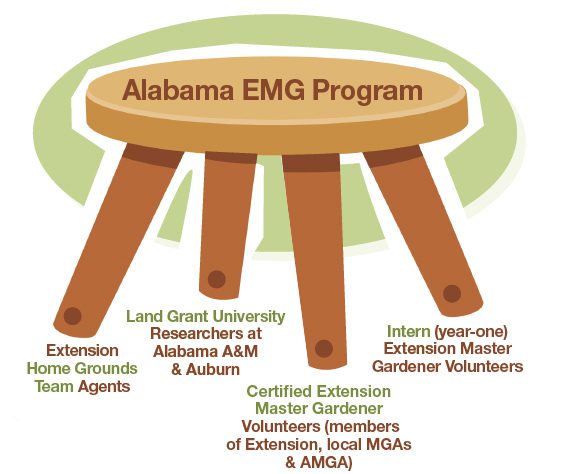
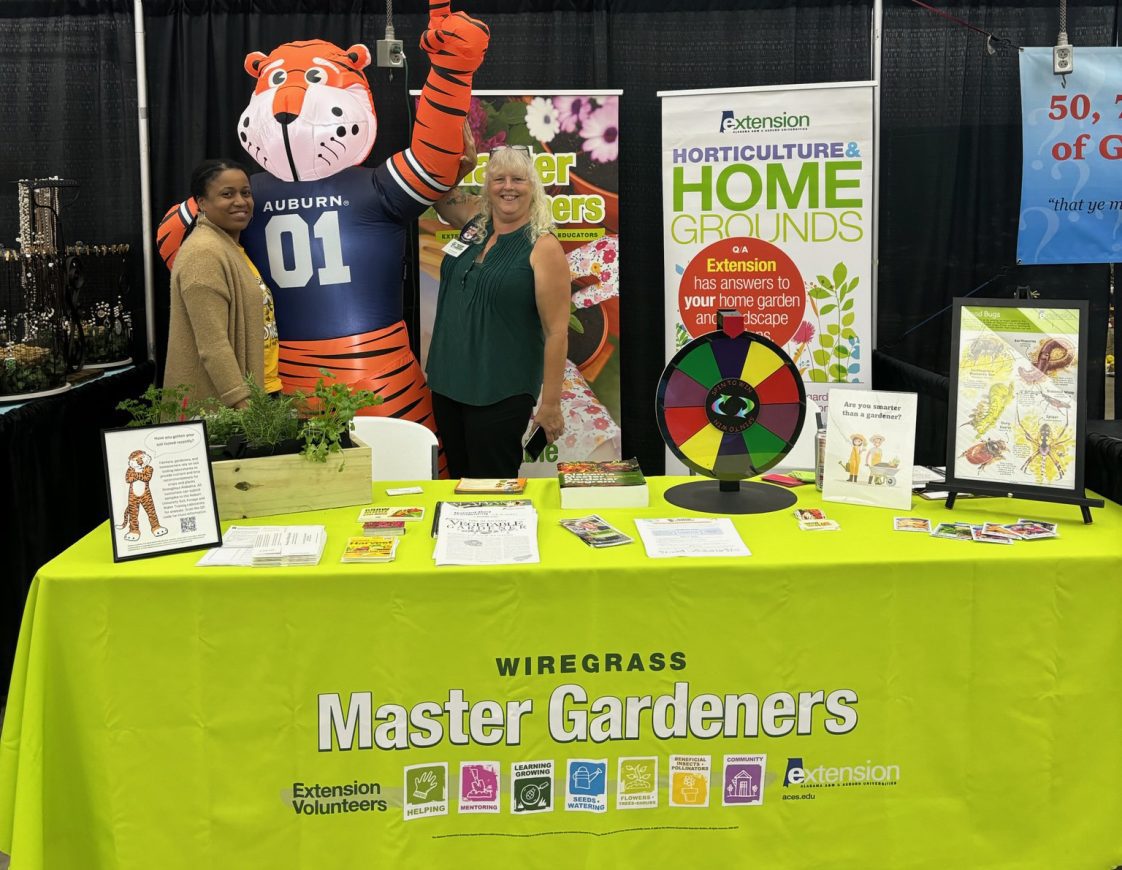
The second leg is agents with the Alabama Cooperative Extension System. Their work stems from two land grant campuses, Alabama A&M and Auburn Universities, and 67 county offices across the state. Their mission is to transform lives through science-based information, practical solutions, and meaningful experiences. Extension agent teams lead public programs related to one priority topic, such as home grounds, food safety, 4-H, and others.
The Home Grounds team agents lead three programs: Extension Master Gardeners (EMG), Alabama Smart Yards, and Grow More, Give More. Through the EMG program, this team trains Extension Master Gardener volunteers and collaborates with and guides them in community projects and educational programs.
The third leg is intern EMG volunteers. Interns are the starting point of the EMG Program, which has a two-fold purpose: increase the availability of home horticulture information through qualified volunteers and extend the land grant mission across Alabama. All interns receive 50 hours of instruction and participate in 50 hours of approved volunteer service to become certified EMG volunteers. In completing their certification, interns volunteer with certified EMG volunteers on projects such as assisting the Junior Master Gardener program; answering Gardener Helpline questions at a local Extension office, library, or farmers market; and helping with plant sales.
The fourth leg is all certified Extension Master Gardener volunteers involved with the program. As trained Extension representatives, all certified EMG volunteers are members of the Extension Home Grounds team. They are also members of one or more Master Gardener associations (MGAs), when one is available and membership dues are current. They improve communities by participating in research-based horticulture activities, such as the following:
- Leading Grow More, Give More projects
- Delivering school presentations
- Hosting Lunch and Learn
- Offering garden programs
- Managing demonstration gardens
Extension Master Gardener volunteers continue to learn through these projects and their peers, at advisory council meetings, and at annual conferences.
The four-legged stool is stable because its strong foundation withstands inevitable changes and gains strength with the presence of all four legs. Just like this stable stool, our universities, Extension, interns, and Extension Master Gardener volunteers statewide work and volunteer to help each other achieve a stronger network. Through this team, we can better serve our communities throughout the state.
Community partners further help our program connect with local communities. Our mission focuses on local activities that address local needs, so input from various perspectives is essential. This input helps us define community needs and guides our priorities to benefit everyone. Community partners expand our potential for community impact. We appreciate their support.
Devonne Ellis, President, Alabama Master Gardeners Association (2023-2025), and Kerry Smith, State EMG Program Coordinator, Auburn University
Revised May 2025, Standing Strong: A Successful Extension Master Gardener Program, ANR-3103