
Landscaping

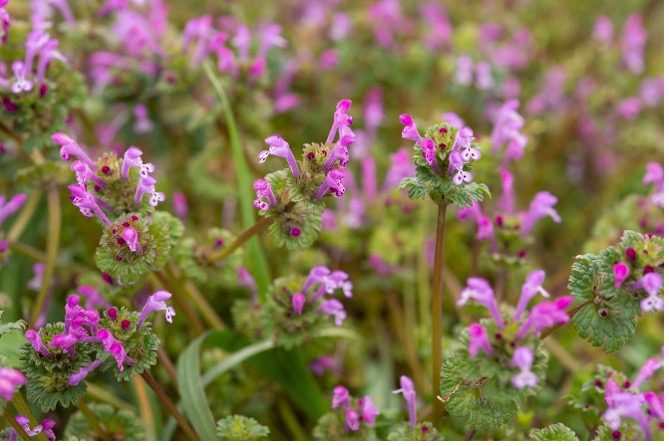
During Alabama’s coldest months, from December through March, most plant species go dormant. However, there are two non-native species that emerge in an often showy way: henbit (Lamium aplexicaule) and purple deadnettle (Lamium purpureum).
Henbit and purple deadnettle are in the mint family, Laminaceae. Both species have many common names. Henbit is also known as henbit deadnettle and hen’s bit. Purple deadnettle is also known as red deadnettle and red henbit. While both species may also be referred to as deadnettle, they are unrelated to the stinging members of the true nettle family.
These weeds are relatively easy to control and are not considered by most as highly invasive. However, these non-native plants can be troublesome in lawns, gardens, pastures, orchards, and fallow fields. The plants reproduce via seeds, which can remain viable for several years or, in some cases, decades.
Identification
Henbit (Lamium aplexicaule)
These annual weeds are native to Eurasia but are found worldwide in temperate regions. They have been established in the United States for hundreds of years. Henbit is common statewide, while purple deadnettle is more prevalent in north Alabama but can be found statewide. There are observations of other non-native Lamium species in Alabama, but henbit and purple deadnettle are by far the most common and widespread across the state. Both species thrive in shaded areas with moist fertile soil but can also grow in other soil and light conditions.
As with most other species in the mint family, henbit and purple deadnettle have square stems and oppositely arranged leaves. They both can have a low, horizontal growth habit—only growing few inches tall—or take on a more upright growth.
They are sometimes confused with one another but have key differences. Henbit only reaches heights of 15 inches, whereas purple deadnettle can grow a bit taller, up to 18 inches.
Henbit leaves lack petioles (leaf stems) and grow opposite from one another with rounded to heart-shaped leaves—which, in the plant’s upright growth habit, give a distinctive, tiered appearance. Leaves have rounded teeth along the edges and can also appear lobed. The upper leaf surface, along with main veins of the underside, contains hairs. Stems may be sparsely hairy. A key identifying feature of henbit is the pink-to-purple hooded flowers that are showy among the green leaves.
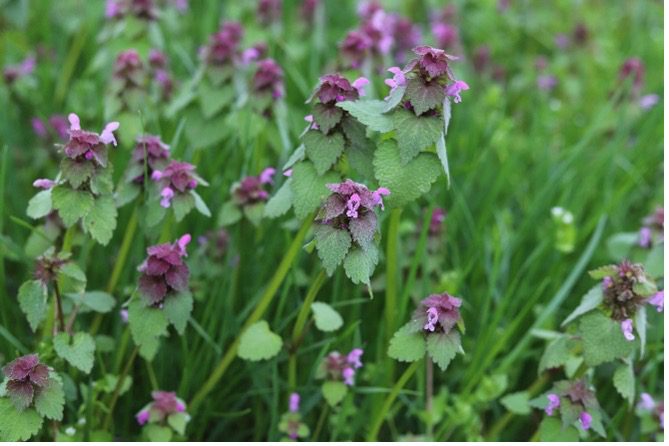
Purple deadnettle (Lamium purpureum)
Purple deadnettle leaves are opposite, but unlike henbit, are more triangular-to-heart-shaped with rounded, but less pronounced, teeth on the leaf margins. In the upright growth habit, lower leaves are green with longer petioles. However, as you move up the plant, leaves may become smaller with less pronounced petioles and take on a red-to-purple color near the top. In the upright form, leaves may appear overlapping and closely layered. Flowers of purple deadnettle have a similar pink-to-purple color. However, because of the tighter leaf arrangement along the stem, they are typically less conspicuous than those of henbit.
Control
Because these plants are the first to bloom in the winter and early spring, it is thought that these plants may provide a source of pollen and nectar for bees and other pollinators. Many people also find henbit and purple deadnettle attractive in landscapes. For both of these reasons, control is often opposed. However, because these plants are more of a concern in cultivated landscapes, and not as much of an issue in native ecosystems, control is often pursued to maintain well-manicured lawns, gardens, or productive pastures and agricultural fields.
A combination of strategies can be implemented to manage winter annual weeds such as henbit. The primary goal of management should be the prevention of seed production and plant germination. This can be accomplished through the use of preemergent herbicides, which are applied in late summer to early fall. Before treating areas with a preemergent herbicide, it is important to check that the selected product is registered for use near ornamental species that may be present in home landscapes. People can also use mulch, hand pull weeds, and spot treat emerged weeds with a postemergent herbicide.
For questions regarding herbicide applications to control henbit or purple deadnettle, reach out to your county Extension office.