
Forestry & Wildlife


AUBURN UNIVERSITY, Ala. — December means that many are rockin’ around the Christmas tree and hanging mistletoe where people can see. Mistletoe is well-known from the holiday tradition of grabbing a sweetheart and sharing a kiss while standing under its sprigs. However, if those love birds knew they were kissing under a parasite, would it change their minds?
It is believed this tradition started approximately 2,000 years ago. Likely beginning with Celtic druids who saw it as a symbol of life and fertility, mistletoe is later tied to Norse mythology, where the goddess Frigg made it a symbol of love and peace. Despite its romantic origins, this plant has a parasitic nature and can cause damage to Alabama trees.
Attacking Trees
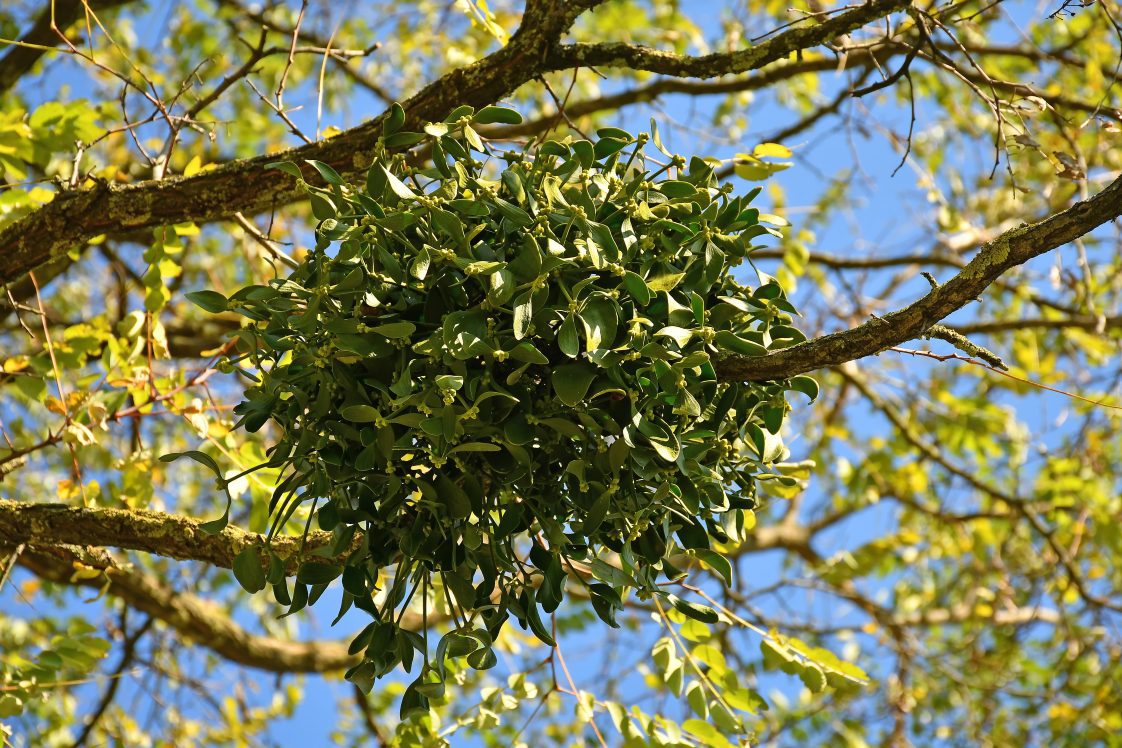
Mistletoe on a hardwood tree branch.
There are approximately 30 species of mistletoe found in the U.S., but there is only one native to Alabama: American mistletoe. This small, evergreen shrub is also the species typically found in holiday decor. Mark Smith, an Alabama Extension forestry and wildlife sciences expert, said mistletoe is a partially parasitic plant. This means that it has chlorophyll and carries out photosynthesis but also relies on a host plant.
“A few mistletoe plants on healthy trees typically have little significant impact,” Smith said. “Large numbers, however, can reduce tree vigor. This is especially the case during droughts, when mistletoe uses water that the host tree can’t afford to lose.”
American mistletoe is identifiable by it its leathery, opposite leaves and white berries. The seeds found inside the berries have a sticky outer layer. This layer helps the seeds anchor to host plants, where the mistletoe germinates and grows. Beau Brodbeck, an Alabama Extension assistant director for field operations, said mistletoe is particular about the trees it inhabits.
“American mistletoe, also known as oak mistletoe, frequently attacks oak trees but can also attack pecan, hackberry, elm, cherry and sycamore trees,” said Brodbeck, whose background is in urban forestry.
Controlling Mistletoe
Mistletoe infestations happen slowly and do little harm to the tree early on. However, as the plant grows, the damage can become more serious. Brodbeck said the sooner people manage mistletoe, the better their chances are of preventing tree disfigurement and death.
“Mistletoe control methods can be as simple as improving tree health and pruning limbs or as severe as removing the whole tree,” Brodbeck said. “Base your decision to control mistletoe on the amount of mistletoe in the tree, how long the mistletoe has been there and the amount of stress the tree is showing.”
For in-depth information on control methods, read the Extension publication, “Controlling Mistletoe in Trees,” at aces.edu.