
Forestry & Wildlife


Leatherleaf mahonia (Berberis bealei) is a member of the Berberidaceae family, commonly called the barberry family. Native to China, this plant was first introduced to the West in the 1800s by a plant collector sent to China by the East India Company to bring back tea. Because of its interesting growth habit and desirable flowers, fruit, and foliage, leatherleaf mahonia became a popular ornamental in England and was used as a specimen plant in shade gardens. Soon after gaining popularity in England, nursery operators in the United States began offering it plant enthusiasts and gardeners alike. While leatherleaf mahonia has many desirable ornamental characteristics—such as drought and salt tolerance—and is less likely to be browsed by deer, it is considered invasive in many parts of the Southeastern United States. This is because of the plant’s tendency to sucker, self-seed, and become naturalized. The spread of leatherleaf mahonia is also encouraged by birds, because of the desirability of its fruit.
Identification
Leatherleaf mahonia is an evergreen shrub with several unique features that make it fairly easy to identify year-round.
The plant can be multi or single stemmed and can grow to 10 feet tall and 8 feet wide. It typically has a shallow root system of yellow-centered roots and stems, which is apparent when cut. Leatherleaf mahonia can have a tiered appearance because of the 1 to 1.5 foot-long compound leaf that radiates outward from its stem (figure 1). These leaves are odd-pinnately compound with stiff and leathery leaflets. This type of compound lead has an odd number of leaflets, with one distinct leaflet at the tip. This terminal leaflet is slightly larger than the lateral leaflets.
Flowers occur in multiple 3 to 6-inch erect clusters on old growth and bloom from late winter to early spring. They are bright yellow and may have a slight odor. The plant’s berry-like clusters of fruit mature in summer and may be blue, black, purple, or green. The berries are less than 1-inch long and somewhat resemble grapes (figure 2). When flowers and fruit are not visible, a key identifying feature for this plant is its sessile leaflets, which lack a leaf stalk and attach directly to the stem or rachis (figure 3).
-
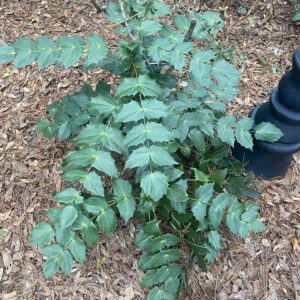
- Figure 1. Leatherleaf mahonia tiered appearance
-
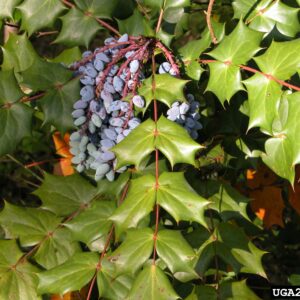
- Figure 2. Leatherleaf mahonia fruit, a bluish berry less than 1 inch long. Photo by Nancy Loewenstein, Auburn University, Bugwood.org
-
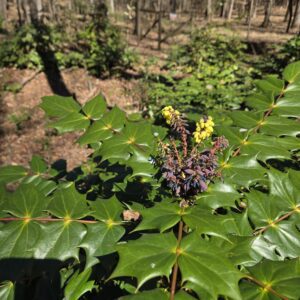
- Figure 3. Stiff and leathery sessile leaflets in bloom. Photo by Nancy Loewenstein, Auburn University
Control and Prevention
There is limited research available on this species, so herbicide recommendations for both residential and nonresidential areas are based on those for similar plants or sites.
Residential Areas
Prevention. Do not plant leatherleaf mahonia. Instead, choose evergreen and noninvasive alternatives such as American holly (Ilex opaca), Florida anise (Illicium floridanum), or a variety of evergreen azalea. See a list of varieties in the Alabama Extension publication, “Evergreen Azaleas for Alabama.”
Physical control. If already established in a landscape, you can help control leatherleaf mahonia by pulling up any new seedlings or using a tree wrench when the soil is moist. You can also burn or bag and dispose of the plant’s fruit.
Chemical control. While several products may effectively treat leatherleaf mahonia in forested or other nonresidential settings, there is a limited number of herbicides that can be used for control in residential settings. These include herbicides that have glyphosate or triclopyr as the active ingredient. These must be carefully used for foliar or cut stump and stem treatments according to label directions to prevent potential damage to nearby desirable vegetation, including trees, shrubs, flowers, grasses, and vegetable gardens. Be careful when treating along property lines. Clearly communicate with neighbors in these situations and read and always follow label instructions. For specific herbicide product recommendations, contact your county Extension office.
Nonresidential Areas
Chemical control. In nonresidential areas, foliar applications are best made during the growing season, when environmental conditions are suitable and plants are actively growing. Consult the label for specific instructions. For specific herbicide product recommendations, contact your county Extension office.
Resources
- Cut Stump Herbicide Treatments for Woody Plant Control, Alabama Cooperative Extension System
- Nonnative Invasive Plants of Southern Forests: A Field Guide for Identification and Control, US Department of Agriculture’s Forest Service