
Forestry & Wildlife

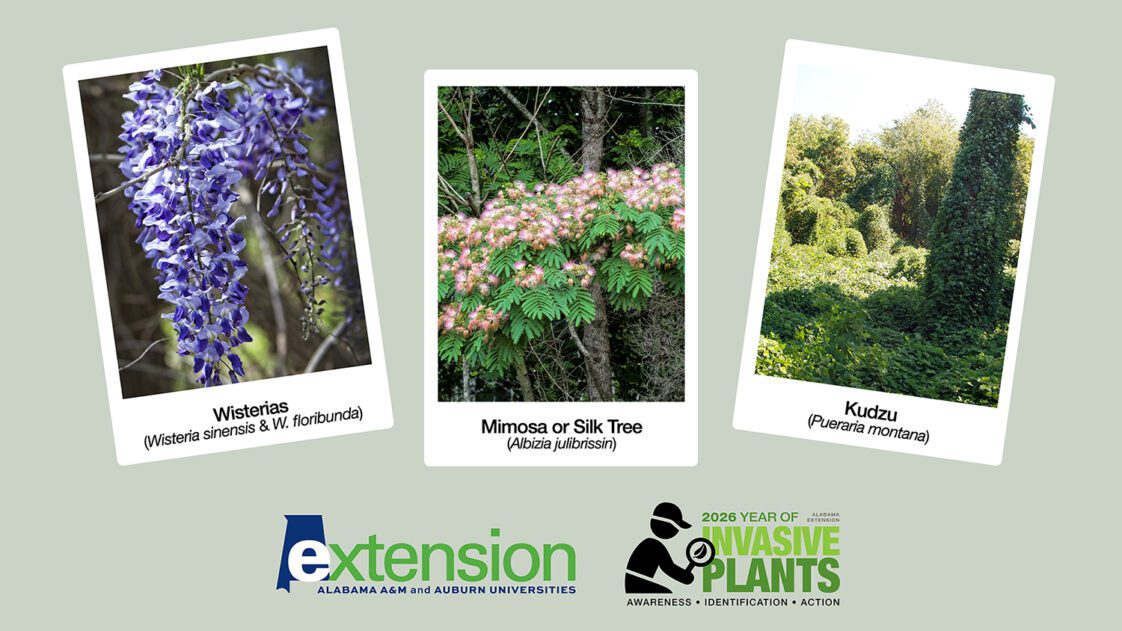
The 2026 Year of Invasive Plants project is an effort to raise public awareness about invasive plants and their impacts throughout Alabama.
Through social media, workshops, and other educational opportunities, people will learn how to identify various invasive species and feel emboldened to take action in controlling plants that negatively impact the state’s economy and harm native ecosystems. This project also includes volunteer opportunities with partner organizations and chances for participants to receive prizes and certificates by logging their hours spent controlling invasive plants.
What are Invasive Plants?
Invasive plants are nonnative species that have been introduced to an area and spread aggressively. They can cause harm to native ecosystems, the economy, recreation, or human health. Some people use the term invasive to describe native plants with aggressive growth or spreading habits. However, the official definition—outlined in Executive Order 13112 (1999) and commonly used in academic settings—does not include native species. The term native also has an important spatial component, referring to areas where a species has historically occurred. This means plants that are native to other states may not be native to Alabama. This project will focus on species that have not historically occurred in Alabama and are considered nonnative invasive species.
For centuries, invasive species have been introduced to the United States, both accidentally and intentionally. International trade is often the culprit of the accidental transport of seeds, spores, or other viable plant parts on packing materials or vessels. However, the most significant contribution to invasive plants in the United States is the intentional introduction of nonnative species. There are a variety of reasons for this—including use in ornamental landscaping, food and medicine, erosion control, livestock forage production, textile dyes, lumber, wildlife enhancement, and much more.
In the United States, the costs of invasive plant damage and control have amounted to more than $190 billion over the last four decades.
Some of these species have escaped their cultivation and become a nuisance in forested or natural areas, home landscapes, agricultural fields, aquatic environments, and rights-of-way. However, not all nonnative species are invasive. Most of the crops grown in Alabama are nonnative, and countless noninvasive ornamental species are used in landscaping and sold at nurseries and home improvement stores. While many nonnative plants do not actively pose a threat, many invasive, nonnative plants remain for sale, sometimes illegally. A 2021 study examining more than 1,200 invasive species in the United States found that 61 percent were available for purchase, including 50 percent of species that are regulated at the state level and 20 percent of those listed as federal noxious weeds. Online marketplaces offer many of these species, making it possible for vendors to ship across state lines with little accountability or consequence. Also, new species are introduced to the market each year, and their potential to become invasive is often unknown at the time of introduction. These species should be closely monitored.
Pledge to Help
Join in on the action and take Alabama’s Year of Invasive Plants pledge. Explain how you will help increase personal or public awareness of invasive plant species, improve your identification skills, and make strides toward controlling nonnative invasive plants in Alabama landscapes.
Record Your Actions
As you remove invasive species on your property, in local communities, or at volunteer events, share your success by completing an online action report. This will help project organizers capture valuable information on the targeted species and when, where, and how they were controlled. Also, share photos of you in action and before-and-after photos of the site. This information will be used to show the impact of this collective effort and demonstrate the dedication and interest of Alabama residents in conserving natural landscapes.
While supplies last, participation incentives are available for those who complete and record 5, 15, and 25 hours of invasive plant control in Alabama. These hours can be completed on personal property or during volunteer workdays at partner-led events. Those who are paid to work in invasive plant control cannot count those paid hours as a part of this project. When recording your actions, use the same contact information for each report, so the hours can be accurately tracked in order for you to receive your incentive item. Once you reach a tier and the hours have been processed, you will be notified about when to claim your item at the Alabama Extension county office nearest you.
Featured Plants
Each week, a new invasive species, or group of related species, will be featured on the Alabama Extension Forestry, Wildlife, and Natural Resources Facebook and Instagram accounts. These posts will include the species’ identifying features, common locations, and other notable facts. The posts will also link to the Extension website for detailed information on control options. Find a link below to the list of featured plants. Also, help raise awareness of these invasive plants on social media at the links below.
View Invasive Plant Gallery Follow on Facebook Follow on Instagram
Resources
At the link below you will find several Alabama Extension publications that outline control methods and other information related to invasive species.
Workshops & Volunteer Events
Throughout the year, Alabama Extension and other partners will host workshops and volunteer events, where people can learn about invasive species and the importance of maintaining native species. This page will be updated throughout the year as new workshops and events are planned. Below is a list of currently planned opportunities.
Events
Alabama Private Pesticide Applicator Training
- Statewide
- This training is primarily intended for farmers and landowners who need permits to purchase and apply restricted-use pesticides. However, the training is open to everyone and provides relevant information for anyone who applies pesticides. The exam given at the end of the training is not required for general-use pesticide applications on personal property. Visit the 2026 Alabama Private Pesticide Applicator Training web page for more information.
-
Cane Creek Canyon Nature Preserve—251 Loop Rd., Tuscumbia, AL 35674
-
Starting at 1 p.m., this event will focus on removing invasive species along trails and throughout the preserve. Volunteers should prepare for hiking over uneven, rocky, and rooted terrain. No experience required. Wear sturdy, closed-toe shoes and bring water, snacks, and work gloves. Extra water, work gloves, and tools will be provided. Registration is required.
-
Wheeler Visitor Center—3121 Visitors Center Rd., Decatur, AL 35603
-
Starting at 1 p.m., this event will focus on removing invasive privet and nandina plants.
March 24 (Tuesday)—After the Storm: Continued Post-Hurricane Forest Management (Online)
- Be prepared for the next storm by knowing how to address common hurricane-related impacts including forest insects, disease, and invasive plants. In this free webinar, you will learn directly from those recovering from Hurricane Helene in Georgia. This webinar is offered by the University of Georgia’s Warnell School of Forestry and Natural Resources.
-
Evergreen Depot—100 Depot Square, Evergreen, AL 36401
-
This workshop is from 11 a.m. to 1 p.m. Information will center on invasive plants and how they affect native plants and pollinators.
-
Troy University Arboretum—101 Pell Ave., Troy, AL 36081
-
This event starts at 9 a.m. Attendees should meet at the Educational Building.
April 16 (Thursday)—Bugwood Summit 2026 (Online)
- Hosted by the Center for Invasive Species and Ecosystem Health
- This virtual event will highlight UGA Center for Invasive Species and Ecosystem Health updates, Bugwood Tools, and strategies for integrating them into education, outreach, and management programs. The summit is ideal for natural resource professionals, educators, researchers, land managers, students, and others interested in invasive species management, pest detection, and ecosystem health tools. Attendance is free, but registration is required.
- Wheeler Visitor Center—3121 Visitors Center Rd., Decatur, AL 35603
-
This even is from 1 to 3 p.m. and will focus on removing invasive privet and nandina plants.
-
Lakepoint State Park—104 Old Hwy. 165, Eufaula, AL 36027
-
Starting at 9 a.m., this even is a hands-on conservation effort to help remove invasive Chinese tallow trees from the park.