
Fish & Water

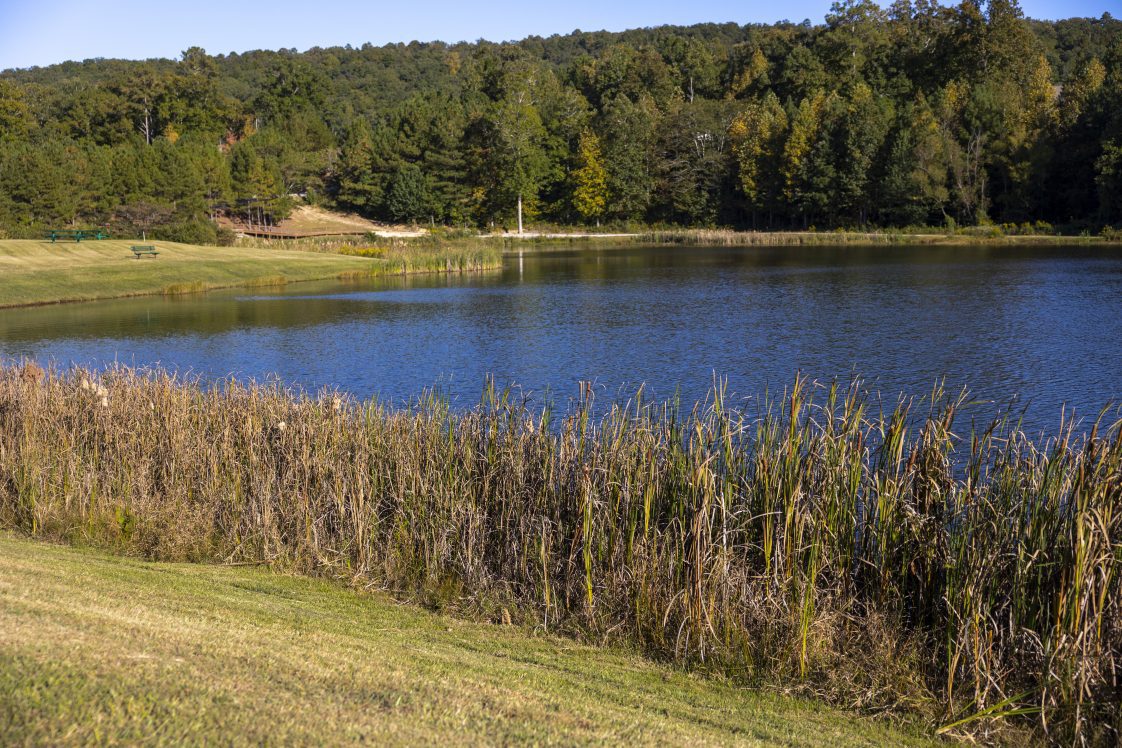
AUBURN UNIVERSITY, Ala. — Ponds add an aesthetically pleasing element to land. However, Alabama’s clay soils can be problematic if clear, pristine water or a good recreational fishing pond is a goal.
Corey Courtwright, an aquatic resources agent with Alabama Extension at Auburn University, said the technical term for muddy pond water is “clay turbidity.”
“Clay is a fine particle so it stays suspended in water longer than other soil types would,” Courtwright said. “Clay turbidity is usually caused by runoff into the pond. That could be due to erosion from construction, dirt roads or bare soil near the pond. It can also be caused by animals, like cattle, catfish or common carp, stirring up the clay from the bottom of the pond.”
A special instrument called a Secchi disk measures the severity of the turbidity.
“The Secchi disk has white and black sections painted on it,” Courtwright said. “When lowered into water, eventually, it will reach a depth where the colors can no longer be seen. That depth tells us how bad the clay turbidity is.”
Rusty Wright, an Extension aquatic resources specialist, said algae can also cause turbidity.
“In fact, ponds are often fertilized to create an algal bloom, which should have a Secchi depth of 18 to 24 inches,” Wright said.
Reasons to Fix Clay Turbidity
While the main issue with clay turbidity is aesthetics, Courtwright said the muddy water can cause problems with the pond’s food chain.
“The muddier the water, the less the sun penetrates,” Courtwright said. “Algae need sun to live and photosynthesize. If the sun can’t penetrate, the pond will not grow a good algae bloom. In turn, that leads to less fish growth due to less available food. Plus, clay turbidity can lead to oxygen issues in the pond.”
The attractive nature of clay particles can present additional problems.
“Clay ties up some of the nutrients in the pond, making those unavailable to the algae,” Wright said. “Also, clay can bind to some herbicides, making those ineffective.”
Treating Clay Turbidity
There are two main treatments for clay turbidity: organic and chemical.
Organic Treatments
“Organic treatment involves adding manure, hay or cotton seed or meal to the water,” Courtwright said. “As these decompose, they release carbon dioxide, which changes the water chemistry. It basically makes the clay settle out.”
The water will clear somewhat slowly, as it takes time for the organic matter to decompose. Because an organic treatment results in less oxygen in the water, Courtwright said it should only be used in specific cases. For one, it can be used for new ponds that are not stocked with fish. Additionally, organic treatments can be implemented in cooler months when oxygen levels are high and fish have less need for oxygen.
Before someone uses an organic treatment method, Wright strongly suggested obtaining expert advice.
“It’s important to contact your local Extension personnel to make sure that you won’t cause an oxygen depletion or kill fish in the pond,” Wright said.
Chemical Treatments
A second option is a chemical treatment, which can start clearing the water within hours. Wright said chemicals bind clay particles together, causing them to settle.
“For ponds with low hardness and alkalinity, agricultural lime is a good first choice, as it has a positive effect on the productivity of the pond,” Wright said. “Another option is gypsum. Also known as calcium sulfate, gypsum increases the hardness more than lime and is, therefore, more effective. There are a few polymer solutions on the market as well.”
Alum, or aluminum sulfate, can also be used. Courtwright said it is a strong additive for clearing ponds. However, it can be expensive and may cause oxygen depletion.
“It’s very important to note that the recommendation on the amount of alum to apply will vary quite a lot based on acre-foot of water, not just surface acres,” Courtwright said.
For the best long-term results, Courtwright said it is imperative to deal with the source of the clay turbidity. If the source is bare ground, add sod. When cattle are the issue, the herd may need to be moved to a different field. If too many catfish are stirring up the clay, fish them down or add bass to reduce the juvenile catfish population.
More Information
Alabama Extension offers numerous educational resources on pond management. For more information about chemical treatments, read Wright’s publication, “Adding Agricultural Lime to Recreational Fish Ponds.” For overall management information, check out “Management of Recreational Fish Ponds,” also written by Wright. Both of these are available online at aces.edu.
More information about how Alabama Extension can help with pond management is available through a video at youtube.com/watch?v=kjxWLNgedA8.