
Crop Production

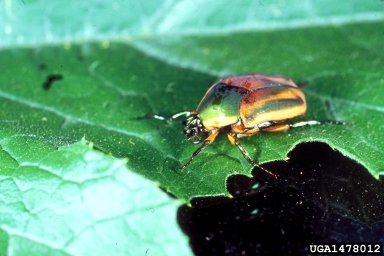
Green June beetles are considered a serious pest and can injure fruits of numerous crops—including grapes, apples, pears, quinces, plums, apricots, peaches, nectarines, blackberries, and raspberries. Adult June beetles are attracted to the ripening fruits as they soften and their sugar content increases. Green June beetle populations fluctuate from year to year. The damage caused to fruit crops ranges from negligible in some years to considerable in other years. In Alabama, high population numbers of green June beetles are often observed on maturing bunch grapes (figure 1). It is important for fruit crop producers to start scouting for limit damage from this pest.
Identification
The adult green June beetle is approximately 3/4 to 1-inch long and 1/2-inch wide. Its color varies from dull brown with irregular stripes of green to a uniform velvet green. The margins of the body can range from light brown to orange yellow. The underside of the beetle is a metallic green or yellow color.
The larva is a typical white grub, about 2-inches long when mature. The larvae are easily distinguished by their habit of crawling on their backs. They overwinter in the soil, and sandy soils that are high in humus or organic matter are their preferred habitats. In the spring, green June beetles tunnel near the surface. The beetles pupate in June, and the adults emerge in July and August.
Damage & Control
The beetle gains entry into undamaged fruits by gouging the fruit with a horn on the front of its heads. It then feeds on the flesh of the fruit. Several beetles may even bury themselves entirely in the fruit. Figure 2 shows a cluster of grapes completely dried-up from June beetle feeding. The beetles’ odor and excrement ruin most pieces of fruit they visit—even if feeding damage is not severe.
For control options and recommendations, refer to the Southern Region Small Fruit Consortium’s integrated pest management and production guides available at smallfruits.org/ipm-production-guides.
-
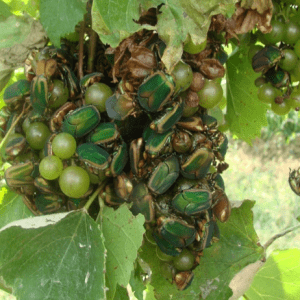
- Figure 1. Green June beetles feeding on maturing Seyval blanc grapes
-
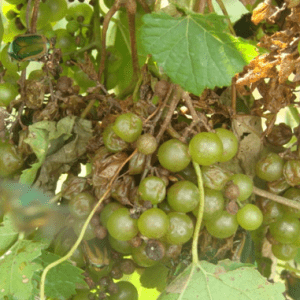
- Figure 2. Green June beetle damage to grape clusters
Featured photo credit: Jim Occi, BugPics, Bugwood.org