
Farm Management

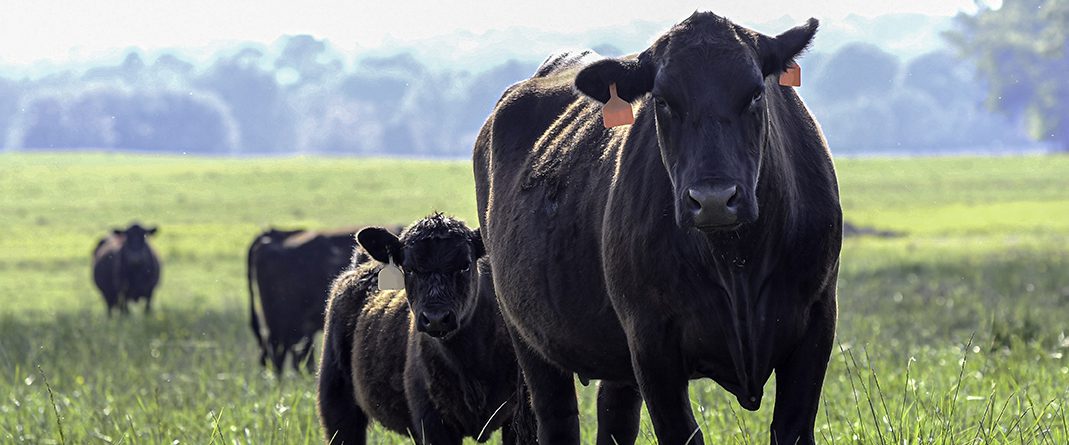
Alabama’s beef cattle industry is an important contributor to the state’s agricultural economy, generating income for farm families while supporting businesses throughout rural communities. This publication reviews the two-year economic impact of adding a 50-head stocker cattle operation to an existing farm in Alabama, using input/output modeling for estimating effects on output, income, employment, and related business activity during 2026 and continuing into 2027.
In this scenario, a producer with an existing farming operation expands into stocker cattle production as a new enterprise. Economic impacts occur both during start-up and throughout the life of the operation. Therefore, the analysis is divided into two components:
- Build Phase + Year-One Operations: Economic effects associated with purchasing capital assets needed to establish the enterprise, combined with the impacts of first-year operations.
- Ongoing Operations (Year Two and Beyond): Estimation of annual economic impact of continuing the enterprise into the next year.
Assumptions
 Several assumptions were used in developing this analysis:
- The producer already owns basic farm equipment, such as a tractor and a farm truck.
- Only new enterprise-specific capital purchases are included in year-one impact. These purchases include a seed drill, livestock trailer, utility terrain vehicle (UTV), fencing, pens, and feeding and watering equipment.
- No land purchases are included in the analysis. The 33 acres of used for the new stocker operation were not previously generating income for the farm.
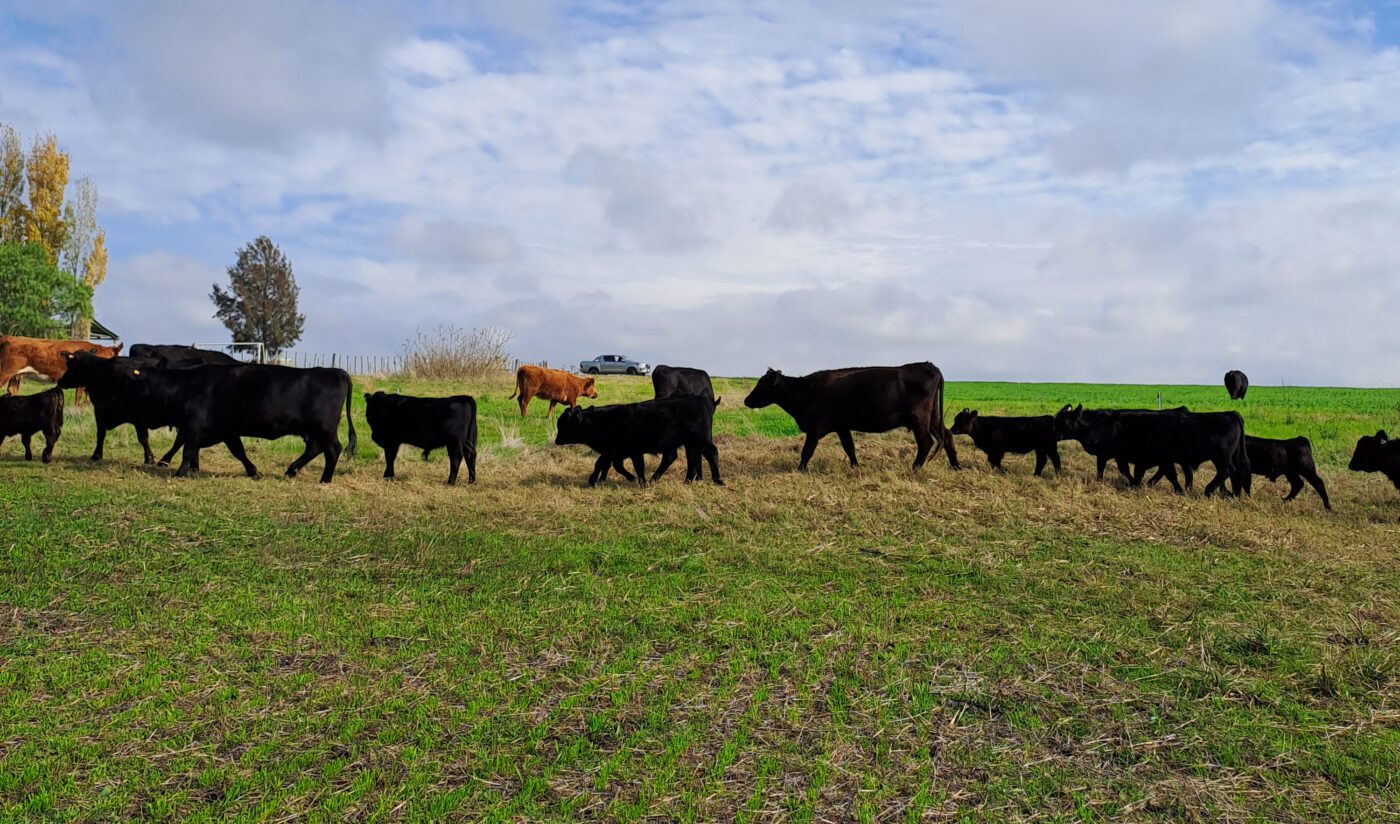
- Stocker calves are grazed on planted fall and winter annual forages and receive supplemental feed as needed.
- Cattle prices are assumed to remain constant while inflation is incorporated into the output numbers for year two.
Under these assumptions, the operation functions as a typical Alabama stocker enterprise. The producer purchases weaned calves from local Alabama sources then acquires feed, veterinary services, fuel, equipment, and supplies from local businesses that may source from outside the state. Feeder cattle are purchased and marketed at prevailing regional prices.
Understanding Economic Impacts
Economic impacts were estimated using IMPLAN input/output model, a commonly used economic analysis tool that measures how spending by one business affects other sectors of the economy. These types of input/output models have limitations. They are single-point-in-time estimations and assume fixed production relationships year to year based on local markets. Factors such as technological changes or input substitutions are not considered. Input/output models attempt to answer the question If this spending occurs, what economic activity is supported under current economic conditions? The model used in this study also assumed a 100 percent local supply of cattle, which could be the most impactful input variable, as cattle could also be purchased at a local sale barn coming from nonlocal sources.
The analysis includes three types of economic effects:
- Direct effects represent the economic activity generated by the stocker operation itself, including farm revenue, labor income, and employment.
- Indirect effects occur when businesses supplying goods and services to the operation purchase additional inputs from other businesses. These impacts are often referred to as supply-chain effects.
- Induced effects result from household spending of wages, salaries, and proprietor income generated by the direct and indirect effects. Examples include expenditures on housing, food, health care, and other consumer goods and services.
 Several measures are used to describe economic impact:
- Employment. The number of full-time and part-time jobs supported by the economic activity.
- Labor income. Employee compensation plus proprietor income.
- Value added. The additional economic value created after accounting for purchased inputs. This measure is comparable to a sector’s contribution to the gross domestic product (GDP).
- Output. The total value of production or business sales generated.
- Tax revenue. State, local, and federal tax collections generated by economic activity.
Economic Impact Results
Based on Alabama Cooperative Extension System enterprise budgets, a 50-head stocker operation is expected to generate approximately $148,471 in annual gross revenue, and $60,892 in producer net cash return is used for modeling inputs. New capital purchases modeled for this new enterprise in year one totaled $102,500.
When the initial investment required to establish the enterprise is combined with first-year operations, the new 50-head stocker operation generates year-one outputs as follow:
- $410,434 in total economic output
- 4.47 jobs supported
- $132,259 in labor income
- $210,533 in value added
- $38,654 in tax revenue
 Once the enterprise is fully established, annual operations continue to contribute significantly to the Alabama economy. Ongoing economic impacts for year two are estimated as follow:
- $329,853 in total economic output
- 4.16 jobs supported
- $114,791 in labor income
- $172,389 in value added
- $29,028 in tax revenue
Table 1. Impacts from Building Phase and Year-One Operations
| Category | Employment | Labor Income | Value Added | Output | Total Tax |
|---|---|---|---|---|---|
| Direct | 3.09 | $79,697 | $95,144 | $219,888 | $18,742 |
| Indirect | 0.98 | $30,962 | $71,266 | $116,100 | $9,824 |
| Induced | 0.40 | $21,598 | $41,122 | $74,448 | $10,087 |
| Total | 4.47 | $132,259 | $210,533 | $410,434 | $38,654 |
Table 2. Year-Two Operations Impact
| Category | Employment | Labor Income | Value Added | Output | Total Tax |
|---|---|---|---|---|---|
| Direct | 2.91 | $69,164 | $69,339 | $164,144 | $11,982 |
| Indirect | 0.91 | $26,783 | $64,495 | $100,673 | $8,234 |
| Induced | 0.34 | $18,843 | $38,555 | $65,036 | $8,811 |
| Total | 4.16 | $114,791 | $172,389 | $329,853 | $29,028 |
Table 3. Impacted Sectors of the Alabama Economy
| Sectors | Amount |
|---|---|
| Beef cattle ranching and farming, including feedlots and dual-purpose ranching and farming | $474,932 |
| Farm machinery and equipment manufa | $42,512 |
| Owner-occupied housing | $19,108 |
| Retail–Building material and garden equipment and supplies stores | $15,971 |
| Retail–Motor vehicle and parts dealers | $9,459 |
| Truck transportation | $8,837 |
| Wholesale–Other nondurable goods merchant wholesalers | $7,972 |
| Other real estate | $7,800 |
| Other animal food manufacturing | $7,003 |
| Monetary authorities and depository credit intermediation | $6,746 |
| Offices of physicians | $5,972 |
| Hospitals | $5,671 |
| Limited-service restaurants | $5,188 |
| Full-service restaurants | $4,259 |
| Insurance carriers, except direct life | $3,212 |
Conclusion
Input/output studies such as this are useful to estimate how spending from one production practice affects the broader economy and can be useful for industry promotion to wider audiences, particularly those interested in employment and overall GDP. These findings demonstrate that even relatively small livestock enterprises produce economic benefits that extend far beyond the farm gate. Through purchases of inputs, utilization of local services, and spending of farm-generated income, small cattle operations support employment, business activity, and tax revenues throughout Alabama’s rural communities.

Dennis Brothers, Associate Extension Professor, Agricultural Economics and Rural Sociology; Adam Rabinowitz, Extension Specialist, Associate Professor, and Ken Kelly, Extension Agent, Farm and Agribusiness Management, all with Auburn University
New November 2026, Two-Year Economic Impact of a New 50-Head Stocker Cattle Operation in Alabama, ANR-3310
For more information, contact your county Extension office. Visit aces.edu/directory.
Trade and brand names used in this publication are given for information purposes only. No guarantee, endorsement, or discrimination among comparable products is intended or implied by the Alabama Cooperative Extension System.