
Crop Production

Sprayers
Safe and efficient application of pesticides is important to fruit producers. Before applying pesticides, producers should be familiar with the types of sprayers used and how to calibrate them. The five types of sprayers are as follows:
- Manual hand sprayers
- Backpack sprayers
- Boom sprayers
- Handgun sprayers (Hydraulic, electric, or power takeoff)
- Airblast sprayers
Manual Hand Sprayers
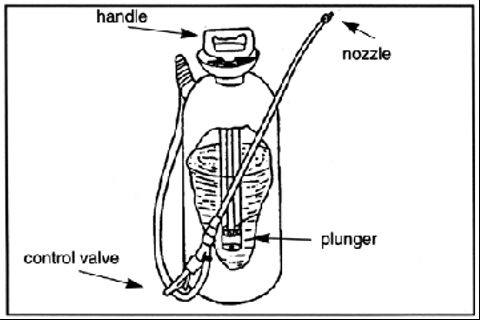
Figure 1. Hand sprayer
Manual hand sprayers are designed for spot treatments and restricted areas unsuitable for larger units (figure 1). Hand sprayers usually come in 1-, 1 1/2-, 2 1/2-, or 3-gallon sizes. Most hand sprayers in these sizes use compressed air to pressurize the supply tank and have adjustable handguns or wands. These sprayers are relatively inexpensive, simple to operate, maneuverable, and easy to clean and store.
Hand sprayers are generally used on small areas; therefore, the amount of spray applied should be calculated for small areas. The labels on the pesticides usually indicate the amount of chemicals to use per gallon of water. The typical size area used to calculate amounts of herbicide or fertilizer is 1,000 square feet.
Most manual hand sprayers do not have pressure gauges or pressure controls; therefore, the pressure in the tank must be regulated by repressurizing the tank frequently or by filling it only two-thirds full so considerable air space is left for initial expansion. If the sprayer does have a pressure gauge, repressurize the tank when the pressure drops approximately 10 pounds per square inch (PSI) from the initial reading.
When using a manual hand sprayer, hold the nozzle at a steady, constant height and spray back and forth in swaths. When applying a calculated amount of material to a given area, maintain uniform walking speed as you spray.
Backpack Sprayers
Although labor-intensive, backpack or knapsack sprayers are relatively light and can be taken places where mounted sprayers are difficult to use. Most backpack sprayers come in 3- or 4-gallon sizes. They work well in small orchards or small fruit garden areas. Backpack sprayers are either manually operated or powered by an engine.
The chemicals to be used will dictate which backpack sprayer is appropriate for a particular job. Airblast sprayers typically work better with insecticides and fungicides, and hydraulic sprayers are more suitable for herbicides. Airblast units are not appropriate for most herbicide applications because of possible drift problems.
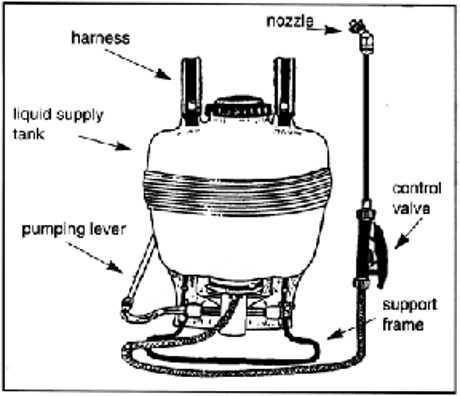
Figure 2. Backpack or knapsack sprayer
Manually Powered Knapsack Sprayer. This type of hydraulic sprayer has a liquid supply tank, a pump and attached pumping lever, a pressure-holding chamber, a hose and wand with control valve and nozzle system, and a support frame and harness for attaching the sprayer to the user’s back (figure 2). The pump draws liquid from the supply tank and delivers it to the pressurizing chamber, where seals and valves hold the liquid pesticide under pressure until the valve on the wand is opened. The pressurized fluid passes through a small orifice on the spray nozzle and is broken into small droplets. As the pressurized flow continues, the pressure in the tank drops and must be reestablished by hand-pumping the lever. Although most hydraulic knapsack sprayers are manually operated, they can also be engine powered.
A manual knapsack sprayer can be a reasonably accurate unit if it is equipped with a pressure gauge or pressure regulator because it can apply a predetermined amount of chemical to a specific area. The nozzle or nozzles (on a hand boom) can be calibrated for set conditions.
Engine-Powered Backpack Mist Blower. The backpack mist blower is a small airblast sprayer. Because air is the carrier, instead of water, as in the hydraulic sprayer, the airblast units have advantages over hydraulic units in labor and coverage. In the airblast unit, only a small amount of water is needed to prepare the spray mix, so there is much less water to carry per acre. The airblast sprayer also gives better coverage because the air turbulence provides superior leaf coverage. This is because the mist-laden air being forced into the plant freely moves in every direction within the plant canopy, whereas the stream from a hydraulic sprayer mainly wets only leaves in line with the direction of the spray.
Boom Sprayers
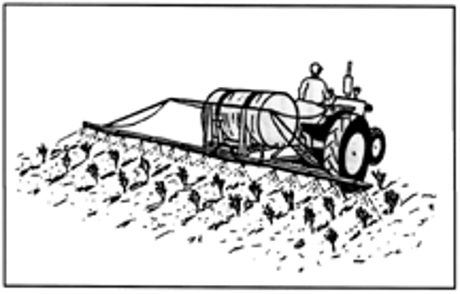
Figure 3. Boom sprayer
Boom sprayers are commonly used for low-growing crops because the boom can extend outward and over the crop (figure 3). They can also be used in maintaining the floor of orchards where herbicides can eliminate or control the growth of ground cover. Boom sprayers can be tractor mounted or self-propelled.
Tractor or Prime-Mover-Mounted Sprayers. Boom sprayers can be mounted on a frame that attaches to a tractor by a three-point hitch system, or they can be attached or mounted to an ATV four-wheeler. The sprayer can be run by an electric pump that is powered by the battery on the ATV four-wheeler or by a separate battery.
Trailer-Mounted Sprayer. Boom sprayers can also be supported by wheels and towed by a farm tractor, ATV four-wheeler, or garden tractor. This sprayer is advantageous for farmers who have small equipment because a larger tank of spray mix can be towed safely. The boom is mounted on the rear of the trailer frame. The pump can be powered by the tractor power takeoff (PTO) or by a gasoline engine mounted on the trailer.
Skid-Mounted Sprayer. A sprayer mounted on a skid frame can be carried in a pickup truck or placed on a trailer. This type of sprayer usually has a tank, engine, and boom. The boom can be mounted on the skid or the rear of the pickup or trailer.
Self-Propelled, High-Clearance Sprayer. This sprayer is commonly used in vegetable production (sweet corn) or cotton production where it is important that the machine clear a relatively high-growing crop. This type of sprayer probably would not be a first choice for small orchard crops.
Handgun Sprayers
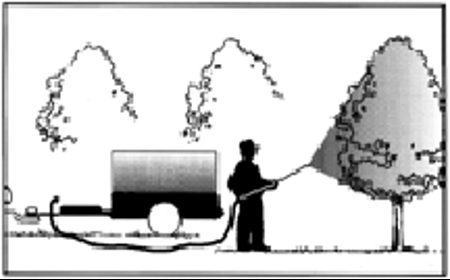
Figure 4. Hydraulic handgun sprayer
Hydraulic handgun sprayers are hand-held gun sprayers that can disperse pesticides into the tops of fruit and shade trees (figure 4). Water is used as both the diluent and the carrier. The sprayer must provide and maintain high pressure and sufficient flow of liquid so the large droplets of the stream can reach the tops of the trees.
Although handgun sprayers are primarily used for spraying trees, they can also be used on small fruit on a limited basis and may be used in combination with a boom sprayer. A directional-control valve can be used on a boom sprayer to direct the flow from the boom to a handgun; then, the boom sprayer can be used as a handgun sprayer for small fruits.
A multiple-outlet gun creates a small boom for small fruit. A variable-discharge-angle gun controls the spray angle from a wide-angle spray for short trees and shrubs to a narrow stream for tall trees. The handle of the gun can be twisted to control the spray angle.
Hydraulic handgun sprayers differ in construction to satisfy the different kinds of tasks for which they are used. Typically, piston pumps are used to achieve the high pressures required. Since piston pumps are commonly low flow, large pumps are needed to reach tall trees. Table 1 lists the pump pressure and flow characteristics needed to deliver spray to trees of different heights. Note the decrease in pressure caused by friction in small-diameter hoses.
Table 1. Selecting Hydraulic Handgun Sprayers
| Tree Height (Feet) | Pump Size (GPM) | Pump Pressure 100-Foot Hose (PSI) | Hose Diameter (Inches) | Nozzle Pressure (PSI) |
|---|---|---|---|---|
| Up to 15 | 3 | 400 | 3/8 | 150 to 200 |
| Up to 25 | 5 | 400 | 3/8 | 250 to 300 |
| 20 to 35 | 10 | 400 | 1/2 | 300 to 350 |
| 30 to 45 | 15 | 400 | 1/2 | 300 to 350 |
Airblast Sprayers
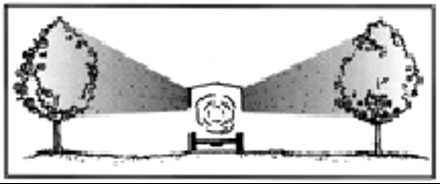
Figure 5. Airblast sprayer
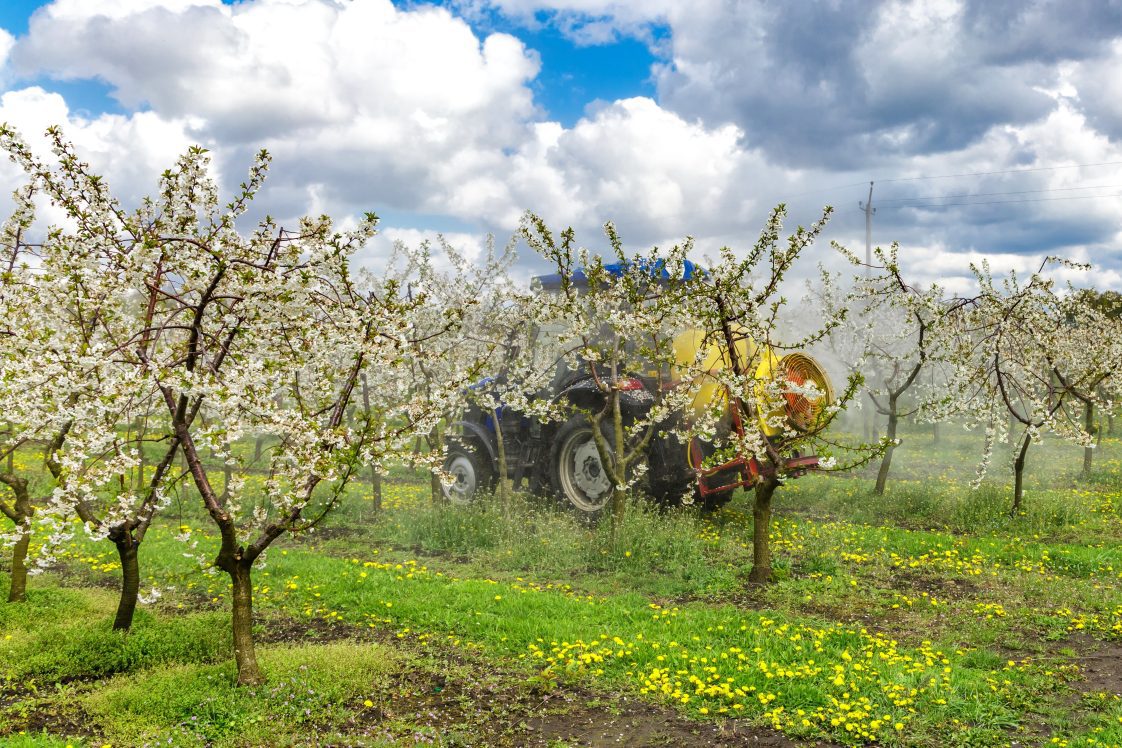
Airblast sprayers use a high-velocity, large-volume airstream to apply a concentrated pesticide mixture (figure 5). Small, tractor-mounted airblast sprayers may be adequate for small acreage and small- to medium-size trees. Airblast sprayers can be one-way (one-sided) or two-way (two-sided).
The goal of airblast spraying is to replace the air contained in the tree with spray-laden air. High air volume capacity in the blower and the correct travel speed are important factors in achieving this. Travel speed must be slow enough to create air momentum to penetrate the plant canopy. Velocity is essential for getting the spray to the top of the trees or across a field. Most airstreams lose 75 percent of their velocity in the first 25 feet from the sprayer.
Airblast sprayers can spray an area in less time than either handgun or boom sprayers can. However, airblast sprayers require more power than boom or handgun sprayers do. Because airblast sprayers apply a concentrated pesticide mixture, a much smaller amount of water is used than in hydraulic or boom sprayers. Pesticide drift can be a serious problem since airblast sprayers are broadcast sprayers.
Sprayer Calibration
Procedures for calibrating the different types of sprayers and more detailed explanations of their working parts can be found in the following Extension publications: “Equipment and Calibration for Low-Pressure Ground Sprayers” (ANR-0570); “Orchard Spraying with an Air-Blast Sprayer” (ANR-0618);” and “Calibrating a Manual Sprayer” (ANR-0744).
See Extension publication “Spraying Home Orchards” (ANR-0050) for information on mixing pesticides, sprayer care, and pesticide precautions.
Pesticide manufacturers will recommend how much pesticide should be applied on a particular area, such as an acre or 1,000 square feet. Sprayer calibration determines how many gallons of water are being applied to a known area. Once an applicator determines how many gallons of water are being applied per acre and how much pesticide is recommended per acre, the applicator can easily determine how much pesticide to add to every tankful. For example, if an applicator has a 100-gallon tank and has calculated the sprayer is applying 20 gallons of water per acre, then the applicator knows that 5 acres can be sprayed with every tankful. If a label recommends 1 pint of product per acre, the applicator will add 5 pints of pesticide to every tank. If less than 5 acres are being sprayed, additional calculations can be made. Calibration should be done on every sprayer no matter the size of the tank.
Whichever sprayer is being used, an applicator must be able to keep a constant speed and pressure while applying pesticides. This is easily accomplished while staying in a certain gear and at a certain RPM while using a tractor. Keeping a constant speed and pressure becomes more difficult when driving an ATV without a speedometer, walking with a backpack sprayer, or using a sprayer without a pressure gauge.
A simple way to calibrate is to use the refill method. Fill the spray tank completely full, spray a known area, and measure the amount of water it takes to refill the tank. If an applicator sprayed 1/2 an acre and it took 10 gallons to refill the tank, it applied 20 gallons of water per acre. Other calibration methods involve timing yourself while driving a predetermined distance at the same speed and RPM as the applicator drives while spraying and then measuring spray caught from spray tips for the amount of time it took to drive the predetermined distance. Other methods of sprayer calibration can be found on the Alabama Extension website at www.aces.edu or by contacting your local Extension office.
Remember to clean the sprayer, spray tips, pump, etc., and run only water in the sprayer while calibrating. The sprayer should have similar outputs at each tip. If this is not the case, recleaning or replacing spray tips may be needed. If adjustments need to be made for putting out more or less water per acre, an applicator can change speed, pressure, or tips. Wear proper protective equipment while calibrating even when only water is being used.
Sprayer Selection
Selecting which sprayer to use is not always easy. Powered and manual sprayers are available in sizes appropriate for small orchards and farms. When considering the type of sprayer for your operation, keep in mind the various uses you may have for the sprayer.
- Is the planting small enough to be covered using a manual sprayer?
- Will a boom sprayer be adequate for low fruit crops and the orchard floor?
- Are there other crops on the farm for which a boom sprayer can be used, such as vegetables, grain, or pasture?
- Will a handgun sprayer be needed to spray a few fruit and shade trees?
- Will an airblast sprayer with attachments be needed to cover both orchard and ground crops? You should also consider how you will move and power your sprayer.
- What size tractor or truck do you have, or what size will you need to purchase? Will the truck or tractor that moves the sprayer also power the sprayer? If not, you may need to purchase a separate engine to operate the sprayer.
- Will you be using other types of primary power equipment such as an ATV four-wheeler or a large garden tractor?
- Will the primary power equipment have PTO capability? If not, your sprayer cannot be PTO powered.
For many home fruit plantings, a small, gasoline-powered hydraulic handgun sprayer with a 10- to 50-gallon tank will be adequate for insect, mite, and disease problems. Spray pressures of 50 to 100 PSI are adequate for many fruit plantings, although taller, larger trees may require a minimum of 100 to 200 PSI for best results. A manual hand sprayer may also be needed for small, select spraying activities.
Other Equipment and Supplies
In addition to spray equipment, other equipment and supplies are needed for pruning, training, cultivating, mowing, and harvesting. The specific equipment needs will vary depending on the size of orchards, the type of fruit grown, and the availability of equipment from other farming operations.
Pruning Tools and Spreading Supplies
Small hand pruners can be used for most pruning cuts during the first or second year. Lopping shears will be needed to cut branches from 3/4 to 1 1/2 inches in diameter. A pruning saw is best for larger cuts. Pole pruners and pole pruning saws are useful for pruning large trees—a combination of the two is available at most orchard supply stores. Some of the finer orchard pruning equipment is imported and may be available only from certain orchard supply houses.
Clothespins, round toothpicks, and limb spreaders are needed during the tree training period for apples and pears. Wooden and plastic limb spreaders are also available commercially.
Cultivators and Mowers
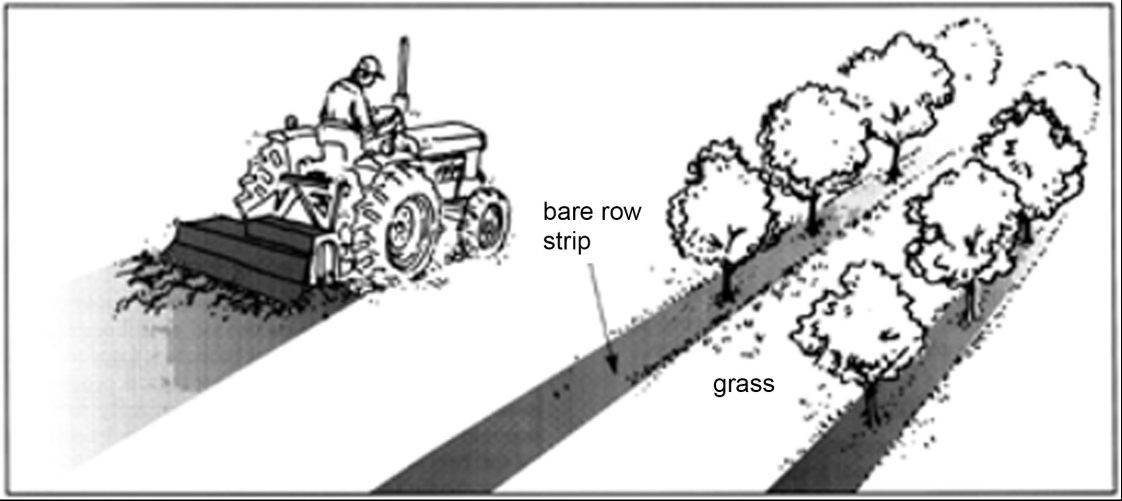
Figure 6. Mechanized tiller used to cultivate bare row strip
Most orchard floors have some type of vegetative cover, usually grass. This vegetation may cover the entire orchard floor or it may cover an area between the rows (row middle) with the area the length of the tree rows (row strip) being mulched or bare.
Vegetation growth must be controlled both in the row strips and row middles. In large commercial operations, vegetation in the row strips is controlled by spraying chemicals, mulching, or cultivating. Vegetation in the row middles is usually controlled by mechanical or chemical mowing.
In most home fruit gardens, weeds on the orchard floor between rows are controlled by mechanical mowing (figure 6). Broadleaf weeds and grasses in the row strips (along and around the plants) are most often managed by limited chemical treatment with safe herbicides, mechanical tillage or hoeing, hand pulling, or mulching. In most cases, a combination of these control measures is used. To avoid damaging plant roots, take special care when using tractor-mounted or hand-operated tillage equipment. Typically, the tillage depth in row strips should not exceed 1 to 2 inches. Avoid using tillage around tree fruits and especially in fall and winter months.
Harvesting Aids
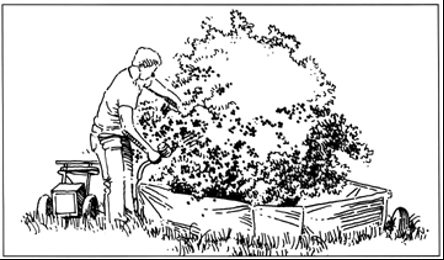
Figure 7. Catch frame and electric vibrator: harvest aid for blueberries
Most fruit in Alabama is harvested by hand. Some tree fruit crops have been developed on trellises, so harvesting them by hand is relatively easy. Harvesting aids have also been developed to assist in harvesting.
One small fruit crop on which harvesting aids are used is blueberries. The harvesting aids include a catch frame, vibrator, and power source (figure 7). These aids would be valuable to small commercial producers.
Mechanical harvesters are also available for large commercial acreages of blueberries. The harvesters are pulled or driven over the row. Mechanical harvesters range in size from a three-point hitch mount to a pull-type or a self-propelled harvester.
 Revised by Chip East, Extension Agent, Commercial Horticulture; David Lawrence, Extension Agent, Commercial Horticulture; Edgar Vinson, Assistant Extension Professor, Commercial Horticulture; and Elina Coneva, Extension Specialist, Professor, Horticulture, all with Auburn University. Originally written by Arlie Powell, former Extension Horticulturist; David Himelrick, former Extension Horticulturist; and Charles Ogburn, former Extension Agricultural Engineer, all with Auburn University
Revised April 2025, Fruit Culture in Alabama: Sprayers for Orchard Maintenance, ANR-0053-P