
Crop Production

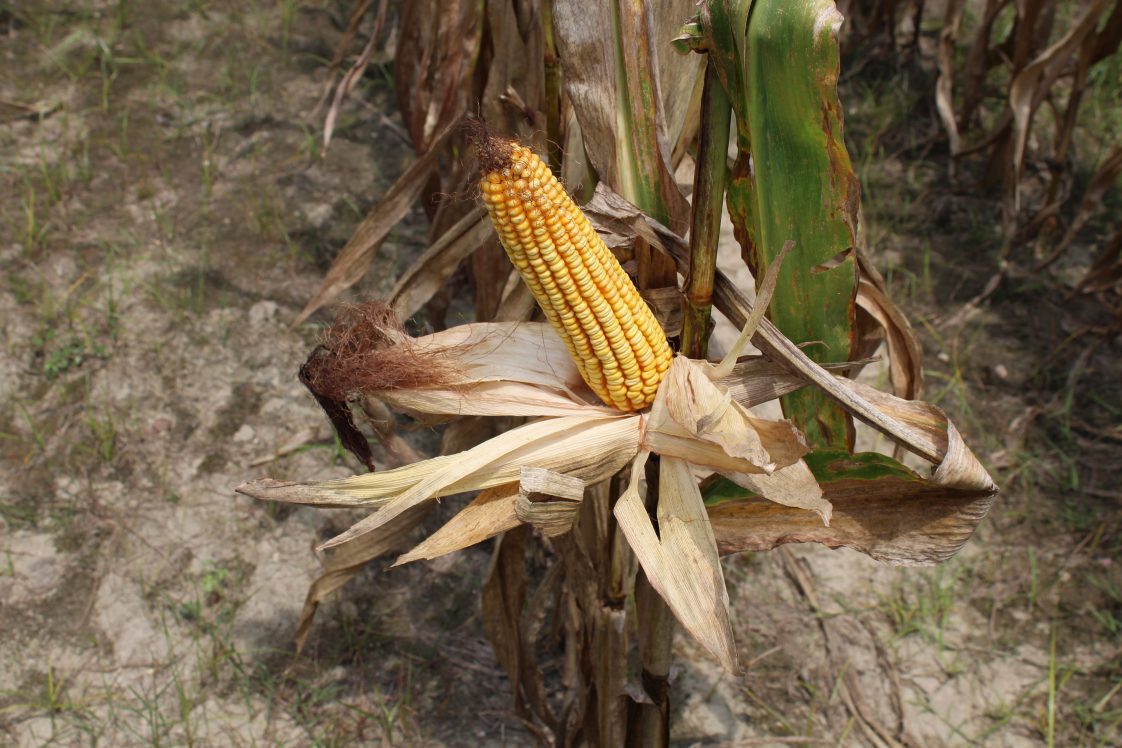
When corn is harvested for grain, nitrogen, phosphorus, potassium, and other nutrients are depleted from the soil. Understanding the extent of nutrient removal is vital because failure to replenish these nutrients can limit soil fertility. The rate at which nutrients are taken up is significantly influenced by the yield, which is affected by the amount of nitrogen (N) fertilizer applied. This publication reports on dryland corn nutrient removal rates as affected by the impact of nitrogen fertilizer rates in three production environments across Alabama.
Plant growth requires 17 essential mineral elements. These are carbon (C), hydrogen (H), oxygen (O), nitrogen (N), phosphorus (P), potassium (K), calcium (Ca), magnesium (Mg), sulfur (S), boron (B), zinc (Zn), manganese (Mn), copper (Cu), molybdenum (Mo), iron (Fe), chlorine (Cl), and nickel (Ni). Plants generally obtain these from the soil except for the elements C, H, and O, which come from air and water. Nine of these elements (C, H, O, N, P, K, Ca, Mg, and S), known as macronutrients, are required in relatively large quantities with plant concentrations measured in percentage. The remaining elements, known as micronutrients, are needed in much smaller amounts, with plant concentrations measured in parts per million (ppm). Regardless of the amounts required, all nutrients are important for crop production. For information about the specific roles of each essential element in plant growth and nutrient removal by crops, please refer to “Essential Plant Nutrients” and “Nutrient Removal by Alabama Crops” publications on the Alabama Cooperative Extension System website at www.aces.edu.
Most Alabama soils are low in macronutrients but contain adequate levels of micronutrients. Nitrogen is usually the most limiting nutrient for corn production. Unlike P, K, Mg, and Ca, which are applied based on soil test values, Auburn University N recommendations for corn are based on yield goals.
Most producers use a traditional thumb rule of 1.2 pounds of N for each bushel of corn. Many row crop producers in the state use broiler litter, which contains an average of 3 percent N, as a soil amendment but still apply the full standard N rate. Increasing the N rate substantially improves corn growth and yield. Sustained extraction of these essential nutrients over an extended period without replenishing them through external sources will ultimately lead to a decline in soil fertility. Therefore, knowledge of corn nutrient removal for current N fertilization practices is critical for optimum nutrition and sustainable grain production.
Nutrient uptake in dryland corn over a range of in-season fertilizer N rates (0, 75, 125, 175, and 225 pounds per acre) was evaluated at three Alabama locations: Wiregrass Research and Extension Center (WREC), Tennessee Valley Research and Extension Center (TVREC), and Gulf Coast Research and Extension Center (GCREC). The inorganic N source was 28 percent urea-ammonium nitrate (UAN) solution injected at the V6 growth stage, commonly known as knee high. Broiler litter was applied to the sites before planting at a rate of 2-tons per acre. Broiler litter used in the study had an average fertilizer grade of 2–2–2 (N–P2O5–K2O) expressed on an as-received (wet) basis.
Corn Nutrient Removal
Corn nutrient removal, a function of biomass yield and tissue nutrient concentration, increased as the fertilizer N rate increased at all locations, with the maximum nutrient removal occurring at 225 pounds of N per acre (table 1). Among macronutrients, N, P, and K exhibited greater total removal than Mg and S. The total accumulation of micronutrients (B, Zn, Mn, Fe, and Cu) in aboveground corn biomass was less than 1 pound per acre (data not shown).
The nutrient removal per bushel of corn also changes with the fertilizer N rate and the production environment. For example, at the highest rate of 225 pounds per acre N, corn removed 1.6 pounds of N per bushel at TVREC (North Alabama) compared to 1.2 pounds of N per bushel at GCREC (South Alabama). However, the removal of P, K, Mg, and S per bushel at each location did not change much among fertilizer N rates.
The agronomic optimum N rate (AONR) for grain yield, defined as the N fertilization rate at which maximum yield will occur, was found at 175 pounds per acre for all locations (data not shown). In general, as the N application rate increases, the magnitude of yield increment decreases and is zero beyond the AONR. At AONR for dryland corn in Alabama, a bushel of corn would need about 1 to 1.4 pounds of N (table 2).
Averaged across commonly used fertilizer N rates, i.e., 125, 175, and 225 pounds per acre and growing conditions, about 1.3 pounds of N, 0.76 pounds of P2O5, 0.84 pounds of K2O, 0.13 pounds of Mg, and 0.10 pounds of S are needed to grow a bushel of corn. In other words, a 200-bushel (per-acre) dryland corn will remove 260 pounds of N, 152 pounds of P2O5, 168 pounds of K2O, 26 pounds of Mg, and 20 pounds of S.
Harvest Index
The harvest index, which indicates the percentage of total uptake that occurred in grains of N, P, K, Mg, and S ranged from 38 to 75 (62, average), 28 to 68 (52), 19 to 45 (33), 29 to 50 (39), and 33 to 67 (53), respectively across locations (table 1). Nutrients with greater harvest index values are highly mobile and get translocated to corn grain from leaf and stem tissues during reproductive growth. More than half of total N and P uptake occurs in grain. As a result, soil N and P pools can get depleted faster by corn grain harvest.
Important Considerations
These results demonstrate how the fertilizer N rate and growing environment can influence corn nutrient removal. The positive effects of N fertilization on total or grain nutrient uptake necessitate a replacement strategy for grain yield optimization. Nutrients with greater total uptake (e.g., N, P, and K) or harvest index values (e.g., N and P) must be supplied where the soils are near or below critical fertility levels following the 4Rs of nutrient stewardship—right source, rate, place, and time. To ensure adequate availability of soil nutrients for corn growth, take representative soil samples before planting. Due to variability in nutrient removal rates among environments, plant samples should be collected at harvest for each field to accurately account for nutrients removed by corn stover and grain. Soil and plant tissue testing for nutrient contents can be done via the Auburn University Soil, Forage, and Water Testing Lab. When only actual yield is known, the amount of nutrients removed by corn grain harvest can be calculated from the nutrient removal rates per bushel shown in table 2. Nutrient removal and soil test levels are essential considerations in making fertilizer recommendations. Construct specific nutrient budgets such as a N budget to better understand nutrient cycling.
Table 1. Corn Total Uptake, Grain Removal, and Harvest Index of Macronutrients at WREC, TVREC, and GCREC During the 2021 Growing Season
1Harvest index is the percentage of total plant nutrient uptake that occurred in corn grains.
| Location | Fertilizer N Rate* | Total Uptake N* | Total Uptake P* | Total Uptake K* | Total Uptake Mg* | Total Uptake S* | Grain Removal N* | Grain Removal P* | Grain Removal K* | Grain Removal Mg* | Grain Removal S* | Harvest Index1 N (%) | Harvest Index1 P (%) | Harvest Index1 K (%) | Harvest Index1 Mg (%) | Harvest Index1 S (%) |
|---|---|---|---|---|---|---|---|---|---|---|---|---|---|---|---|---|
| WREC | 0 | 52 | 18 | 35 | 8 | 5 | 39 | 10 | 15 | 3 | 3 | 75 | 56 | 43 | 38 | 60 |
| 75 | 95 | 28 | 53 | 10 | 9 | 67 | 18 | 24 | 5 | 5 | 71 | 64 | 45 | 50 | 56 | |
| 125 | 120 | 29 | 58 | 10 | 10 | 85 | 18 | 25 | 5 | 5 | 71 | 62 | 43 | 50 | 50 | |
| 175 | 147 | 37 | 73 | 13 | 11 | 104 | 19 | 27 | 5 | 6 | 71 | 51 | 37 | 38 | 55 | |
| 225 | 160 | 40 | 92 | 13 | 12 | 111 | 22 | 29 | 6 | 6 | 69 | 55 | 32 | 46 | 50 | |
| TVREC | 0 | 141 | 47 | 95 | 10 | 12 | 54 | 13 | 18 | 4 | 4 | 38 | 28 | 19 | 40 | 33 |
| 75 | 178 | 54 | 100 | 21 | 16 | 86 | 20 | 26 | 6 | 6 | 48 | 37 | 26 | 29 | 38 | |
| 125 | 227 | 65 | 117 | 25 | 19 | 141 | 33 | 39 | 11 | 10 | 62 | 51 | 33 | 44 | 53 | |
| 175 | 284 | 82 | 139 | 31 | 23 | 153 | 34 | 40 | 12 | 10 | 54 | 41 | 29 | 39 | 43 | |
| 225 | 329 | 86 | 146 | 34 | 26 | 174 | 35 | 41 | 12 | 11 | 53 | 41 | 28 | 35 | 42 | |
| GCREC | 0 | 118 | 34 | 85 | 19 | 11 | 79 | 23 | 32 | 6 | 7 | 67 | 68 | 38 | 32 | 64 |
| 75 | 186 | 47 | 132 | 20 | 14 | 119 | 25 | 40 | 7 | 9 | 64 | 53 | 30 | 35 | 64 | |
| 125 | 203 | 46 | 137 | 20 | 14 | 125 | 27 | 41 | 8 | 9 | 62 | 59 | 30 | 40 | 64 | |
| 175 | 210 | 46 | 131 | 21 | 15 | 139 | 31 | 45 | 8 | 10 | 66 | 67 | 34 | 38 | 67 | |
| 225 | 230 | 54 | 150 | 23 | 18 | 138 | 28 | 44 | 8 | 10 | 60 | 52 | 29 | 35 | 56 |
Table 2. Corn Removal of Macronutrients Per Bushel Yield at WREC, TVREC, and GCREC During the 2021 Growing Season
*Pounds Per Bushel
Note: To calculate grain yield at a specific fertilizer N rate and location, divide total nutrient uptake (table 1) by nutrient removal (table 2).
| Location | Fertilizer N Rate (Pounds Per Acre) | Nutrient Removal N* | Nutrient Removal P* | Nutrient Removal K* | Nutrient Removal Mg* | Nutrient Removal S* |
|---|---|---|---|---|---|---|
| WREC | 0 | 0.9 | 0.30 | 0.58 | 0.13 | 0.08 |
| 75 | 1.0 | 0.31 | 0.58 | 0.11 | 0.10 | |
| 125 | 1.3 | 0.30 | 0.61 | 0.10 | 0.10 | |
| 175 | 1.3 | 0.34 | 0.66 | 0.12 | 0.10 | |
| 225 | 1.4 | 0.35 | 0.81 | 0.11 | 0.11 | |
| TVREC | 0 | 1.5 | 0.49 | 0.99 | 0.10 | 0.12 |
| 75 | 1.3 | 0.40 | 0.74 | 0.16 | 0.12 | |
| 125 | 1.2 | 0.35 | 0.63 | 0.13 | 0.10 | |
| 175 | 1.4 | 0.41 | 0.70 | 0.16 | 0.12 | |
| 225 | 1.6 | 0.43 | 0.73 | 0.17 | 0.13 | |
| GCREC | 0 | 0.9 | 0.25 | 0.61 | 0.14 | 0.08 |
| 75 | 1.1 | 0.27 | 0.75 | 0.11 | 0.08 | |
| 125 | 1.1 | 0.25 | 0.75 | 0.11 | 0.08 | |
| 175 | 1.0 | 0.23 | 0.65 | 0.10 | 0.07 | |
| 225 | 1.2 | 0.28 | 0.77 | 0.12 | 0.09 |
Suggested Resources
- Essential plant nutrients. Alabama Cooperative Extension System.
- Nutrient removal by Alabama crops. Alabama Cooperative Extension System.
- Nutrient recommendations for Alabama crops. Alabama Cooperative Extension System.
- Using a nitrogen budget in farm management. Alabama Cooperative Extension System.
 Rajveer Singh, Research Associate, and Rishi Prasad, Extension Specialist, Associate Professor, both in Crop, Soil, and Environmental Sciences, Auburn University
New November 2023, Corn Nutrient Removal: Nitrogen Rates & Broiler Litter Application, ANR-3043