
Crop Production

Citrus budding, or grafting, is an important tool in creating a plant that stands up to varying environmental conditions and grower goals. Because freeze injury is the most limiting factor for citrus production in Alabama, use of cold-hardy rootstocks is important. Knowing how to properly bud a citrus plant to achieve the desired fruit is essential for growers.
Budding or grafting is a technique used to join two plants so they grow as one. The upper portion is the scion, and the lower portion is the rootstock. In citrus, the scion is a detached bud, twig, or shoot from a known cultivar that produces the desired fruit. The rootstock produces the root system and is selected to provide benefits the scion may not have on its own. Depending on the rootstock, these benefits may include resistance to diseases, insects, or nematodes; tolerance of drought or wet soils; increased yield or fruit size; and reduced tree size (dwarfing). Citrus is commonly grafted using a single bud (budding).
Trifoliate orange (Poncirus trifoliata) is currently the only recommended rootstock for Alabama citrus production. It is among the most cold-hardy citrus rootstocks available and is often necessary for tree survival during freeze events (figure 1). When used as a rootstock for satsuma mandarins, trifoliate orange can add up to 5 degrees F of cold tolerance, allowing dormant trees to tolerate temperatures as low as 15 to 18 degrees F rather than 20 to 23 degrees F. In comparison, satsumas grown with Swingle citrumelo (X Citroncirus spp.) as a rootstock do not add any degree of cold tolerance to the scion.
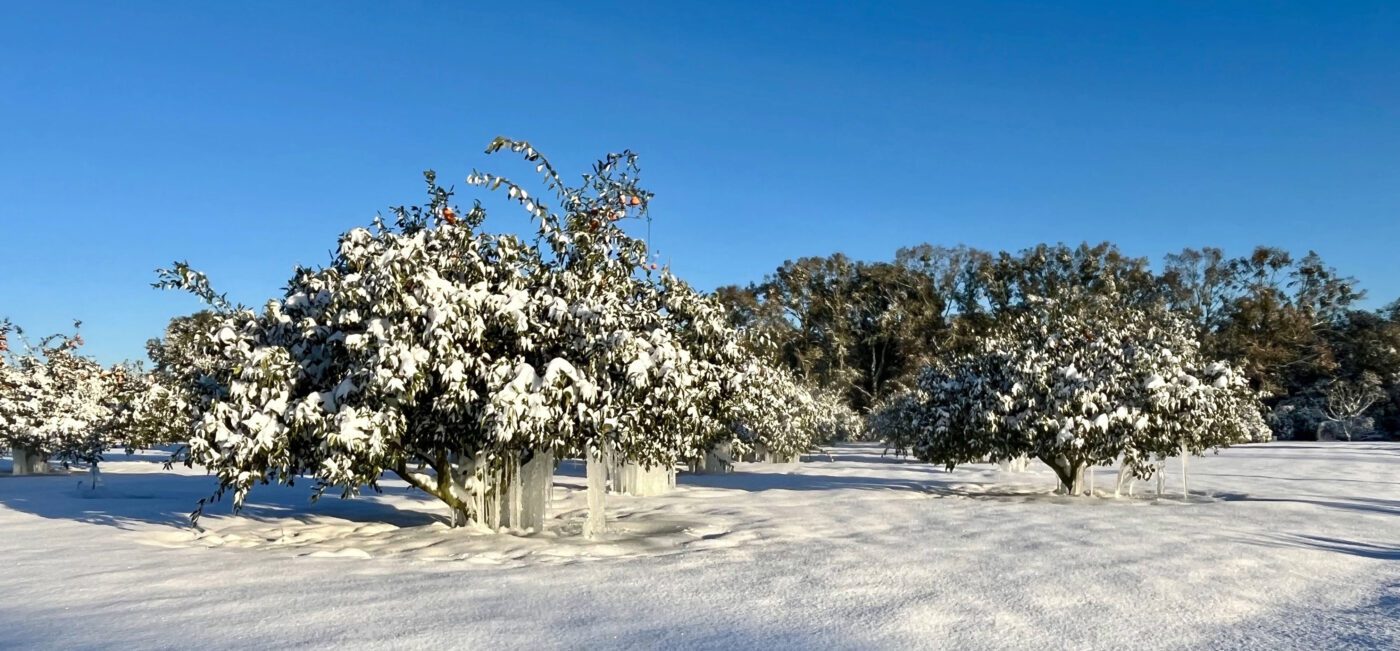
Figure 1. Satsuma trees during the January 2025 snow and freeze event. These trees survived and went on to produce fruit.
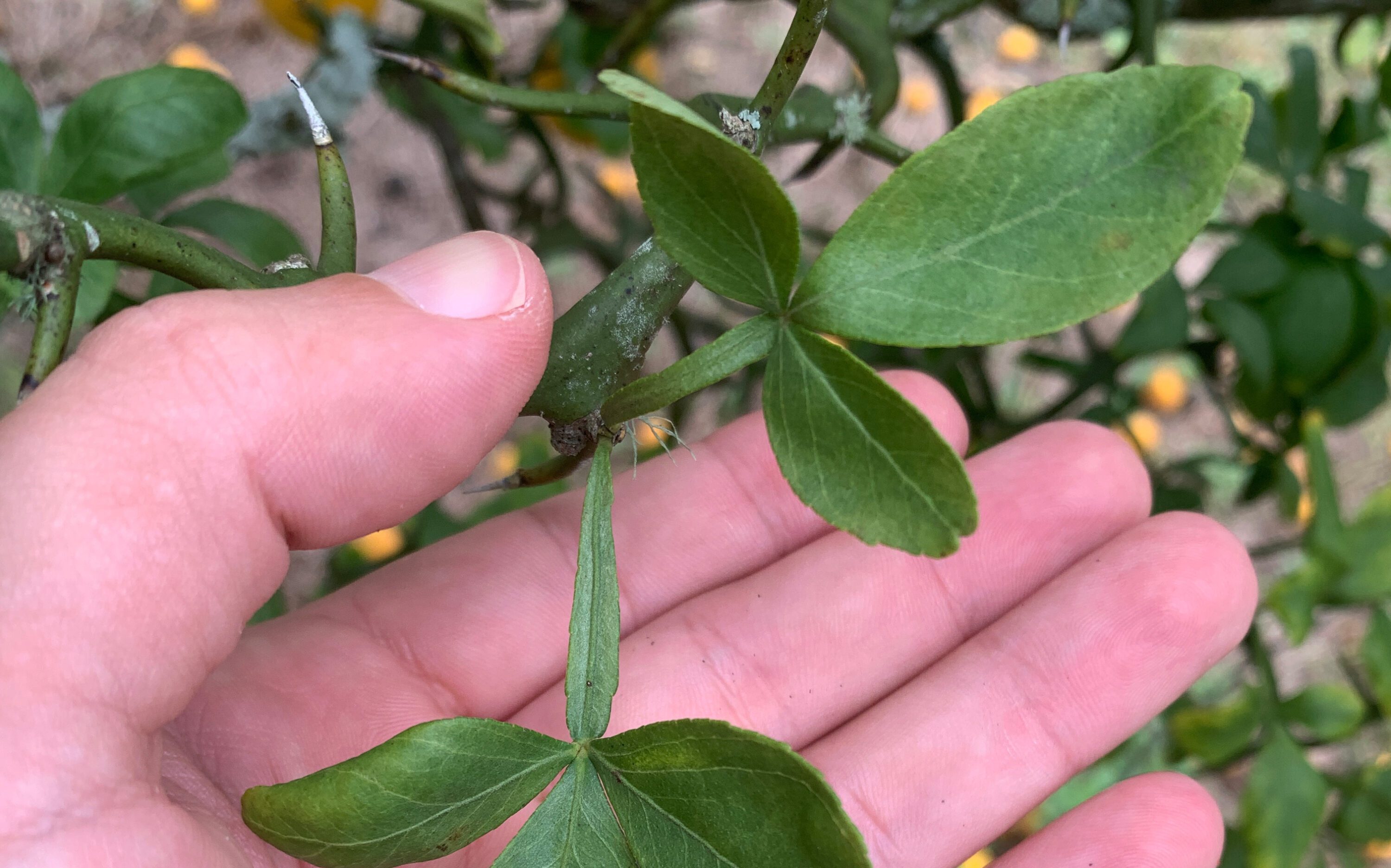
Trifoliate orange is deciduous, and dormancy is triggered by daytime temperatures consistently below 70 degrees F. Leaves are compound with three leaflets (the center leaflet isusually the longest). Trifoliate orange (figure 2) produces abundant seed and may be invasive in some areas. The fruit is not considered edible. Rootstocks are typically produced from seed.
Two cultivated trifoliate orange selections are commonly used as rootstock: ‘Rubidoux’ and ‘Flying Dragon’. ‘Rubidoux’ is the most common choice for commercial growers in the region due to its vigor and growth habit. Mature trees grafted to ‘Rubidoux’ rootstock may reach about 15 feet tall. ‘Flying Dragon’ is a dwarfing selection used for high-density plantings and is well suited for many trees intended for residential landscapes. Trees grafted to ‘Flying Dragon’ often range from 6 to 8 feet tall. Both selections can produce thorns 1 to 2½ inches long. Thorn shape can help distinguish between the two: ‘Rubidoux’ typically has straight thorns; ‘Flying Dragon’ has curved “fish-hooked” thorns (figure 3).
-
- Figure 2. Trifoliate orange has a compound leaf with three leaflets.
-
- Figure 3. “Fish-hooked” thorns of ‘Flying Dragon’.
The citrus industry faces several devastating diseases, so it is important to start with clean plant material before grafting. Alabama and many surrounding states are under citrus quarantine. Plant material entering or leaving the state will be subject to testing by the Plant Protection Division of the Alabama Department of Agriculture and Industries (ADAI). For more information on quarantine and relevant diseases, see “Citrus Tree Care for the Home Gardener” on the Alabama Extension website at aces.edu or visit the ADAI website. The National Clean Plant Network for Citrus provides information on sourcing certified clean plant material and should be consulted when acquiring budwood or other citrus propagation material.
When to Bud Citrus
Citrus budding is typically done during the growing season when bark is “slipping” (generally May to August). Bark is considered slipping when the plant is actively growing, and the bark separates easily from the underlying wood. Bud take is usually highest during this period. Chip budding can be performed any time of year when the rootstock bark is not slipping. To bud citrus, the following tools and materials are needed (figure 4):
- A sharp budding or grafting knife (a box cutter can work)
- Polyethylene budding tape
- Rootstock plants
- Budwood from the desired cultivar
- Labels and a permanent marker
-
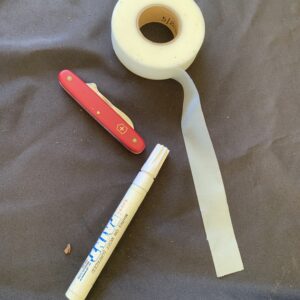
- Figure 4. Tools required for citrus budding.
-
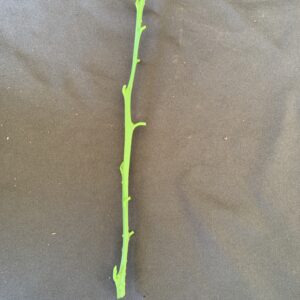
- Figure 5. Straight budwood stick for grafting.
-
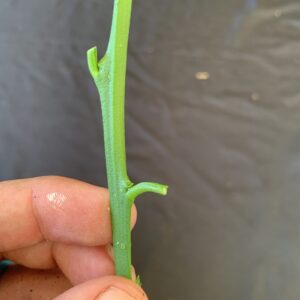
- Figure 6. Recently matured buds are ready to be grafted. The lower bud is on a more rounded stem and is more mature. The top bud is on a more angular stem and is less mature.
Budwood Selection
Budwood selection is the foundation of a successful graft union. Collect budwood from healthy, disease-free plants to increase success and reduce the risk of spreading pests and diseases. Budwood is typically taken from the most recently hardened (mature) flush of growth; these twigs are more rounded and less angular than new growth. Choose straight shoots with well-formed buds in the leaf axils from the desired cultivar (figures 5 and 6). Ideally, budwood diameter should be similar to the rootstock stem diameter.
After collecting budwood, trim twigs to 8 to 10 inches. Remove leaves and thorns, leaving about 1/8 to 1/4 inch of petiole to help handle and protect the bud. Label budwood with the cultivar and collection date. Store budwood with a damp paper towel (not dripping) in a sealed polyethylene bag in a refrigerator at 32 to 40 degrees F for up to 2 weeks. For best results, collect budwood and use it as soon as possible.
T-Budding
T-budding is a simple, high-success method when the rootstock bark is slipping and fresh budwood is available. Start with a clean budding knife or razor blade. Make a vertical cut through the bark, about 1 to 1½ inches long, on a smooth section of the rootstock stem. Next, make a horizontal cut at the top (regular T) or bottom (inverted T) of the vertical cut. Use the knife tip to gently lift the bark flaps along both sides of the vertical cut.
To cut the bud, hold the budstick with the apical end (tip) facing you. Place the knife blade nearly parallel to the budstick about 1/2 inch below the selected bud. Make a smooth cut toward the bud, passing under it, and continue until the blade is about 1/2 to 3/4 inch above the bud. Then make a second cut at about a 45 degree angle to free the bud from the budstick. The finished bud piece should include the bud and a thin sliver of wood beneath the bark (figure 7).
Handle the bud by the remaining leaf petiole. Touching the cut surfaces can reduce success. As soon as possible, slide the bud under the bark flaps on the rootstock. The bud should be fully enclosed by the T-cut, with only the bud and petiole exposed (figure 8). Wrap the union with budding tape, starting about 1/2 inch below (or above) the incision, and cover the entire cut area. Keep firm pressure while wrapping to prevent movement and ensure good bud-to-rootstock contact (figure 9).
Finish by tucking the tape end under the last wrap so it does not unravel (figure 10). To see T-budding in action, visit Alabama Extension on YouTube and search for Citrus Budding with Alabama Extension.
-
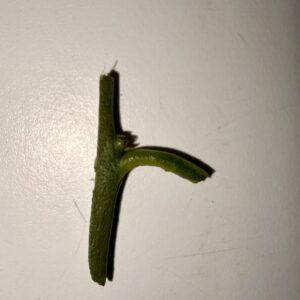
- Figure 7. Loose bud ready to insert into T-bud graft (approximately 1 inch).
-
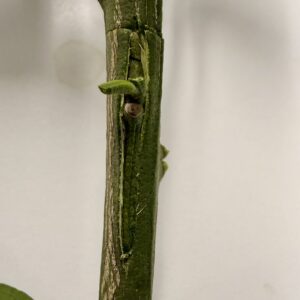
- Figure 8. T-bud after the bud is set and ready for taping. (approximately 1 inch).
-
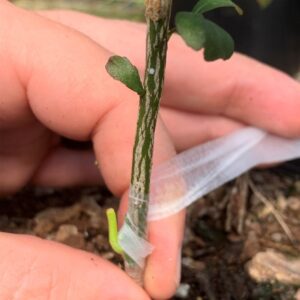
- Figure 9. Wrap graft with budding tape. Be sure to keep constant pressure applied as the graft is wrapped.
-
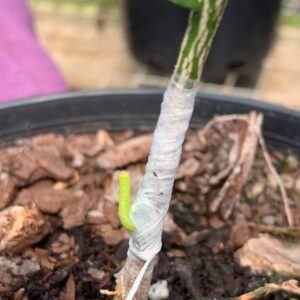
- Figure 10. Finished graft ready with tape.
Chip Budding
Chip budding can be used when the bark is not slipping or when T-budding is not feasible. It often requires more practice to achieve consistent success. Hold the budstick with the apical end facing you. Make the first cut below the bud at about a 45 degree angle, cutting into the wood. Then make a second cut above the bud and “scoop” downward to remove a chip that contains the bud (figure 11). Make a matching set of cuts on the rootstock to create a notch for the bud chip to sit in (figures 12 and 13).
For best results, match the cuts closely so that the cambium layers align. The cambium is a thin, actively growing layer located where the bark meets the wood. Successful budding requires cambium-to-cambium contact between the bud and rootstock. If both sides cannot be aligned, align the cambium on at least one side. Wrap the union with budding tape as with a T-bud, keeping firm pressure so that the bud stays in place.
-
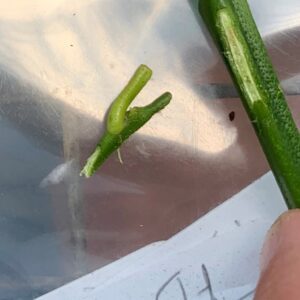
- Figure 11. Free bud ready for chip budding.
-
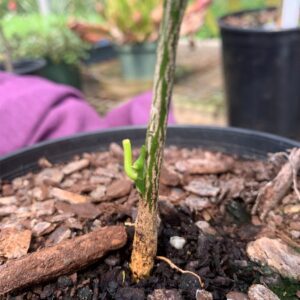
- Figure 12. Bud sitting in seat of chip bud (side view).
-
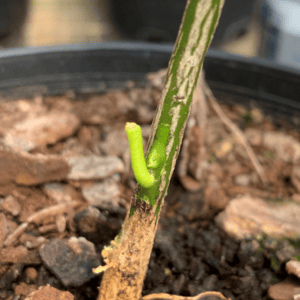
- Figure 13. Chip bud firmly seated and ready for taping (front view).
-
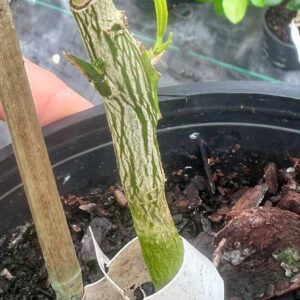
- Figure 14. Grafted bud beginning to grow.
Aftercare
Leave buds wrapped for 3 to 4 weeks. After removing the tape, callus tissue should be visible around the cut edges, and the bud should remain green. Buds often need to be “forced” by reducing apical dominance. The hormone auxin is produced in actively growing shoot tips and moves downward, suppressing buds below, including the newly inserted bud.
Two common ways to reduce apical dominance are to (1) make a cut about two-thirds through the stem above the bud and bend the top over, or (2) bend the top into a loop to slow auxin movement. Removing the entire top above the bud is not recommended because it can reduce the photosynthates needed for healing and may lower success rates. If the bud is still green but not growing after several weeks, remove the top of the rootstock to force the bud to break and grow.
Once the bud has produced a shoot that is at least 6 inches long (figure 14), cut the remaining rootstock back to about 1/4 to 1/2 inch above the bud union. Stake new shoots to keep them upright. Remove any suckers that originate from the rootstock. Plant the new tree when the shoot reaches about 24 inches tall, then pinch (or remove) the tip to encourage branching.

Jacob Kelley, Extension Agent, Commercial Horticulture, and Morgan O’Neill, Extension Intern, both with Auburn University
New July 2026, Citrus Budding: A Step-by-Step Guide, ANR-3275
For more information, contact your county Extension office. Visit aces.edu/directory.
Trade and brand names used in this publication are given for information purposes only. No guarantee, endorsement, or discrimination among comparable products is intended or implied by the Alabama Cooperative Extension System.