
Crop Production

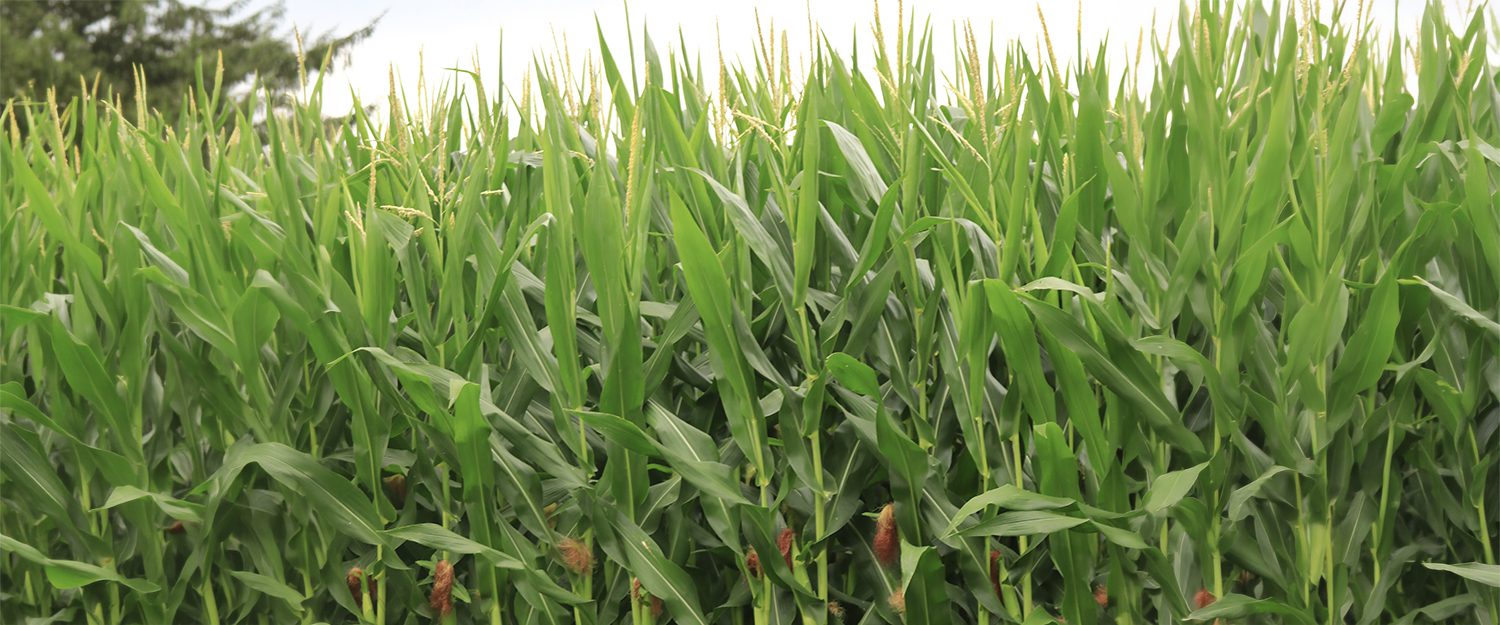
Nitrogen (N) is the most important nutrient in corn production and one of the largest fertilizer investments for growers. It is the second most impactful factor in corn yield (26%), after weather (27%), and followed by hybrid (19%), previous crop (10%), plant population (8%), soil tillage (6%), and growth regulator (4%). Because N is also highly vulnerable to loss, improving nitrogen use efficiency (NUE) is essential for increasing yield and profitability and maintaining the sustainability of the agroecosystem.
Corn requires large amounts of N to support vegetative growth, ear development, and grain filling. It usually takes 1.3 pounds of N to produce one bushel of corn. Nitrogen rate should be based on yield potential, and growers should consider soil and environmental conditions, including soil organic matter (SOM), previous crop (soybean, peanut, cover crops, etc.), residue levels, irrigation, and expected yield. Auburn University recommends up to 200 pounds N/A on dryland and 250+ pounds N/A under irrigation and a ratio of 0.9 to 1.25 pounds of N per expected bushel of corn. When using this ratio, the rate should be adjusted according to the soil and environmental conditions mentioned above, seeking better N use efficiency.
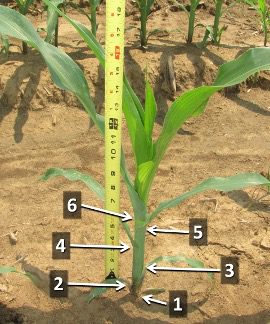
Figure 1. Corn plant at V6 or “knee high” (six expanded leaves with visible collars).
However, crop response to N is influenced not only by the amount applied but also by weather, hybrid selection, soil conditions, previous crop, plant population, and management practices. Nitrogen that is not taken up by the crop may be lost through leaching, denitrification, volatilization, or runoff. For that reason, efficient N management is not simply about applying more fertilizer. It is about supplying the crop with enough N, in the right way and at the right time, to meet crop demand while minimizing losses.
Corn takes up 70% of its total N by R1 (silking), with a peak demand around V10 to V14 (ten to fourteen expanded leaves). Front-loading all N at planting may increase the risk of loss or reduce efficiency. Auburn University recommends splitting N rate 30% at planting and 70% at V6 (six expended leaves, also known as “knee high”; figure 1) to mitigate potential losses and maximize N efficiency. In a study conducted at three locations in Alabama evaluating the timing of N application under irrigated and dryland conditions, the results indicated that the timing of N application had a significant impact on corn yield. The treatments tested different timing of N application, ranging from early (all at planting) to late (up to silking) split applications using a constant rate of urea at 200 pounds N/A, with a control with no N applied. Despite yield differences among locations, corn response was similar, resulting in higher yields when the N rate was split, with 25% at planting and 75% at V6.
Splitting N helps reduce potential losses and better matches crop uptake. Strategies could include preplant + sidedress, starter + sidedress, preplant + Y drop at V6-V10, or application in multiple small doses. While the majority of N should be applied before reproductive stages, small-dose applications can be applied via an irrigation system after R1 in some cases (e.g., when losses occur or to guarantee a high level of N supply to a crop in a high-yield environment). A single big application is rarely the most efficient or profitable way.
Important Considerations
There are multiple N fertilizers on the market with distinct characteristics regarding composition and potential loss. To identify the best option for each condition, it is important to understand the major N-loss pathways. Nitrogen can be lost from the soil through leaching (nitrate—NO3—moves downward with water), denitrification (anaerobic soils result in conversion of NO3 to gas), volatilization (surface-applied fertilizers can be lost as ammonia gas), and runoff (surface loss of N). Some common N fertilizers and their restrictions include the following:
- Urea (46% N, granular): most economical but must be incorporated mechanically or via water to prevent volatilization. The rule of thumb is to apply urea 48 hours before a rainfall event, via irrigation, and on dry soil. Urea inhibitors can be applied to reduce ammonia loss.
- UAN (28% to 32% N, liquid): versatile but also prone to volatilization; it can carry sulfur around 5%. Urea inhibitors can also be applied to reduce ammonia loss.
- AMS (21% N, granular): volatilization free but lower N concentration. It carries sulfur (24% S) along, which is an advantage for crop nutrition. Its long-term use can promote soil acidification.
- Anhydrous ammonia (82% N, gas): stable, high concentration, low loss risk when sealed, but dangerous to apply.
- Manure/organic N: slow release, variable concentration (2% to 5% N), and availability.
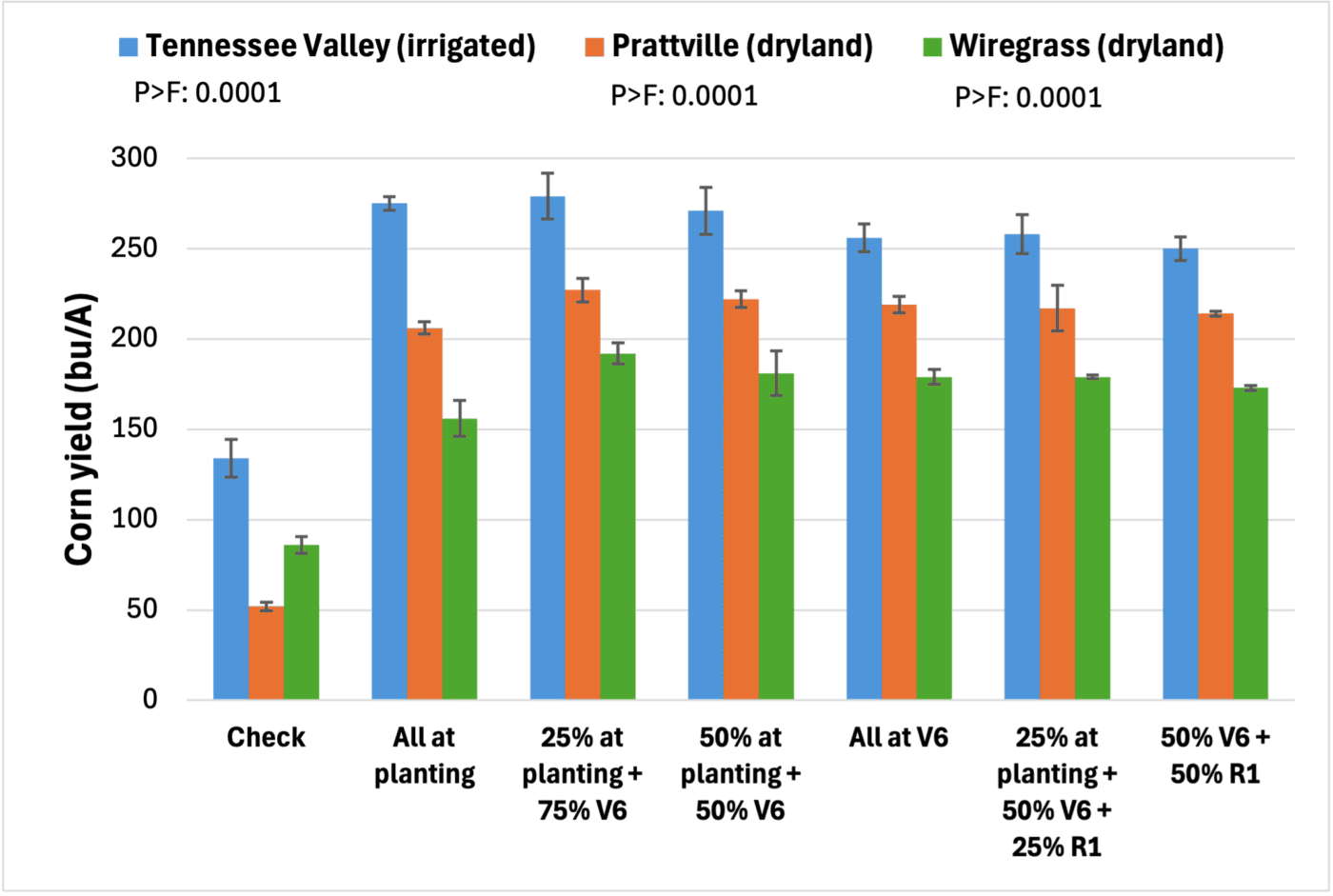
Figure 2. Corn yields in response to different timing of N applications in three locations in Alabama. Error bars represent one standard deviation for each location separately.
The most effective placement method depends on the N source, soil conditions, equipment, and growth stage. Incorporating or injecting fertilizer can reduce volatilization risk compared with placing fertilizer on the soil surface. Fertilizers can be injected or incorporated to reduce volatilization; banded or side-dressed near the root zone; Y-dropped to target the base of the plant during peak demand; or applied via irrigation systems. Placement decisions should be based on practical field conditions. For example, surface-applied N without timely rainfall or irrigation can be risky, especially with urea-containing materials. Likewise, the value of injection, side-dressing, Y-drop, or fertigation depends on equipment availability and labor needed to make timely applications. Matching source and placement is a key part of improving NUE.
Several additional factors strongly influence how efficiently corn uses N, including the following:
Soil Type and Drainage
Soil characteristics greatly affect N behavior in the field. Sandy soils are more prone to leaching, so split applications are often beneficial. Clay or poorly drained soils have greater risk of denitrification, especially under prolonged wet conditions, so high doses of preplant N applications may be less efficient. Soils with higher organic matter can contribute more N through mineralization, which may reduce the amount of N fertilizer needed.
Hybrid Selection
Corn hybrids differ in their ability to take up and use N efficiently. Some hybrids respond better to late-season N applications, while others may require higher plant populations and more aggressive nutrient management to reach maximum yield. When possible, N management should be aligned with hybrid characteristics and yield goals.
Weather Conditions
Weather is one of the most important drivers of NUE. Warm, wet springs increase the risk of N loss, while dry early-season conditions may reduce losses but can also delay crop uptake. Because weather patterns are unpredictable, flexibility is important. Nitrogen programs that include split applications or in-season adjustments are often better suited to variable conditions than one-time applications. Several tools can help growers make better N decisions during the season. These include the following:
- Plant tissue testing
- Chlorophyll meters
- Drone or aerial imagery
- Soil nitrate or soil moisture sensors
These tools can provide additional information on crop status and field variability, helping growers refine N timing or rates when conditions change. Although not every tool fits every operation, they can improve decision-making when used with sound agronomic recommendations.
Practical Takeaway Notes
- Front-loading all your N at planting can result in losses and reduce efficiency.
- A single, big application is rarely the most efficient or profitable.
- Wet springs and poorly drained soils require more flexibility.
- Match the source to your soil, equipment, and timing—not just price.
- Match N strategy to hybrid characteristics when possible.
- Adaptive N strategies (sidedress, Y-drop, in-season testing) outperform fixed plans.
- Make N management decisions based on yield goals and local conditions.
References
- Auburn University. (2020). Nutrient recommendations for Alabama row crops. 20p.
- Bender, R.R., Haegele, J.W., Ruffo, M.L., Below, F.E. (2013). Nutrient uptake, partitioning, and remobilization in modern transgenic insect-protected maize hybrids. Agron. J. 105:161-170. doi:10.2134/agronj2012.0352.
- Fred Below. Seven wonders of the corn yield world.
- Singh, R. and Prasad, R. (2023). Corn nutrient removal: nitrogen rates and broiler litter application. ANR-3043.

Eros Francisco, Extension Grain Crops Specialist, Assistant Professor; Emmanuel Abban-Baidoo, Postdoctoral Fellow; and Nina Higuchi, Graduate Research Assistant, all in Crop, Soil, and Environmental Sciences, Auburn University
New September 2026, Best Timing for Nitrogen Application in Corn Production, ANR-3294
For more information, contact your county Extension office. Visit aces.edu/directory.
Trade and brand names used in this publication are given for information purposes only. No guarantee, endorsement, or discrimination among comparable products is intended or implied by the Alabama Cooperative Extension System.