
Coastal Programs

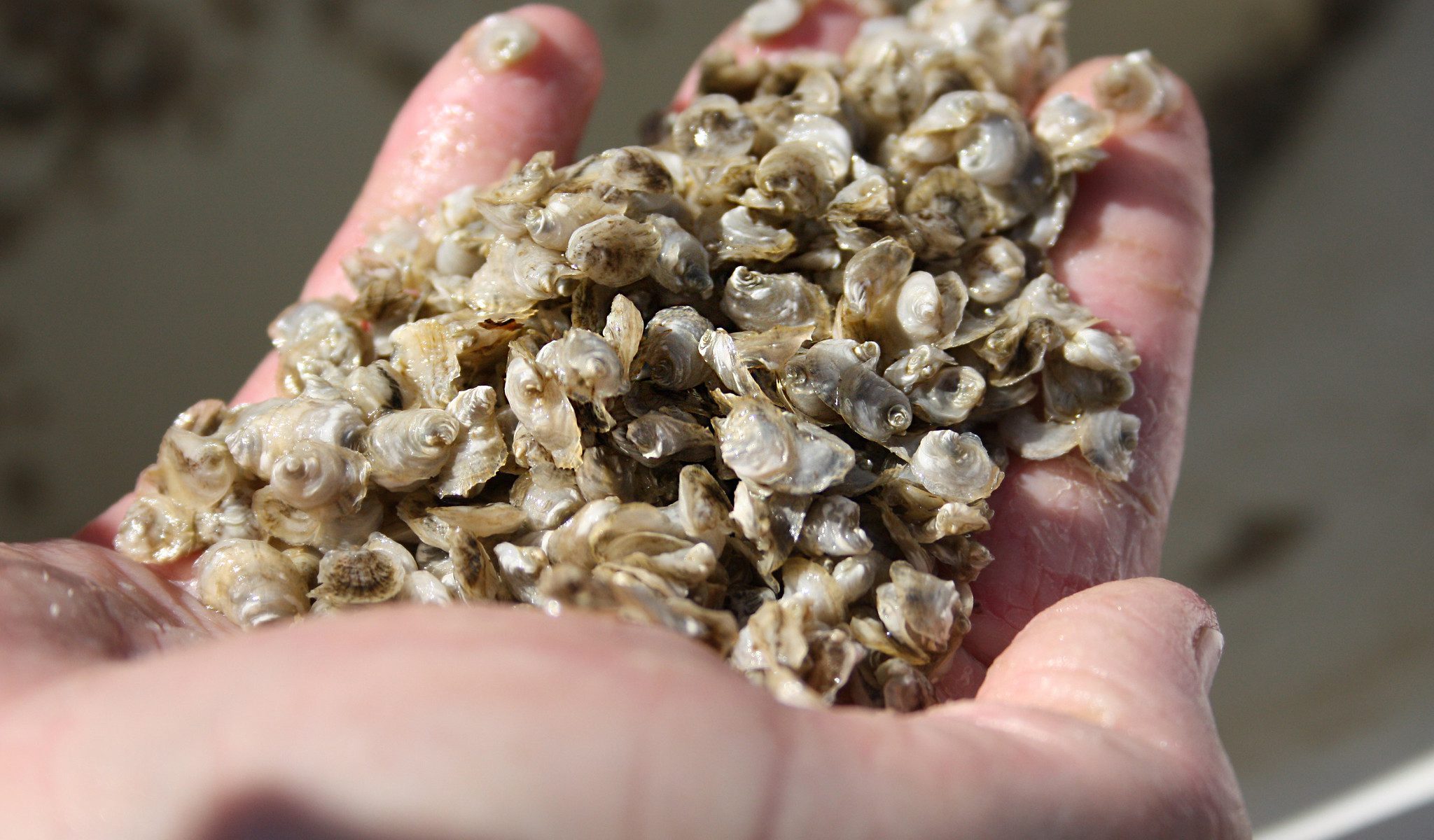
Learn definitions for the various life stages of oysters and how they are used for different purposes.
The process for producing oyster seed for commercial oyster farming starts in a hatchery. Broodstock, or adult breeding oysters, are induced to spawn by changing water temperatures between warm and cool cycles and introducing natural chemical cues into the spawning tanks (figure 1).
The eggs and sperm (figure 2) released from the broodstock are mixed at the proper ratio for fertilization. Within 12 hours, the fertilized eggs will become free-swimming larvae called trochophores. Within 1 day, the larvae often become veligers. The term veliger originates from the Latin words velum, meaning “sail,” and gerere, meaning “to carry.” Veliger larvae are so named because they carry a sail-like structure called the velum, which is used for both swimming and feeding.
Veliger larvae are reared in tanks in a hatchery where larvae are fed phytoplankton (figure 3), and water quality is maintained until veligers become pediveligers and have developed a foot structure (in Latin, pedis means “foot”). The foot is used to crawl around surfaces, looking for a good spot to attach. Once that spot is selected, oyster larvae use a cement-like substance to permanently attach themselves in a process called setting.
-
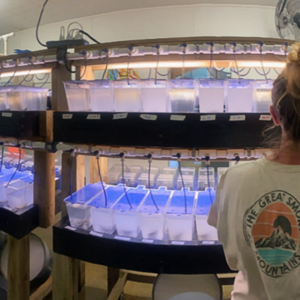
- Figure 1. Spawning tanks
-
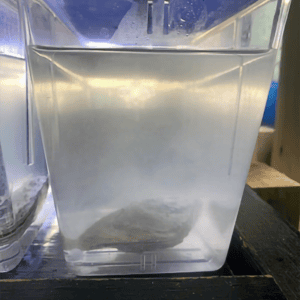
- Figure 2. Sperm from spawning oyster
-
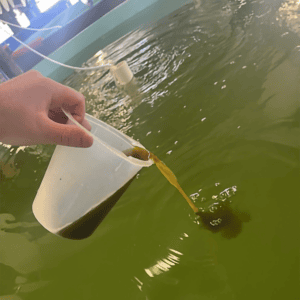
- Figure 3. Feeding phytoplankton to oyster larvae
Spat
Once oyster larvae are set or attached to a surface, they are called spat. What surface the larvae attach to and how they grow after setting determine how they are referred to past this stage.
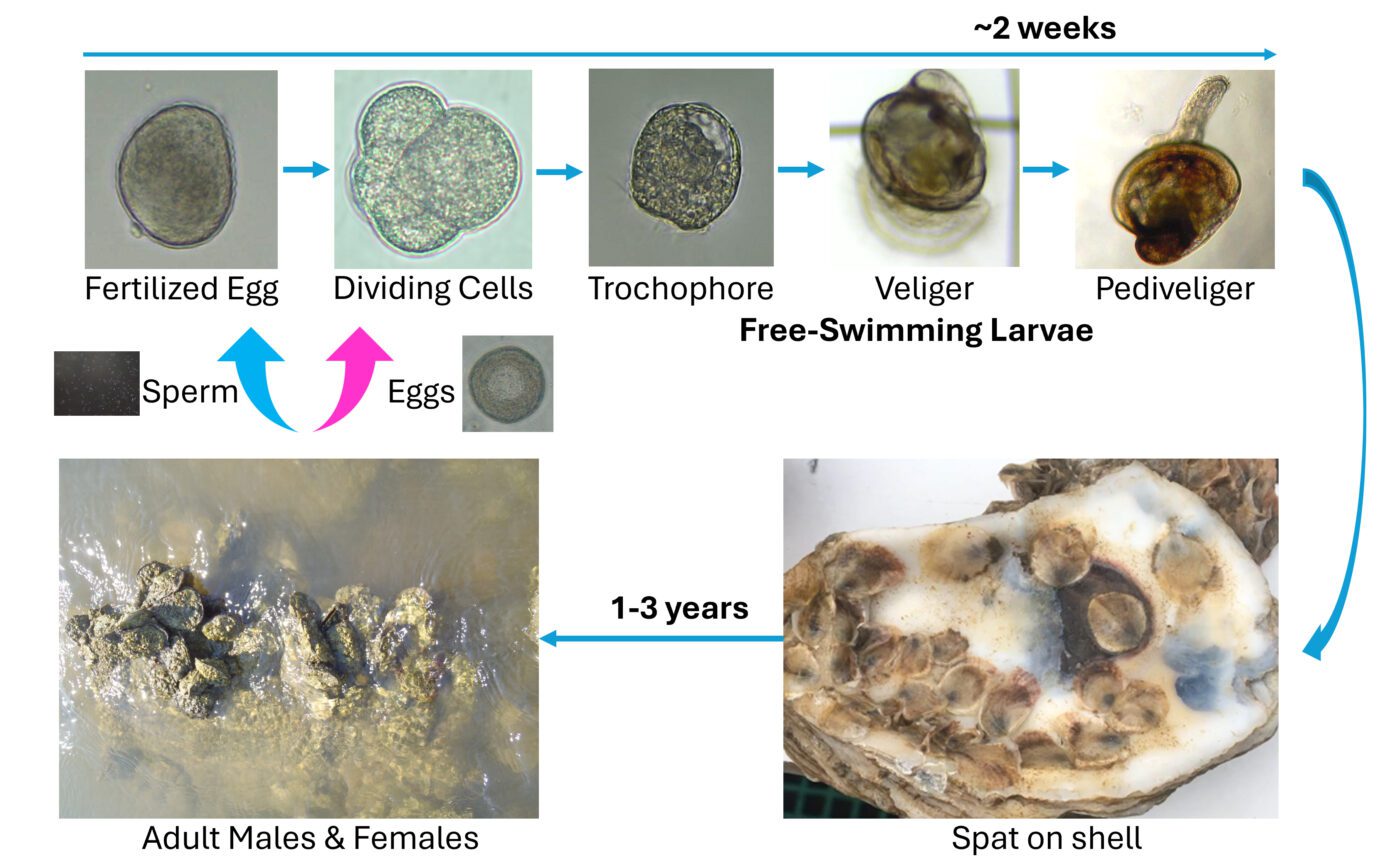
Oyster Life Cycle
Seed
To generate single oysters desired by the commercial aquaculture industry, oyster hatcheries place pediveligers in tanks with a layer of micro-culch, or very small (about 250 to 300 microns) pieces of oyster shell, on the bottom. Each oyster larva is slightly smaller than the size of one piece of micro-cultch, so there is only space for one larva to attach. This prevents other larvae from attaching to the same piece. Once set, the spat grows into individual oysters, referred to as seed (figure 4). Seed are raised in a nursery until they reach the desired size for customers, which is usually 6 to 9 millimeters and priced by the thousand. Some hatcheries sell oyster larvae to nursery operators that take on the cost and associated risk of setting to raise them to these desired sizes.
Spat on Shell
Pediveligers may also be exposed to cured oyster shells, which have been exposed to sunlight and the outdoors to ensure that they are clean. In this case, many spat can adhere to the same oyster shell, producing spat on shell (SoS) figure 5). As the oysters grow, a cluster is produced similar to oysters found on wild oyster reefs. These are used for restoration projects, educational oyster gardening programs, and on-bottom oyster culture for consumption.
Florets
Florets (figure 6) is a relatively new term used to describe the process of placing SoS in cages for protection from predators until they have grown into remarkable little living reef ecosystems that resemble broccoli or cauliflower florets. The idea was put forward as a more marketable name than the term clusters since they can be grown in large quantities using commercial oyster farming systems.
-
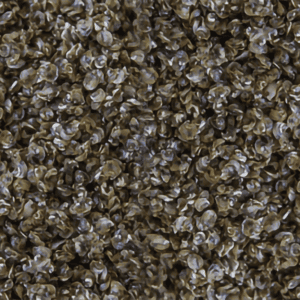
- Figure 4. Oyster seed
-
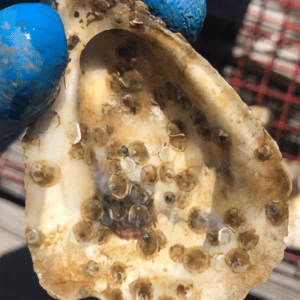
- Figure 5. Spat on shell
-
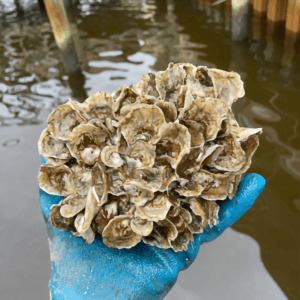
- Figure 6. Oyster floret
Oyster florets can be produced in one growing season and when ready for deployment, the juvenile oysters are about an inch (25 mm) long with an average of eleven per floret. Research funding has been awarded to evaluate how florets and other oyster reef restoration techniques compare in order to get the best return on investment. Recently, funding has been awarded to evaluate how these florets and other oyster reef restoration techniques compare to determine the best return on investment. Other proposals are in the works to determine the cost of manufacturing florets in a commercial setting, conduct a market assessment, and determine whether the production of florets for restoration could be another revenue stream for the oyster aquaculture industry.
In conclusion, spat are newly attached oysters that, when grown individually, are called seed. However, when grown as multiple individuals on a shell, they are referred to as spat on shell. As spat on shell grows, it makes florets that are small-scale oyster reefs. When used for restoration, they will grow to generate an oyster reef ecosystem. In all cases, oysters continue to provide benefits such as water filtration and habitat for small and large aquatic creatures.

Russell Grice, Extension Specialist, Aquaculture Business, Auburn University Shellfish Lab, Mississippi Alabama Sea Grant Consortium, and Andrea Tarnecki, Assistant Extension Professor, Auburn University Shellfish Lab, both with Auburn University
New July 2026, Seed, Spat, SoS, Florets—What Are We Talking About Here?, ANR-3278
MASGP 26-028
This work was supported by the Mississippi-Alabama Sea Grant Consortium, National Oceanic and Atmospheric Administration, U.S. Department of Commerce, and the states of Alabama and Mississippi. Federal grant number NA24OARX417C0155-T1-01. The statements, findings, conclusions, and recommendations are those of the authors and do not necessarily reflect the views of any of these funders.
For more information, contact your county Extension office. Visit aces.edu/directory. Trade and brand names used in this publication are given for information purposes only. No guarantee, endorsement, or discrimination among comparable products is intended or implied by the Alabama Cooperative Extension System.