
Aquaculture

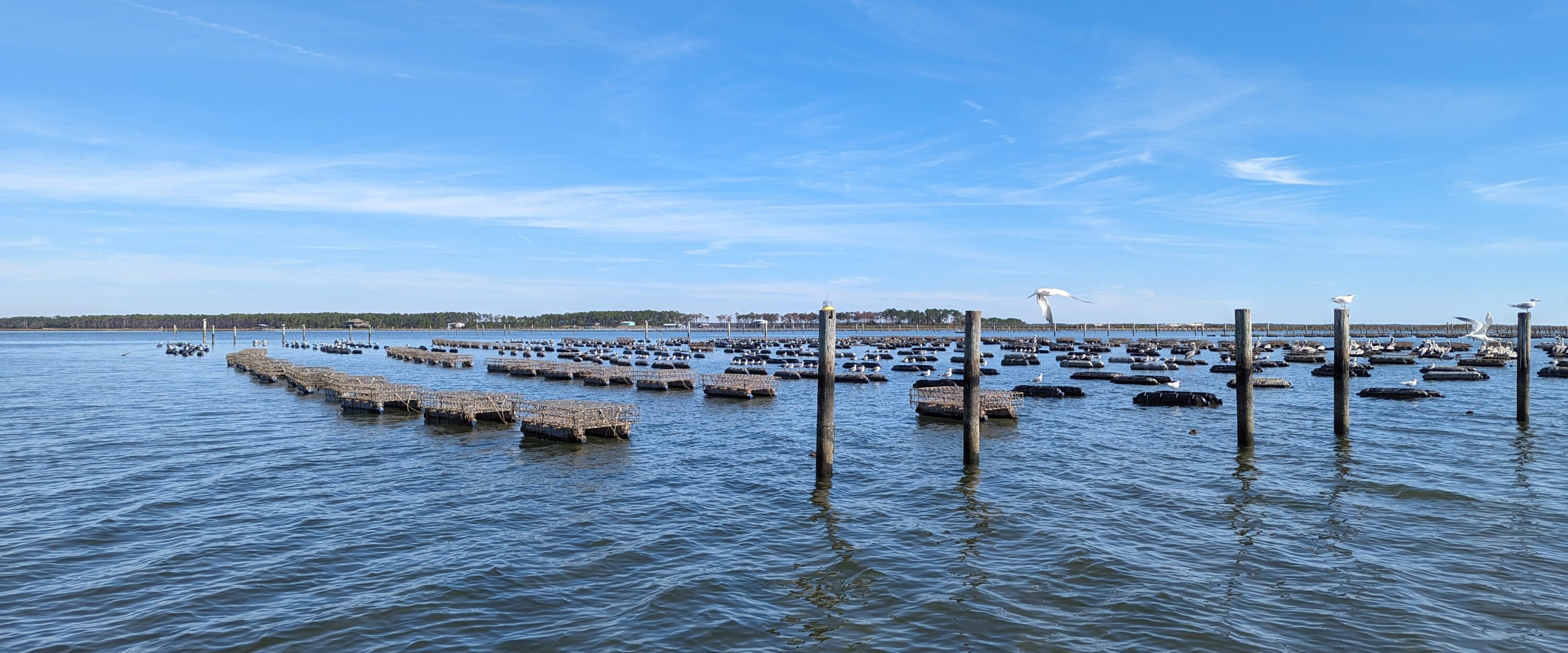
Alabama’s shellfish aquaculture industry produces eastern oysters (Crassostrea virginica) through off-bottom farming techniques, including adjustable long-line and floating cage systems. The 2025 Alabama oyster production trends and industry activity are summarized in this report.
Highlights for 2025
- Thirteen commercial oyster aquaculture operations reported harvests in Alabama, which was the same as 2024.
- Nine operations provided 2025 harvest numbers and prices, down one from 2024.
- An estimated 7.1 million farmed single market oysters were harvested, a reduction of approximately 3 million from the previous year.
- Price realized ranged from 25 cents to 67 cents each with an average of 49 cents each, down 7 cents from 2024.
- An estimated value of $4.0 million for Alabama oyster aquaculture based on the number of oysters sold and average price realized.
- Two commercial hatcheries and two commercial nurseries were operational in Alabama.
- Sixty-seven acres were permitted for commercial oyster aquaculture with an estimated 57 acres used in production.
Alabama Farmed Single Market Oysters
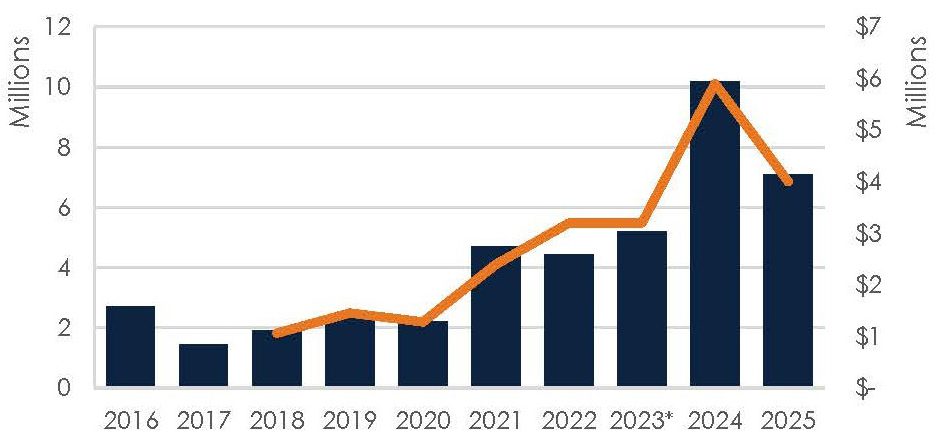 Harvested by Year
- 2016: 2,698,755 million
- 2017: 1,460,513 million
- 2018: 1,921,586 million
- 2019: 2,425,000 million
- 2020: 2,208,134 million
- 2021: 4,711,166 million
- 2022: 4,451,015 million
- 2023: 5,200,000 million*
- 2024: 10,197,403 million
- 2025: 7,100,000 million
*2023 estimate based on meat pounds reported from the Alabama Department of Conservation and Natural Resources, Marine Resources Division.
Estimated Value by Year
- 2018: $1,062,473 million
- 2019: $1,452,000 million
- 2020: $1,280,000 million
- 2021: $2,400,000 million
- 2022: $3,200,000 million
- 2023: $3,200,000 million
- 2024: $5,900,000 million
- 2025: $4,000,000 million
This update is based on data obtained from participating commercial farms, the Auburn University Shellfish Lab, and the Alabama State Lands Division Department of Conservation and Natural Resources.

Russell Grice, Extension Specialist, Aquaculture Business, Auburn University Shellfish Lab, Mississippi Alabama Sea Grant Consortium, and Andrea Tarnecki, Assistant Extension Professor, Auburn University Shellfish Lab, both with Auburn University.
Revised August 2026, Alabama Shellfish Aquaculture Update: Production Year 2025, ANR-2997
For more information, contact your county Extension office. Visit aces.edu/directory.
Trade and brand names used in this publication are given for information purposes only. No guarantee, endorsement, or discrimination among comparable products is intended or implied by the Alabama Cooperative Extension System.
Acknowledgments: This publication was prepared by the Mississippi-Alabama Sea Grant Consortium using federal funds under award NA18OAR4170080 from the National Sea Grant Office, NOAA, US Department of Commerce. The statements, findings, conclusions and recommendations are those of the authors and do not necessarily reflect the views of the National Sea Grant Office, NOAA, US Department of Commerce. MASGP-26-29
