
Landscaping

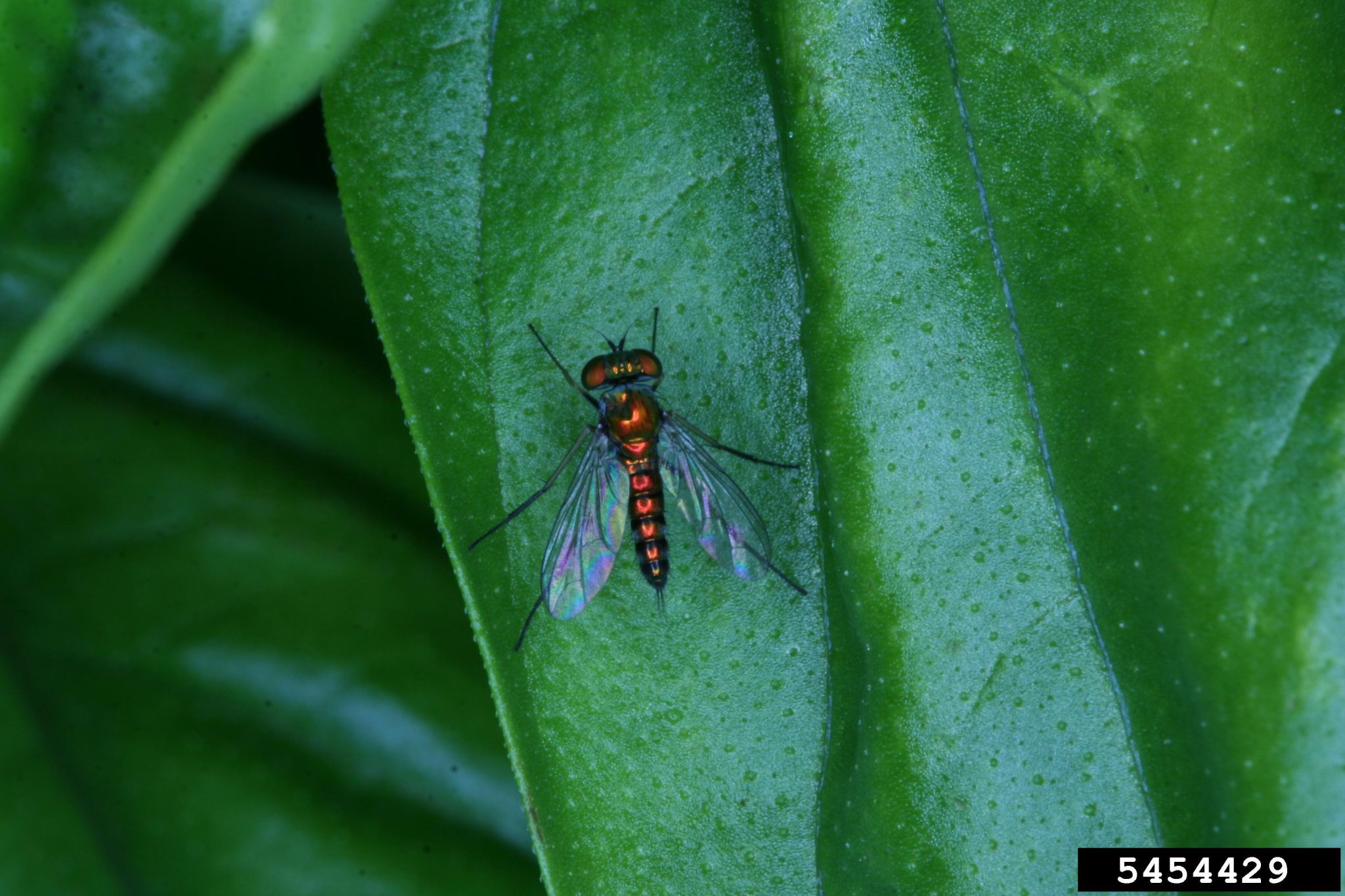
When gardening, pulling weeds, or visiting plants in your yard and landscape, you may encounter long-legged flies that dash from leaf to leaf, scurry about on plants, or even appear to dance on leaves in the sunlight. These flies are beneficial predators both as adults and larvae.
Long-legged flies eat a variety of small, soft-bodied arthropods, including other flies, aphids, thrips, spider mites, springtails, leafhoppers, whiteflies, small caterpillars, beetle larvae, and even termites. The larvae of some long-legged flies eat other small arthropods in the soil, while others are scavengers.
Long-legged flies pose no threat to humans as they do not bite, sting, or spread diseases. Plus, they prefer to remain outdoors, so you will unlikely find long-legged flies in your home.
Identification
Long-legged flies are members of the order Diptera (true flies) and the family Dolichopodidae. More than 1,300 species of varying appearance and biology live in North America.
Adult flies (figures 1, 2, 3, and 4) are easily recognizable for characteristics that differentiate them from other flies, such as metallic green bottle flies and blowflies. Long-legged flies have a distinct and eye-catching appearance: small and slender bodies (1 to 9 millimeters, mostly 5 millimeters) with metallic casting of green, blue, red, copper, or gold; long, slender legs; and one pair of transparent wings that may be marked with dark spots or bands near the wing tip. Their wings are held away from the body instead of folded flat against it.
Crane flies are another common fly with long legs, but they are large (7 to 35 millimeters) with elongated wings (wingspan 10 to 65 millimeters) and elongated legs that easily fall off. They are pale brown in color and very weak fliers. Because they look like oversized mosquitoes, they have wrongly been called “mosquito hawks.”
Larvae of long-legged flies (figure 5) are maggot-like and develop in soil, rotting organic matter, or under bark. They are creamy white in color and short and stout in shape. The pupae (figure 6) live inside cocoons constructed by the larva.
-

- Figure 1. Long-legged flies have a distinct appearance. (Photo credit: Copyright © Lewis Scharpf)
-
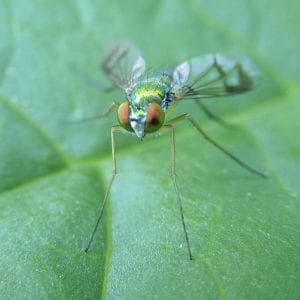
- Figure 2. Long-legged flies have long, slender legs. (Photo credit: Copyright © Lewis Scharpf)
-
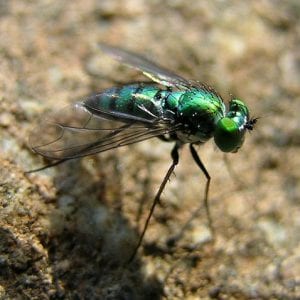
- Figure 3. Long-legged flies often have a green metallic casting. (Photo credit: Copyright © Lewis Scharpf)
-
- Figure 4. Long-legged flies hold their wings away from their bodies.
-
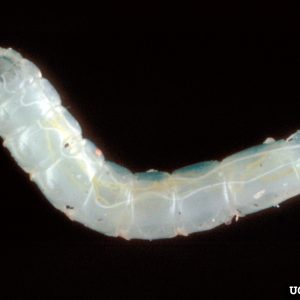
- Figure 5. Long-legged fly larva. (Photo credit: Gerald Lenhard, LSU, Bugwood.org)
-
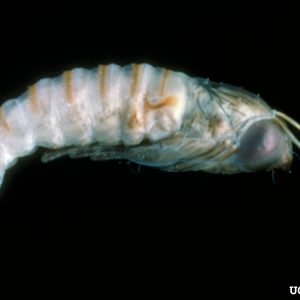
- Figure 6. Long-legged fly pupa. (Photo credit: Gerald Lenhard, LSU, Bugwood.org)
Behavior
Long-legged flies are excellent fliers but, when disturbed, usually move short distances, such as from leaf to leaf. Adult flies are often seen in a characteristic predatory posture, standing high on their legs on vegetation or other objects. They run about leaves in search of prey. Some species of long-legged flies even walk on the surface of still water, searching for mosquito larvae to eat.
Males of many long-legged fly species exhibit flag-like appendages on their front legs or modified antennae. The flag-like appendages are used to attract females during an elaborate, unique, slow-motion cycle-walking courtship dance. Adult flies can be seen carrying prey during flight. They are secreting digestive juices into the prey that allow them to feed on the liquefied contents.
Habitats
Long-legged flies occur in a wide range of habitats, preferably wet areas near water margins and in meadows, woodlands, orchards, vineyards, gardens, and urban landscapes. These habitats support primary food sources of small insects and protect long-legged flies from predators such as birds.
Adult female flies typically lay eggs in moist soil and decaying organic matter, sometimes under the bark of trees. Once eggs hatch, larvae develop through several stages (instars) in soil ranging from moist to wet, under tree bark or algal mat, or in tree holes. Mature larvae create cocoons of soil particles glued together and pupate inside the cocoons. The pupal stage is when a larva transforms into an adult.
Humans will likely encounter long-legged flies when they reach their adult stage in the spring and last through the fall. They provide essential biocontrol of garden and yard pests and contribute to maintaining a balanced ecosystem. They should be encouraged in the landscape by planting a diversity of plants and minimizing the use of insecticides whenever possible.
 Xing Ping Hu, Extension Specialist, Professor, Entomology and Plant Pathology, Auburn University
Revised July 2024, Beneficial Long-Legged Flies in Gardens & Yards, ANR-2791