
Forestry

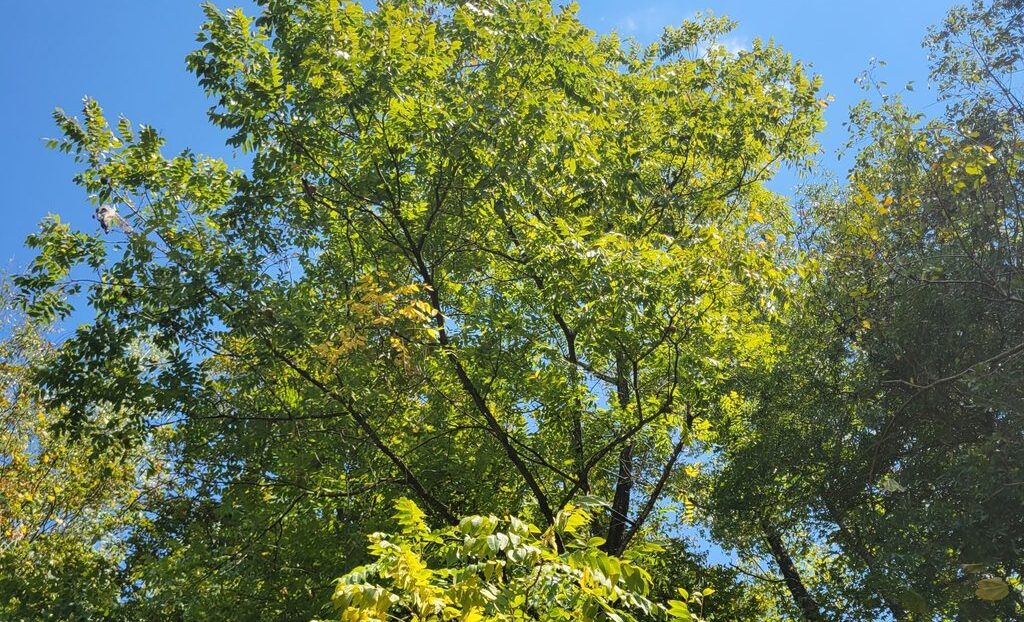
Closely related to hickories, walnuts are a less common component of Alabama’s forests. There are two native walnut species—black walnut and butternut. Both of these have great benefits for humans and wildlife, and the trees offer diverse use options, from timber to dye.
Black Walnut (Juglans nigra)
Description
Black walnut is by far the more common of the two native walnut species. The trees can grow up to 120 feet in good soil and forest-grown conditions. They are shorter and stouter if planted openly. The bark is dark, tight, and deeply furrowed. The compound leaves are large, up to 2 feet in length, and generally made up of fifteen to nineteen leaflets with fuzzy undersides. Unlike hickories, the terminal leaflet is often small or not present. The foliage turns yellow in the fall. The nuts are large, almost the size of a baseball when including the husk. The husk does not separate from the nut before it falls in late fall and winter.
-
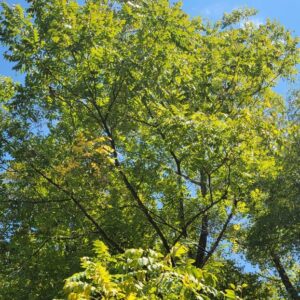
- Black walnut tree
-
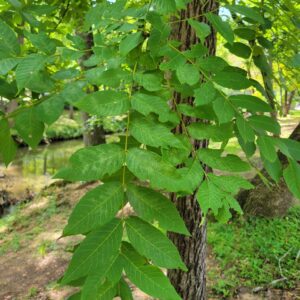
- Black walnut leaf
-
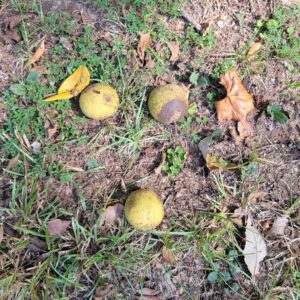
- Black walnuts
Range
Black walnuts are found growing throughout the state on rich, moist soils.
Uses for People
The nut has an excellent eating quality but is difficult to access. The husk is firmly attached and difficult to remove, especially when dry. The nut itself has a thick, hard shell. Try to remove as much of the husk as possible, as the tannins are powerfully bitter and can stain skin easily. Remove hulls shortly after harvest, so they do not dry out. Methods of removal include agitating them in a barrel of water with a mixing attachment on a corded drill. Mechanical dehullers are used in commercial processing.
Once it has been shelled, the kernel can be eaten by itself, in ice cream or other prepared foods, or pressed for oil. Many people crack black walnuts for their own use at home, but there is also a small commercial market. The husks are an excellent source of dye and were utilized heavily during the American Civil War. The wood is dark, heavy, and fine grained with many ornamental and tool applications.
Uses for Wildlife
Some animals will utilize the nuts, especially after the husks have softened and partially rotted away. The tree itself offers nesting sites for birds.
Availability
These trees are readily available from nurseries and online. The cultivar ‘Hickman’ was recently released for nut production.
Cultivation
Black walnut trees prefer a rich and moist, but well-draining soil. They will not thrive under shady conditions and do not transplant well. While they grow well from seed, they need to be planted in deep, square pots if not being directly sown in the ground. To grow black walnuts from seed, collect nuts shortly after they mature and stratify them at about 34 degrees F for 5 months in a slightly moist, sterile media such as sand or coconut coir. Radicles (the beginning of a root) will begin to emerge in some of the nuts. Plant nuts with radicles into tree pots containing a growing media and slow-release fertilizer or directly into a protected location in the field. Do not plant them near garden spaces or other desirable plants, as the tree produces a compound known as juglone that inhibits the growth of many plants. Black walnuts can take a decade to come into nut production. Some trees have a tendency to produce large nut crops on alternate years.
Butternut (Juglans cinerea)
Description
Butternut trees are smaller than black walnuts, averaging between 40 and 60 feet tall, with he trunk tending toward a forked or crooked growth form. The bark is grey-brown and tight with shallow ridges. The leaves are between 10 and 20 inches long with eleven to nineteen leaflets. The nut is oblong and up to several inches long, falling September through October. Butternut is an S1 species in Alabama, meaning they are critically imperiled because of extreme rarity. This is an extremely vulnerable species, and wild populations should not be harmed.
-
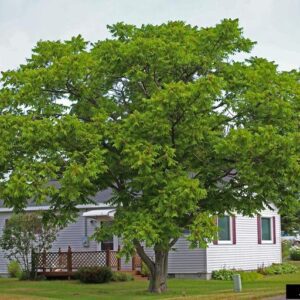
-
Butternut tree
Photo by Rob Routledge, Sault College, Bugwood.org.
-
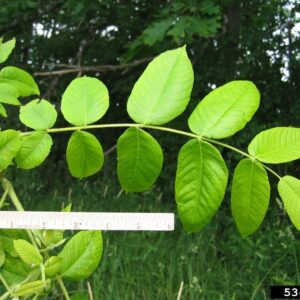
-
Butternut leaf
Photo by Keith Kanoti, Maine Forest Service, Bugwood.org.
-
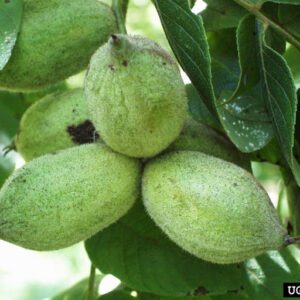
-
Butternuts
Photo by Paul Wray, Iowa State University, Bugwood.org.
Range
Butternut trees are found rarely in far-north Alabama, with some sparse populations further south. They can grow in a wide range of sites and soil types.
Uses for People
The nut is good quality and easier to husk and shell than black walnuts. They can be used similarly to other walnut species. The timber is desirable but the increasing rarity of butternut means that it is rarely used or available.
Uses for Wildlife
The nuts are consumed by many animals where the tree is present.
Availability
Occasionally available online or from native nurseries. Many offered for sale are some degree of hybrid with the Japanese walnut (Juglans ailantifolia), so look closely before purchasing. Some cultivars are available.
Cultivation
The butternut is declining across much of its range because of butternut canker (Ophiognomonia clavigignenti-juglandacearum), an invasive pathogen that has severely threatened the viability of the species. The tree is shade and competition intolerant but may be grown on a variety of well-draining soils. Like black walnuts, butternuts produces juglone, which can weaken nearby plants, so choose the site carefully. Butternut grows readily from seed using the same practices as black walnuts. However, because the blight can transmit through seed, a quarantine period is advisable. It does not transplant well because of its prominent taproot.
Resources
- Keener BR, Diamond AR, Barger TW, Davenport LJ, Davison PG, Ginzbarg SL, Hansen CJ, Spaulding DD, Triplett JK, and Woods W. 2025. Alabama Plant Atlas. [SM Landry and KN Campbell (original application development), Florida Center for Community Design and Research. University of South Florida]. University of West Alabama, Livingston, Alabama.
- Leisso R and Hudelson B. 2024. Butternut canker. University of Wisconsin Extension. Available at https://hort.extension.wisc.edu/articles/butternut-canker/.
- Mizzou Agroforestry. 2023. Black walnut stratification. Available at https://www.youtube.com/watch?v=uMt_2chBH5s. Accessed September 9, 2025.
- USDA. Woody Plant Seed Manual. Accessed September 2025. https://www.fs.usda.gov/nsl/nsl_wpsm.html