
Forestry


Draft animal logging is the practice of moving timber and managing forests with the help of horses, mules, or oxen that have been trained to pull loads. This operational model can be practical to use in a variety of forest types, including many in Alabama.
Draft animal logging is a time-honored method of harvesting timber that is still utilized across the Southeast. In this brief overview, you will learn how modern draft animal logging is practiced and applied to meet the forest management needs of small-parcel landowners.
Benefits of Draft Animal Logging
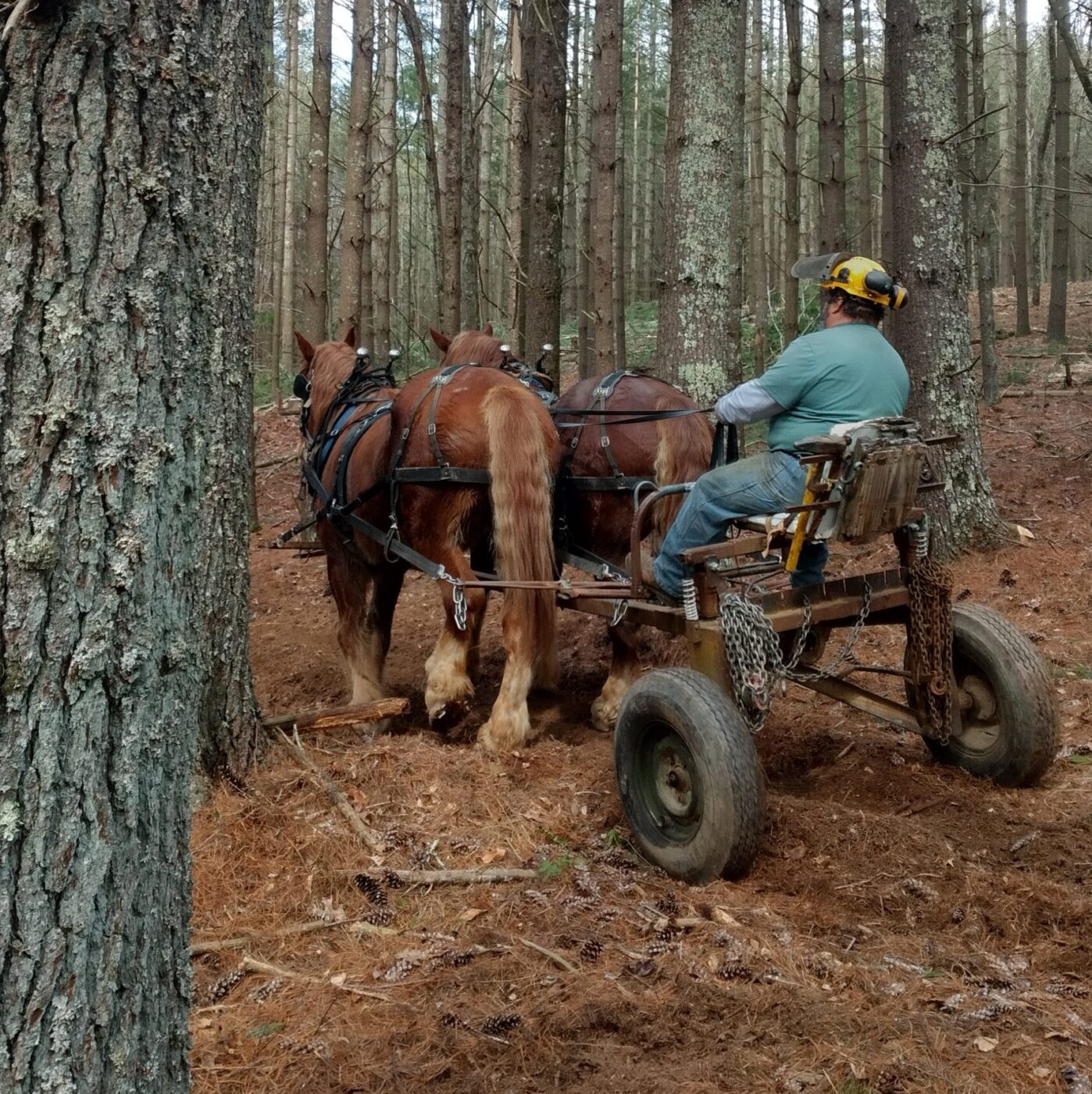
A horse logger riding a log arch pulled by two Suffolk Punch horses. This log arch design is typical of those used by most draft animal loggers in the Southeast.
There are two primary reasons why forest landowners view draft animals as an attractive alternative to the highly productive forestry machines used in conventional mechanized logging:
Less cost. Draft animals are less expensive to keep than mechanized logging equipment. Therefore, forest tracts as small as one acre can be financially worthwhile to harvest, as can group selection or shelterwood harvests on larger tracts.
Less land impact. Draft animals typically have less impact on soil and residual trees during harvesting. This makes them a good option for landowners interested in harvesting timber while maintaining the aesthetic and recreational value of their land and preserving wildlife habitat. Low-impact forest management can also help reduce erosion, reduce losses in future timber value associated with soil compaction and residual tree damage, and generally help maintain the ecological function of the stand.
A survey of Alabama’s draft animal loggers conducted by researchers at Auburn University found that as recently as the early 2000s more than thirty draft animal loggers were operating across Alabama. Most were located in the northern part of the state, where steep ground and high-value hardwood trees create a suitable market niche. At that time, about 90 percent of practitioners were over the age of 40, leaving the future of the practice uncertain. Today, no draft animal loggers are known to be operating commercially in Alabama. However, draft animal loggers continue to occupy their historical niche in other southeastern states, where they remain in high demand among local landowners.
Operations
Draft animal loggers fell trees, limb them, and buck them into logs with a chainsaw. They then skid (drag) the logs using draft animals: horses, mules, or oxen.
Oxen were once a common draft animal across the United States but are rarely used for logging in the southeastern United States today. The most common draft horse breed used for logging in the Southeast is the Suffolk Punch, although Percherons and Belgians are also used. Proponents of the Suffolk Punch cite its stout build, strength, and willing temperament as its primary advantages. Mules are also common, with proponents claiming they fare better in the heat than draft horses, eat less, have fewer health problems, and have a more methodical temperament. The decision of which to use largely comes down to the personal preference of the logger and what is available locally.
Logs can be skidded on the ground behind a single animal, but many draft animal loggers typically work a pair of animals on a device called a log arch or log cart. This two-wheeled cart generates a small amount of lift at the front of the log, preventing it from digging into the ground and making it considerably easier to skid. A log arch, or the plans to construct one, can be sourced from the draft animal logging community.
Some draft animal loggers utilize a four-wheeled log wagon that can be loaded with logs. This is an efficient method to use on relatively flat ground, but it does not work on steeper terrain.
Most draft animal loggers also use some sort of mechanized equipment, such as a tractor, skid steer, or small knuckleboom loader to sort and stack logs at the landing and load them onto a truck. This is much faster and more efficient than doing so by hand, which requires the use of a cant hook or peavey to roll the logs and draft animals to crosshaul them onto the wagon.
Many draft animal loggers own a log truck or trailer and haul logs to the mill themselves. Others have a portable sawmill and mostly saw their own logs rather than sell to a mill. Some key differences between these business models warrant further discussion.
-
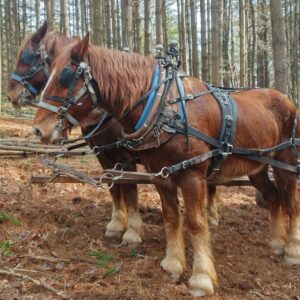
- Figure 2. Suffolk Punch horses, the most common breed of logging horse in the Southeast
-
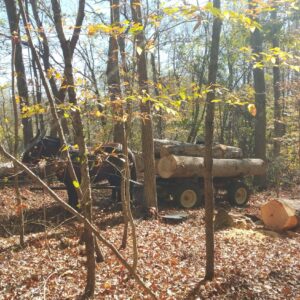
- Figure 3. A pair of mules and a loaded log wagon
-
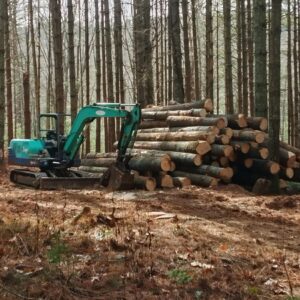
- Figure 4. Many draft animal loggers integrate machinery into their operations for decking and loading logs. Here, logs have been decked at a landing with a mini excavator after being skidded by horses.
Business Models and Economic Considerations
Many individuals who log with draft animals do so exclusively on their own property. They may fell, skid, and saw wood if they need lumber to construct or repair barns, fences, or sheds. Some expand their range a little farther to help neighbors harvest and saw timber.
The self-sufficiency that comes with this “homesteading” style of draft animal logging is the primary draw for many of these individuals. This model can be practical in a variety of forest types, including many across Alabama.
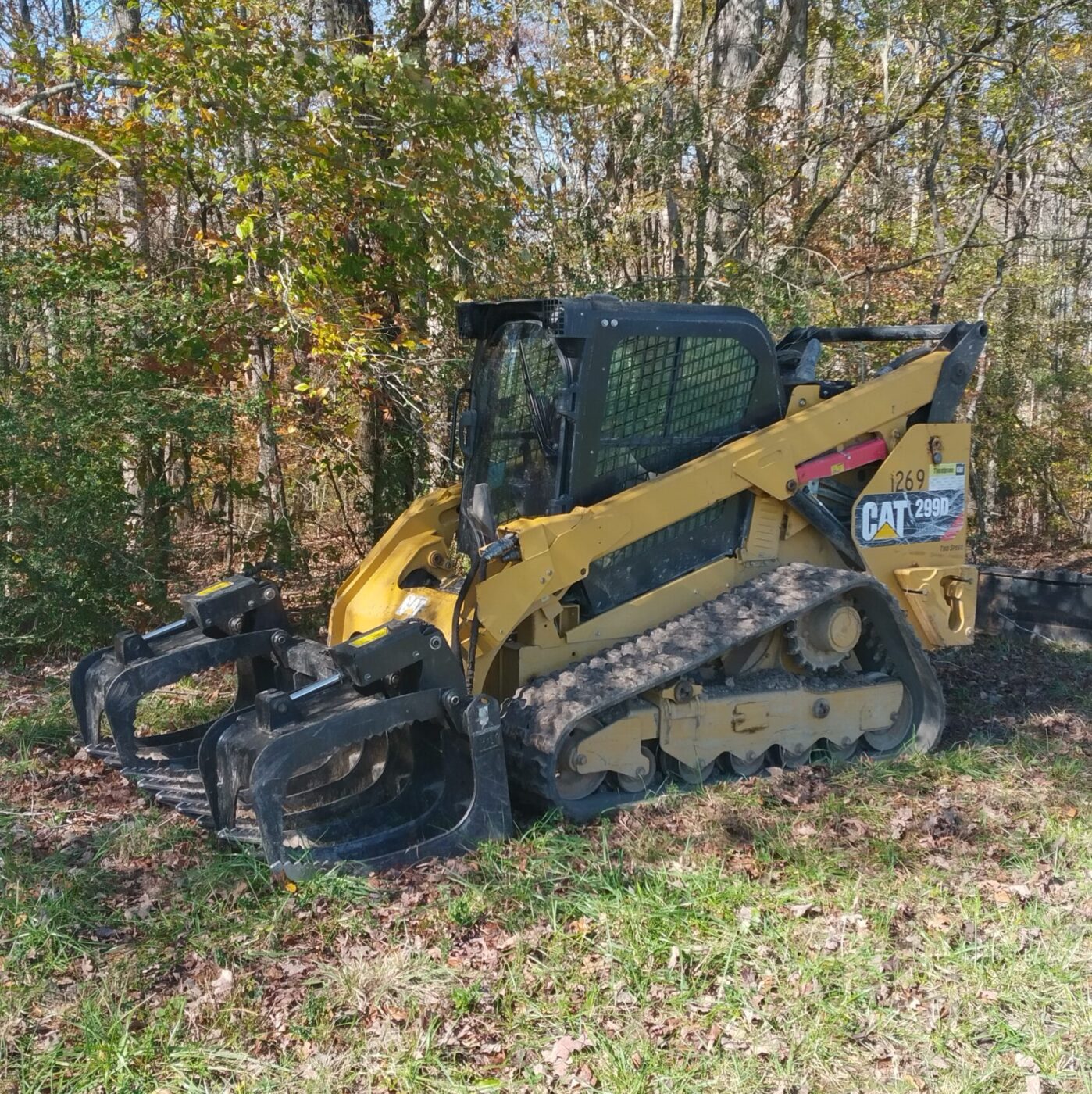
Figure 5. This skid steer is used by a mule logger in Tennessee to stack logs and load his log truck.
For the few draft animal loggers who describe logging as their primary occupation, two primary business models exist: (1) sell harvested logs to small commercial sawmills, or (2) use a portable sawmill to saw logs oneself. These opportunities vary with local markets and mills.
Selling logs to a mill is effective when the landowner’s primary objective is to harvest trees for profit, as it allows both the logger and the landowner to receive the timber revenue swiftly and directly. This is common in areas where timber is an important financial asset for landowners. In these cases, the logger and landowner split the money received from the sawmill. A 60–40 split is common, with loggers receiving 60 percent of the timber revenue and the landowner 40 percent. However, these percentages can range from 50–50 to 75–25 depending on the difficulty of the skids, the value of the timber, and the local timber markets.
One of the difficulties associated with selling logs to a mill is that opportunities are highly dictated by local timber markets and prices. The prices of pulpwood and pine sawtimber are typically too low for draft animal loggers to cover their expenses harvesting those products and selling them to a mill.
Higher-value hardwood trees present greater opportunities. However, as with any timber harvesting, landowners must be conscious of high-grading. High-grading is cutting the best, highest-value trees out of the stand and leaving the inferior trees, which degrades the stand. Landowners interested in harvesting timber while minimizing high-grading and promoting regeneration of desirable species must balance the potential revenue from high-quality trees with their other objectives.
Draft animal loggers who have a portable sawmill or contract with a local portable sawmiller to saw their logs may see less immediate returns than those selling to a sawmill. However, they are not restricted by local timber markets and prices at local mills.
Using a portable sawmill, loggers can saw sizes and species of logs that might be low value or unmerchantable at commercial sawmills. They can advertise their work and products as artisanal and draft animal–logged. This can be effective where people are willing to pay a premium for lumber harvested with draft animals and sawed locally.
Financial arrangements for draft animal loggers who incorporate a portable sawmill into their operations include the following:
- Contract to harvest storm-damaged timber and keep the logs, which can be sawed into lumber, in exchange for clearing the snapped and wind-thrown trees.
- Charge an hourly rate for timber stand improvement, particularly in operations that do not yield much merchantable wood. Examples include a precommercial thin, in which some trees are removed to increase resource availability for crop trees that will be harvested later, or a thinning to meet a landowner’s ecological or aesthetic management objectives.
- Charge an hourly rate to harvest trees for a construction or carpentry firm building with timber harvested and sawed on the property.
Conclusion
Although not currently practiced in Alabama, draft animal logging’s niche has persisted, and the need for suitable small-tract ecological forest management strategies is growing. Draft animal logging warrants consideration alongside other alternatives because of its effectiveness at the small-tract forest scale and the aesthetic and ecological appeal of its low-impact nature.
Potential draft animal loggers and interested landowners can connect with the draft animal logging community through the Draft Animal Power Network, Facebook groups such as the Horse Loggers Round Table, and by contacting practitioners directly.
References
- Butler, B. J., S. M. Butler, J. Caputo, J. Dias, A. Robillard, and E. M. Sass. 2021. Family forest ownerships of the United States, 2018: Results from the USDA Forest Service, National Woodland Owner Survey. General Technical Report NRS-199. Madison, WI: U.S. Dept. of Agriculture, Forest Service, Northern Research Station.
- Cordero, W., and A. Howard. 1996. Use of oxen in logging operations in rural areas of Costa Rica. Proceedings of a symposium organised by IUFRO Subject Group S3.0500, “Forest Operations in the Tropics” at the XX IUFRO World Congress, 6–12 August 1995, Tampere, Finland. 5–12.
- Cubbage, F. 1983. Economics of forest tract size: Theory and literature. General Technical Report SO-41. New Orleans, LA: U.S. Dept. of Agriculture, Forest Service, Southern Forest Experiment Station. 21.
- Ficklin, R. L., J. P. Dwyer, B. E. Cutter, and T. Draper. 1997. Residual tree damage during selection cuts using two skidding systems in the Missouri Ozarks. In: Pallardy, Stephen G., R. A. Cecich, H. G. Garrett, P. S. Johnson, eds. Proceedings of the 11th Central Hardwood Forest Conference; Gen. Tech. Rep. NC-188. St. Paul, MN: U.S. Dept. of Agriculture, Forest Service, North Central Forest Experiment Station. 36–46.
- Garrison, G. A., and R. S. Rummell. 1951. First-year effect of logging on Ponderosa pine forest range lands of Oregon and Washington. J. of Forestry 49(10), 708–713.
- Hales, L. P., J. L. Hart, P. Hiesl, M. C. LaFevor, and I. M. Snider. 2025. Characterizing draft animal logging operations in the southeastern United States. Trees, Forests and People 20, 100824.
- Hales, L. P., J. L. Hart, P. Hiesl, M. C. LaFevor, and I. M. Snider. 2025. Soil and residual tree impacts of a draft animal–logged timber harvest case study in the southeastern United States. Forest Science 71(5), 611–624.
- Knezevic, J., J. Music, V. Halilovic, and A. Avdagic. 2023. Damages of skidder and oxen logging to residual trees in uneven-aged mixed forest. Forests 14(5), 927.
- Latterini, F., R. Venanzi, and R. Picchio. 2024. ACORN review: To what extent can we consider animal logging as a low-impact harvesting system? Forest Ecology and Management 564, 122047.
- McCabe, P. P., and E. Tiner. 1992. Mule-logging: A dying art? Alabama’s Treasured Forests 11(2), 14–15.
- Naghdi, R., M. Lotfalian, I. Bagheri, and A. M. Jalali. 2009. Damages of skidder and animal logging to forest soils and natural regeneration. Croatian J. of For. Engineering 30(2), 141–149.
- Rummer, B., J. Baumgras, J. McNeel. 1997. Forest Operations for Ecosystem Management. Proceedings of the Sustainable Forestry Working Group at the IUFRO all division 5 conference, 1997 July 7–12, Pullman, WA, Madison, WI.
- Shrestha, S. P., B. L. Lanford, R. B. Rummer, and M. Dubois. 2005. Utilization and cost of log production from animal logging operations. International J. of For. Engineering 16(2), 167–180.
- Shrestha, S. P., B. L. Lanford, R. Rummer, and M. Dubois. 2008. Soil disturbances from horse/mule logging operations coupled with machines in the southern United States. International J. of For. Engineering 19(1), 17–23.
- Toms, C. W., M. R. Dubois, J. C. Bliss, J. H. Wilhoit, and R. B. Rummer. 2001. A survey of animal-powered logging in Alabama. South. J. of Appl. Forestry 25(1), 17–24.
 Lucas Hales, Graduate Student, Forest Dynamics Lab, Geography and the Environment, University of Alabama; Becky Barlow, Assistant Director, Agriculture, Forestry, and Natural Resources, Associate Dean for Extension, Auburn University; and Justin Hart, Professor, Forest Dynamics Lab, Geography and the Environment, University of Alabama
New February 2026, Introduction to Draft Animal Lodging, FOR-2193