
Forestry

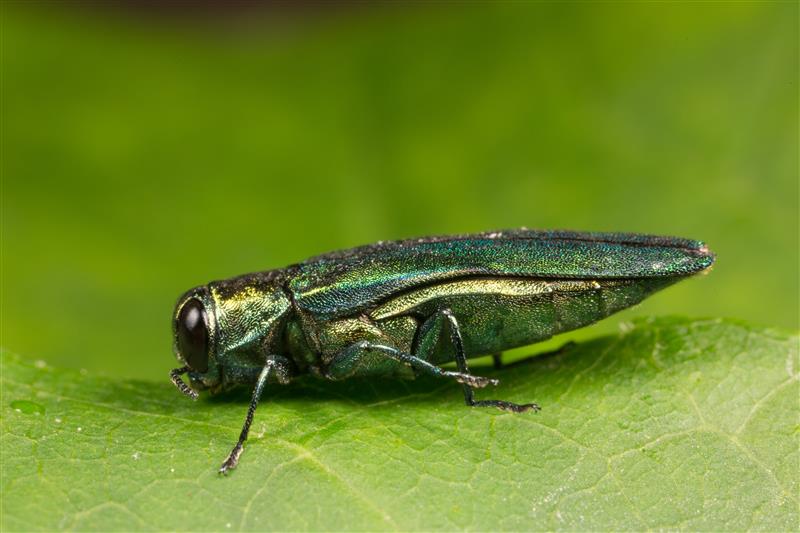
Alabama landowners should be aware of another looming threat to the health of some Alabama forests: the emerald ash borer (EAB). This insect is a member of the Buprestidae family of beetles in the order Coleoptera. This family is typically referred to as flatheaded borers or metallic wood borers because of their metallic exoskeleton. Most species of metallic wood borers are secondary pests that usually attack injured or dying trees. This, unfortunately, is not the case with the EAB, which directly targets healthy ash trees. This pest is fully capable of attacking and killing healthy ash trees, a consequence of a lack of evolutionary history between the Asian insect and North American ash trees.
Characteristics
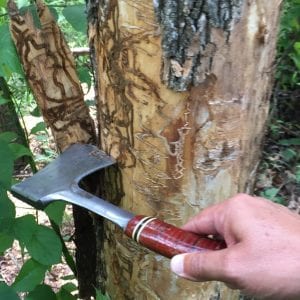
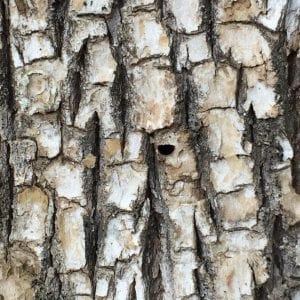
Once a suitable host tree is located, female EABs lay their eggs on the bark of ash trees. When the eggs hatch, the larvae chew their way into the cambium layer of the tree. Winding galleries caused by larval feeding within the cambium may cut off the transmission of nutrients to the upper portion of the tree, effectively girdling the host tree. If you are unable to see the classic larval gallery pattern of the EAB, you can sometimes see their D-shaped exit holes that the adults create as they chew their way out of the tree.
Found in Alabama
In July 2017, the Alabama Forestry Commission collected the first documented EAB larvae from green ash trees on private property in Calhoun County. Two weeks later, larvae were obtained from trees standing on a private residence in Talladega County. Larvae had chewed galleries through the phloem to approximately two feet above the base of the tree. Death of the main stem had already occurred, leaving behind many root sprouts. This indicates that the EAB has been present in those counties for several years, based on the timeframes given from previous studies. Since 2017, the EAB has been detected in St. Clair and Shelby Counties. The Alabama Department of Agriculture and Industries is in the process of deregulating the pest, since all containment and eradication efforts have failed across the United States.
Ash Trees in the State
The Forest Inventory and Analysis program (FIA) provides an array of forest statistics. Information from the FIA indicates that ash trees comprises only 1 percent of the total tree species composition in Alabama. There are an estimated 224 million trees that are partitioned primarily on privately held lands. This number is somewhat misleading, as ash can comprise a sizable percentage of the moist upland and bottomland sites in some localities.
In Lowndes County, ash species comprise 6.5 percent of all standing trees within the county. Outside of planted pine stands within the county, general observations have shown that ash trees are present along most of the creek drainages and moist flats surrounding Black Belt pastures and prairies. The greatest stocking of ash trees occurs in the Cahaba and Tombigbee River drainages in Clarke, Perry, and Sumter Counties, where over 24 million ash trees reside.
Treating Infestations
Private landowners bear the most substantial burden of the invasion and subsequent consequences of the EAB infestation. These include ash mortality, timber revenue losses, and further occupation by invasive species, such as Chinese privet.
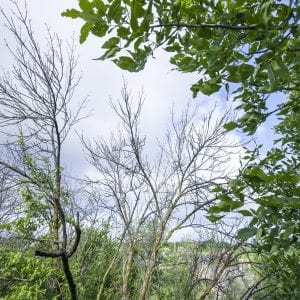
EAB infestations begin in the upper crowns of ash trees and slowly move their way down the main trunk of the tree over a period of 2 to 4 years. By the time unmistakable signs of infestation are apparent, it is often too late to save the tree, because the cambium has been compromised beyond the point of practical treatment. If treatment is conducted, it typically involves an injection of systemic insecticides into the cambium of high-value ash trees by certified arborists. Treatment is expensive and unreasonable to use on a forest scale. Once you begin treatment in an EAB-infested area you must continue to treat the trees every two years to protect them from infestation.