
Forestry

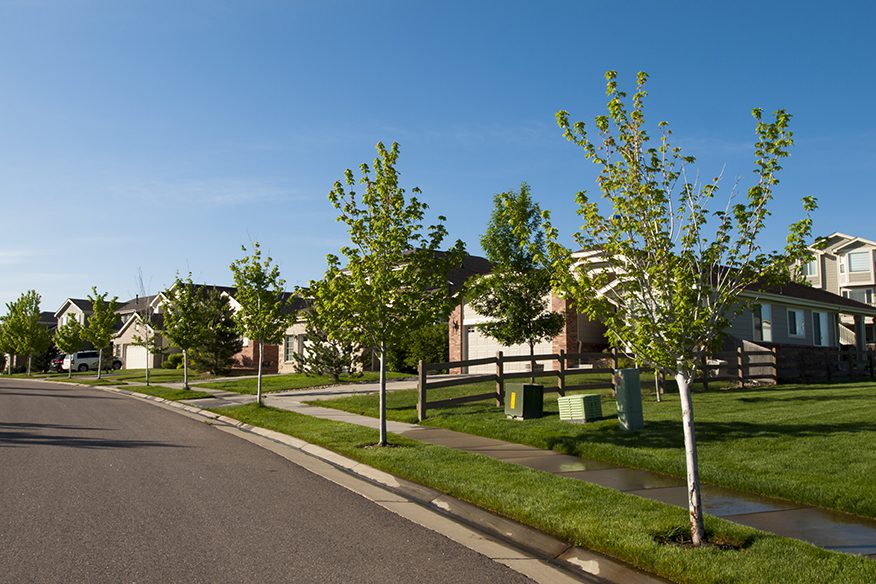
Planting a tree is one of the most valuable investments a community or individual can make for the future. Trees enhance property values, provide shade, improve air quality, reduce stormwater runoff, sequester atmospheric carbon, and contribute to healthier and more livable cities. However, many trees planted in urban and suburban landscapes fail to thrive or die prematurely because of avoidable mistakes made at planting time. This publication offers research-based guidelines for successful tree planting and is designed for the general public and professional audiences.
Appropriate Tree Planting Time
The time of tree planting has a profound effect on long-term establishment across the United States, as conditions vary significantly by region. In temperate regions, the best planting times are early spring, before buds break and growth resumes, and fall, after leaves have dropped but before the ground freezes. Planting during these windows reduces stress on the tree, allows roots to establish in cooler soil temperatures, and positions the tree for healthy growth in the following season. In hot and dry climates, late fall, winter, and early spring planting is usually preferred, as it allows the tree to benefit from winter rains and milder conditions. In tropical and subtropical areas, planting is best scheduled at the onset of the rainy season to ensure adequate soil moisture during the establishment phase. Regardless of location, planting during extreme weather conditions, including summer heat waves, droughts, frozen soils, or periods of prolonged flooding, should always be avoided, as these conditions severely compromise root establishment.
Planting Pit: Depth and Width
One of the most common causes of early tree decline is planting too deeply. A properly prepared planting pit should never be deeper than the tree’s root ball or root system. The root flare, where the trunk widens at the base before transitioning into roots, should always remain slightly above the surrounding soil grade to prevent suffocation and root collar disorders. While depth should be carefully controlled, width should be generous. A pit two to three times the diameter of the root ball provides loosened soil that encourages rapid lateral root expansion. Finally, loosening the surrounding soil in the pit with a shovel or a pickax is important to avoid the formation of smooth “glazed” surfaces that roots cannot penetrate (see figures 1–5).
-

- Figure 1. Measuring the width of the planting pit.
-
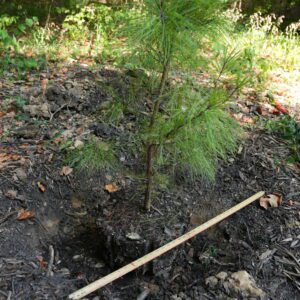
- Figure 2. The planting pit needs to be two to three times the diameter of the root ball. The pit should never be deeper than the tree’s root ball or root system.
-
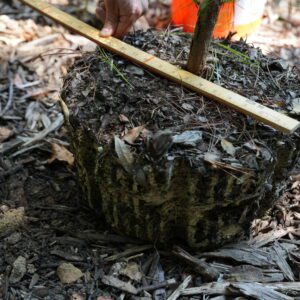
- Figure 3. Measuring the size of the root ball. The image shows the root ball before it was shaved with a handsaw (also see figure 6).
-
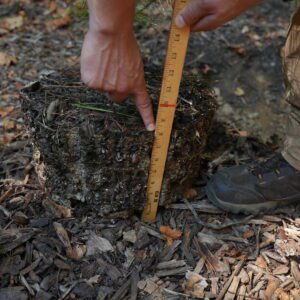
- Figure 4. Measuring the size of the root ball. The image shows the root ball before it was shaved with a handsaw (also see figure 6).
-
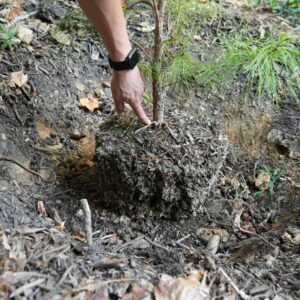
- Figure 5. The root flare should always remain slightly above the surrounding soil grade.
-
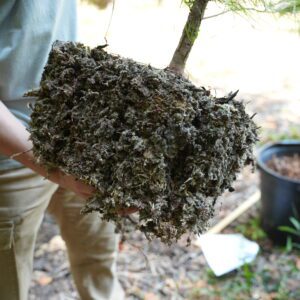
- Figure 6. Shave or cut 1 or 2 inches from the outer root ball and gently tease out circling roots before planting. This image shows the root ball after it has been shaved with a handsaw.
Root Ball Shaving and Root Preparation
Root preparation is an essential step often overlooked in the planting process. Container-grown trees frequently develop circling or girdling roots as they outgrow their pots. If these roots are not corrected at planting, they can strangle the trunk and severely restrict growth years later. The best practice is to shave or cut 1 or 2 inches from the outer root ball and gently tease out circling roots before planting (see figure 6). When cutting tools are unavailable, outer roots can be loosened and carefully separated by hand. When using cutting tools, protective gloves and eye protection are recommended. All ropes, wires, and synthetic burlap from balled and burlapped (B&B) trees must be removed, as these materials do not decompose and can girdle the trunk or roots. Even natural burlap should be peeled back from the top and sides of the root ball to prevent moisture loss and fungal growth near the trunk. Bare-root trees require special attention as their roots should be spread evenly in the planting hole. Broken or damaged roots should be trimmed, but roots should not be excessively pruned.
Watering Guidelines
Watering is the most critical factor in ensuring survival during the establishment phase, which typically lasts 2 or 3 years after planting. At planting, thoroughly water the root ball and backfill soil to settle the soil and remove air pockets. During the establishment period, trees benefit from deep, frequent watering, i.e., generally once or twice per week, depending on rainfall and soil type. The objective is to moisten soil to a depth of 8 to 12 inches, encouraging roots to grow deeper rather than staying near the surface. Shallow and too frequent watering encourages weak root systems and increases drought vulnerability. As the tree matures, the frequency of supplemental watering can be reduced, but occasional deep watering remains beneficial during prolonged dry periods. Soil moisture should be checked regularly, either with a soil probe or by hand-digging, before applying additional water. Overwatering is just as harmful as underwatering, as waterlogged soils deprive roots of oxygen. An efficient way to water trees is to use slow-release watering bags.
Below are some specific watering guidelines during the first year:
- Water daily during the first 2 weeks for recently planted trees.
- Then water every 2 or 3 days for about 3 months.
- After 3 months, water the trees weekly until the they are established.
Remember to adjust for soil type, as sandy soils require frequent watering, while clay soils retain moisture longer and need watering less often.
Staking
Not all trees require staking, and in many cases, staking can do more harm than good if it is improperly installed or left in place for too long. Staking should be considered only when a newly planted tree is unstable, located in a windy or exposed site, or vulnerable to vandalism. When staking is necessary, attach two flexible ties low on the trunk, below the canopy, to allow the tree to sway with the wind. This natural movement strengthens both trunk tissue and root development. Remove stakes as soon as the tree can stand independently, usually after one growing season and no longer than 12 to 18 months. Failure to remove stakes promptly can result in bark damage, trunk constriction, and poor structural development. An effective staking technique is to use wood logs nailed into the ground just above the root ball. This supports tree stability without restricting essential trunk movement, while wood logs will eventually decay.
Mulching
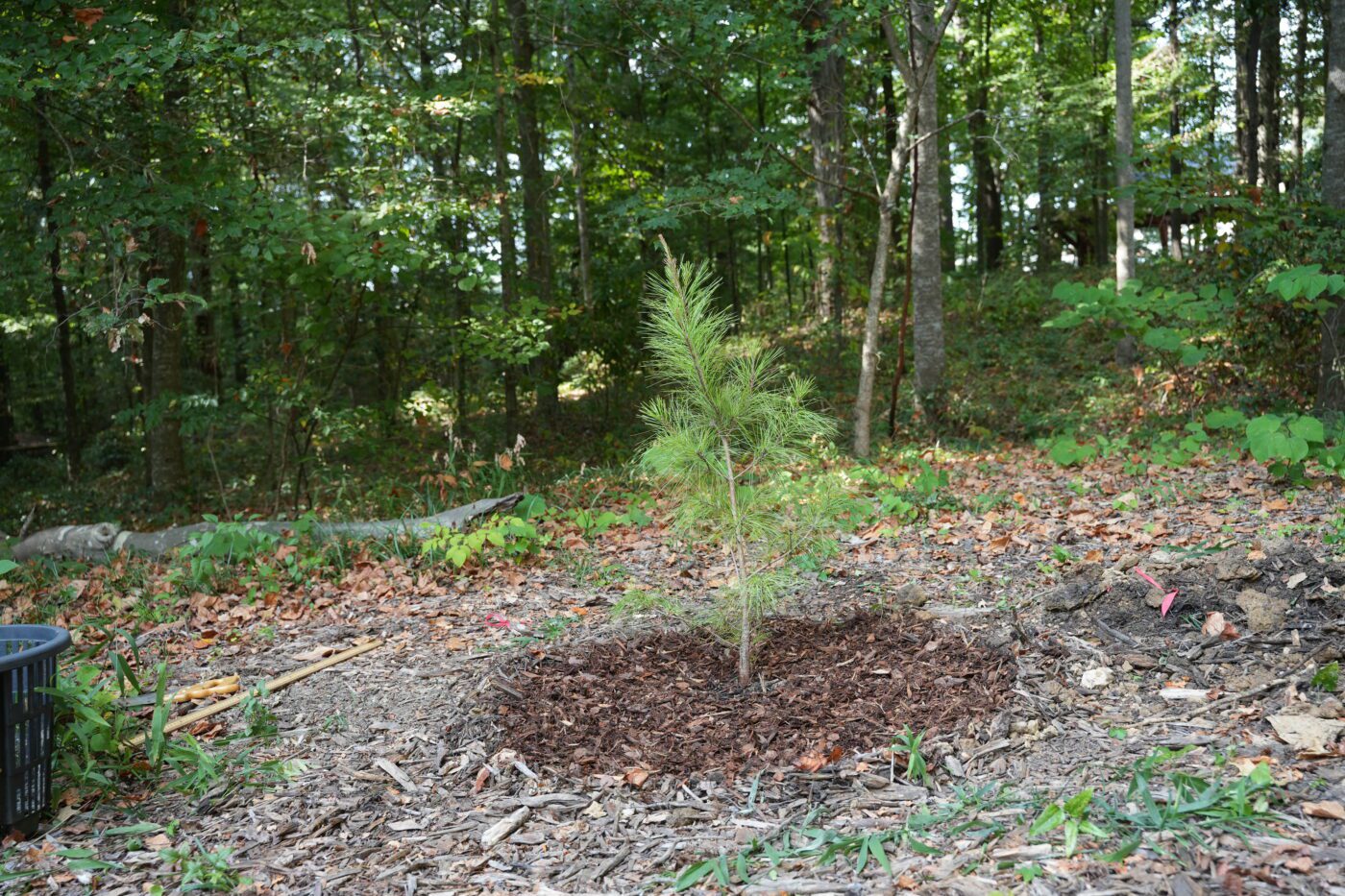
Figure 7. Pine straw is an excellent mulch material. Apply mulch in a broad ring around the base of the tree without being in direct contact with the trunk.
Proper mulching offers numerous benefits to newly planted trees. A layer of organic mulch helps moderate soil temperature, retain moisture, and reduce weed competition. Wood chips, shredded bark, pine straw, etc., are excellent materials for this purpose. Mulch should be applied in a broad ring around the base of the tree, ideally extending several feet outward and, if possible, to the tree’s drip line in open landscapes (see figure 7). The depth of mulch should generally be maintained at 2 to 4 inches. Keep mulch away from direct contact with the trunk; piling mulch against the bark, commonly known as “volcano mulching,” traps moisture, promotes decay, and attracts pests. A gap of at least 2 to 3 inches around the trunk base ensures bark health while still employing the benefits of mulch in the root zone.
Conclusion
Tree planting is both a science and an art. Success requires attention to detail at every stage—from timing and site preparation to root management, watering, staking, and mulching. When these best practices are followed, trees are more likely to establish quickly, grow vigorously, and provide long-term ecological and social benefits. Whether you are a homeowner planting a shade tree in your yard or a city forester managing urban canopy expansion, following these guidelines helps ensure that the trees planted today will thrive for generations to come.
 Georgios Arseniou, Extension Specialist, Assistant Professor, Forestry, Wildlife, and Environment, Auburn University.
New January 2026, Best Practices for Successful Tree Planting, FOR-2192