
Forestry & Wildlife


English ivy (Hedera helix) is an evergreen and perennial vine native to Europe. It was brought to the United States by early settlers as an ornamental and is currently found in 28 states, including Alabama, and western Canada (figure 1). Historically, English ivy has been used for roadside beautification and erosion control, though it does not form an extensive underground root system. Today, this plant is commonly sold in the United States as an ornamental.
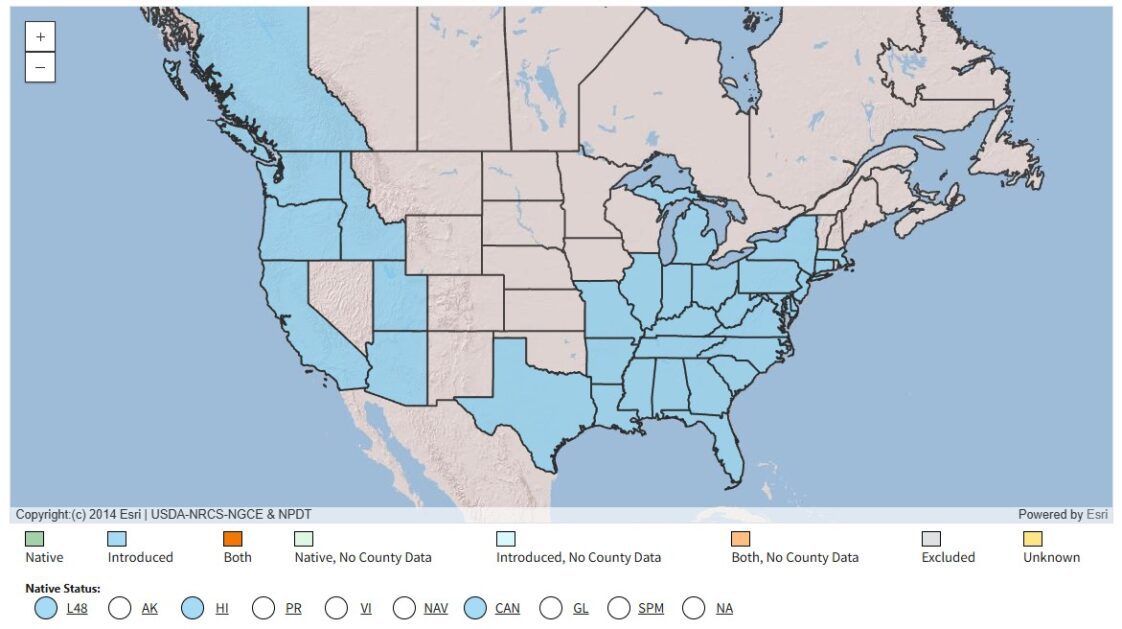
Figure 1. English ivy distribution map. Photo by US Department of Agriculture, Natural Resources Conservation Service.
Identification
Most people are familiar with the juvenile English ivy plant. Its green, waxy, and heart-shaped leaves have three to five pointed lobes (figure 2). The mature or reproductive stage of English ivy produces thicker woody stems. Mature leaves are ovate shaped, not lobed, and are lighter green with white or pale-green veins. If sunlight is accessible, small clusters of greenish-yellow flowers appear from June to October (figure 3). Clusters of berry-like drupes develop from October to May (figure 4). When ripe, these drupes are dark blue to purple or almost black. English ivy prefers moist woodlands but can be found in many habitats and soil types. However, it does not tolerate extremely wet conditions. The plant is highly shade-tolerant and spreads quickly with its climbing-vine structure. These vines use rootlets to adhere to trees and other structures, climbing up to 90 feet.
Damage
English ivy can heavily colonize and damage trees by causing the trees to uproot and break from the weight of the vines and by blocking sunlight needed for tree growth. On the forest floor, English ivy can create a monoculture ground cover that is 6 to 8 inches tall (figure 5). This can crowd out native forest understory species.
Birds will eat the drupes and distribute seeds, but the drupes contain a mild toxicity, which prevents overconsumption. The sap of English ivy can cause dermatitis in humans, and ingestion of the fruit or plant is toxic to humans and livestock.
-
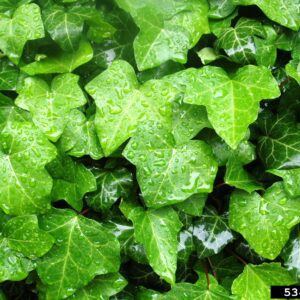
- Figure 2. English ivy leaves. Photo by Jan Samanek, State Phytosanitary Administration, Bugwood.org
-

- Figure 3. English ivy flower. Photo by Jan Samanek, State Phytosanitary Administration, Bugwood.org
-
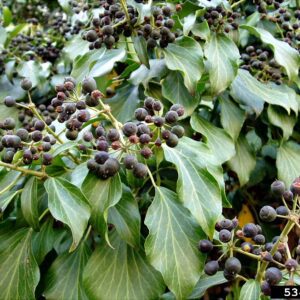
- Figure 4. English ivy fruit. Photo by Jan Samanek, State Phytosanitary Administration, Bugwood.org
-
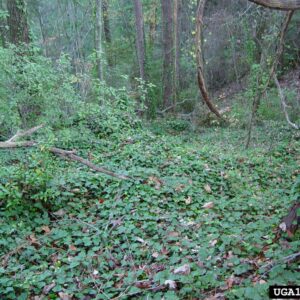
- Figure 5. English ivy infestation. Photo by Chris Evans, University of Illinois, Bugwood.org
Prevention and Control
The best prevention method is to never plant English ivy. However, in areas where already established, there are mechanical and chemical options for control. It is best to pull, cut, and treat the plant when fruit are not present. Also, bag and dispose or burn any of the plant material, including the fruit.
Mechanical Control
For young infestations, repeatedly cut or mow the plants to the groundline. If possible, remove the entire plant, including all roots and runners, by hand or using a digging tool. Mulching may be effective to control small infestations if several inches are applied for two or more growing seasons. Cut climbing or trailing vines as close to the root collar as possible. It is not necessary to remove the vines from the tree once they are cut, although they may continue to live on the tree bark for a period of time. Cuttings and roots left in the ground will resprout, and an herbicide should be used at the time of cutting or mowing for best control.
Chemical Control
Chemical control is possible through foliar, cut stump, and basal applications.
- Foliar. Thoroughly wet all the leaves with a recommended herbicide (tables 1 and 2) mixed with water and a surfactant at the recommended rate. July to October is the best time of year to make these applications.
- Cut stump. Cut large vines and apply herbicide to cut surfaces.
- Basal. Spray large vines, avoiding the bark of desirable trees.
Table 1. Recommended Herbicides for Residential Sites
b Cut-stump treatment involves cutting the plant down at the base and quickly treating the cut surface with the herbicide, which should be mixed with water if not used at full strength.
c Pathfinder II is a ready-to-use formulation that does not require mixing or dilution.
| Active Ingredient | Trade Name | Application Method | Rate |
|---|---|---|---|
| Glyphosate | Roundup or generic product (41% or more active ingredient) | Foliar spraya | 4% v/v (5 oz. per gal.) |
| Glyphosate | Roundup or generic product (41% or more active ingredient) | Cut stumpb | 50 to 100% v/v |
| Glyphosate + triclopyr | Roundup Poison Ivy Plus Brush Killer | Foliar spray | 6 oz. per gal. |
| Triclopyr amine | BioAdvanced Brush Killer Plus (8.8% active ingredient) | Foliar individual plant treatment | 4 oz. per gal. |
| Triclopyr amine | BioAdvanced Brush Killer Plus (8.8% active ingredient) | Cut stump | 100% |
| Triclopyr ester | Pathfinder II (13.6% active ingredient)c | Basal bark | 100% |
Table 2. Recommended Herbicides for Nonresidential Sites
b Herbicide is mixed with a penetrating oil carrier rather than water, allowing the herbicide to penetrate through the bark. Diesel fuel can be used, but newer oil carriers—such as basal and bark oils—are safer and just as effective.
c Pathfinder II is a ready-to-use formulation that does not require mixing or dilution.
| Active Ingredient | Trade Name | Application Method | Rate | Sitea |
|---|---|---|---|---|
| Glyphosate | Roundup or generic product (41% or more active ingredient) | Foliar spray | 4% v/v (1 pt. per 3-gal.) | Managed forests, natural areas or parks, and urban landscapes |
| Glyphosate | Roundup or generic product (41% or more active ingredient) | Cut stump | 50 to 100% v/v | Managed forests, natural areas or parks, and urban landscapes |
| Triclopyr amine | Garlon 3A, Renovate, or generic products | Foliar spray | 3 to 5% v/v (12 to 20 oz. per 3 gal.) | Managed forests, natural areas or parks, and urban landscapes |
| Triclopyr ester | Garlon 4 Ulta, Remedy Ultra, or generic product | Foliar spray | 3 to 5% v/v (12 to 20 oz. per 3 gal.)b | Managed forests, natural areas or parks, and urban landscapes |
| Triclopyr ester | Garlon 4 Ulta, Remedy Ultra, or generic product | Basal spray | 20% v/v (5 pt. per 3 gal.) | Managed forests, natural areas or parks, urban landscapes |
| Triclopyr ester | Pathfinder II (13.6% active ingredient)c | Basal spray | Spray or paint with undiluted solution | Managed forests, natural areas or parks, and urban landscapes |