
Food Safety

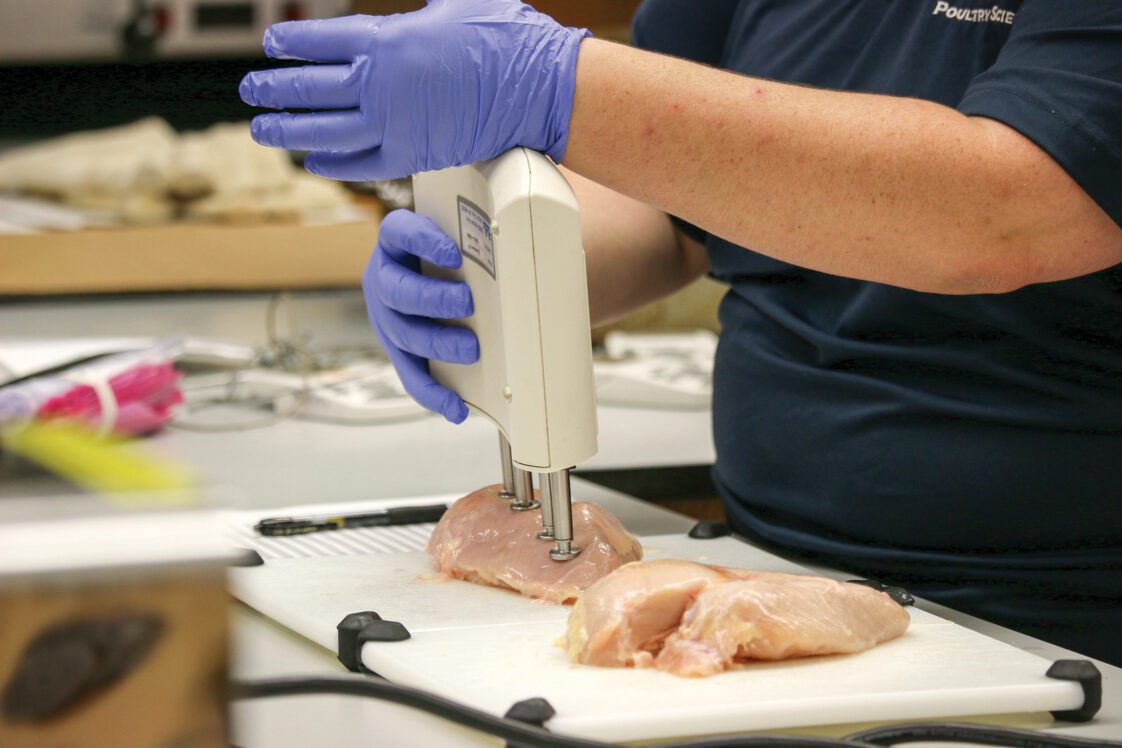
AUBURN UNIVERSITY, Ala. — This time of year, poultry is a popular pick to grace the dinner table. However, if not properly prepared, food poisoning could strike. Fortunately, poultry scientists at Auburn University dedicate countless hours to advancing food safety practices — from production and processing to commercial retail.
Through the Alabama Agricultural Experiment Station, a team of researchers and students investigate strategies to control salmonella outbreaks in retail poultry. Leading the project is Dianna Bourassa, an associate professor and Alabama Extension specialist in poultry science, specializing in food safety. Additionally, Aeriel Belk, assistant professor in Auburn’s Department of Animal Sciences, plays a key role in the research team.
“Foodborne pathogens are all around us,” Bourassa said. “Through research, we can uncover why these pathogens persist and identify practical ways to protect ourselves from them as we shop for food and consume it.”
Protection in Processing
A grant-funded project launched in 2024 supports Auburn researchers’ work in analyzing poultry-associated foodborne pathogens. The goal is to protect consumers through science-supported guidance. Over the next four years, updates from this project will continue as the team discovers new insights into pathogen dissemination.
Prioritizing safe food protocols, the U.S. Department of Agriculture Food Safety and Inspection Service has regulatory requirements of poultry plant processors. However, even large agencies, like the Food Safety and Inspection Service, cannot stop every single pathogen, from process to plate.
To strengthen the baseline, this grant project extends beyond the scope of standard poultry processing safety protocols. It enhances microbial detection and uncovers threats that traditional protocols sometimes miss.
The primary objective of this project is to survey sample raw poultry products from processing facilities. That includes areas from rehang, post-chill and packaging to retail and further-processing sites.
Precision Sampling
Notably, poultry often can carry enteric bacteria like salmonella and campylobacter into processing facilities. As a result, contamination commonly occurs during handling. In response, comprehensive safeguards are in place to make poultry handling as secure as possible.
Through a meticulously controlled operation, poultry processing is designed to ensure humane treatment as well as food quality and safety from start to finish. Methods include ventilated crates for transport, proper handling and care, visual and automated inspections and chilling poultry to halt bacterial growth. These strategies are used to help control bacterial growth or pathogen presence in poultry meat.
To combat contamination, processing companies use everything from antimicrobial processing aids to environmental monitoring. When addressing microscopic risks, processors turn to biomapping. Biomapping is a method of mapping microbial presence through careful, stage-by-stage sampling.
Working in partnership with the Agricultural Research Service, Bourassa and the food safety team conduct sampling beyond standard inspection requirements. Everything from tray pack items, like breast fillets, thighs and wings, to marinated or raw chicken portions are sampled for testing.
“Considering Alabama is the second largest broiler producer in the country, we know how important it is to be able to find results in the scope of this project,” Bourassa said. “We are able to take sampling to another level than the typical requirements, showing us just how prevalent pathogens are.”
Responding to Retail Risks
To analyze retail risks, the second objective of this project is to investigate pathogen prevalence and survival in raw chicken. Sampling in big box stores and local grocers, faculty and student researchers map pathogens in many ways. The data seeks to better understand the survival of pathogens all the way to purchase. The scope includes various poultry production methods, such as conventional, antibiotic-free and organic.
To make this research even more precise, retail isolates of salmonella and campylobacter are matched with facility data. By linking isolates to facility data, Auburn researchers identify genetic traits linked with survival. From there, it becomes clearer how certain strains of pathogens withstand production and could reach the end consumer.
To have more comprehensive data, the food safety team extends their testing methods. With nine ways to test for bacteria, they are doing everything they can to reveal traits, trends and trajectory of pesky pathogens.
“In Food Safety and Inspection Service regulatory sampling, if a facility has less than the threshold percent positive, it’s ranked Category 1 — the best. Category 2 means it meets the regulatory standard, and Category 3 means it falls short,” Bourassa said. “We’re trying to see if what you see at the grocery store correlates with those categories. For testing, the Food Safety and Inspection Service places the chicken in a bag and ships the liquid rinse for analysis. We test the whole chicken right there in the rinse.”
Knowledge for Safer Shopping
Through research and educational outreach, the four-year project aims to elevate pathogen control across the poultry supply chain. Armed with knowledge, the team plans to inform the public on ways to shop smarter by understanding science-backed results.
As she and the team continue working, Bourassa said she hopes this project helps uncover the mysteries surrounding foodborne pathogens.
“From pre-harvest to raw product, our research spans the board in poultry consumption and production safety in a farm-to-fork approach,” Bourassa said. “Every study gives us the ability to help consumers purchase safer products and every outreach program though Alabama Extension helps us share the science in ways that matter.”
To discover food safety tips, go online to aces.edu/go/food-safety.