
Fish & Water

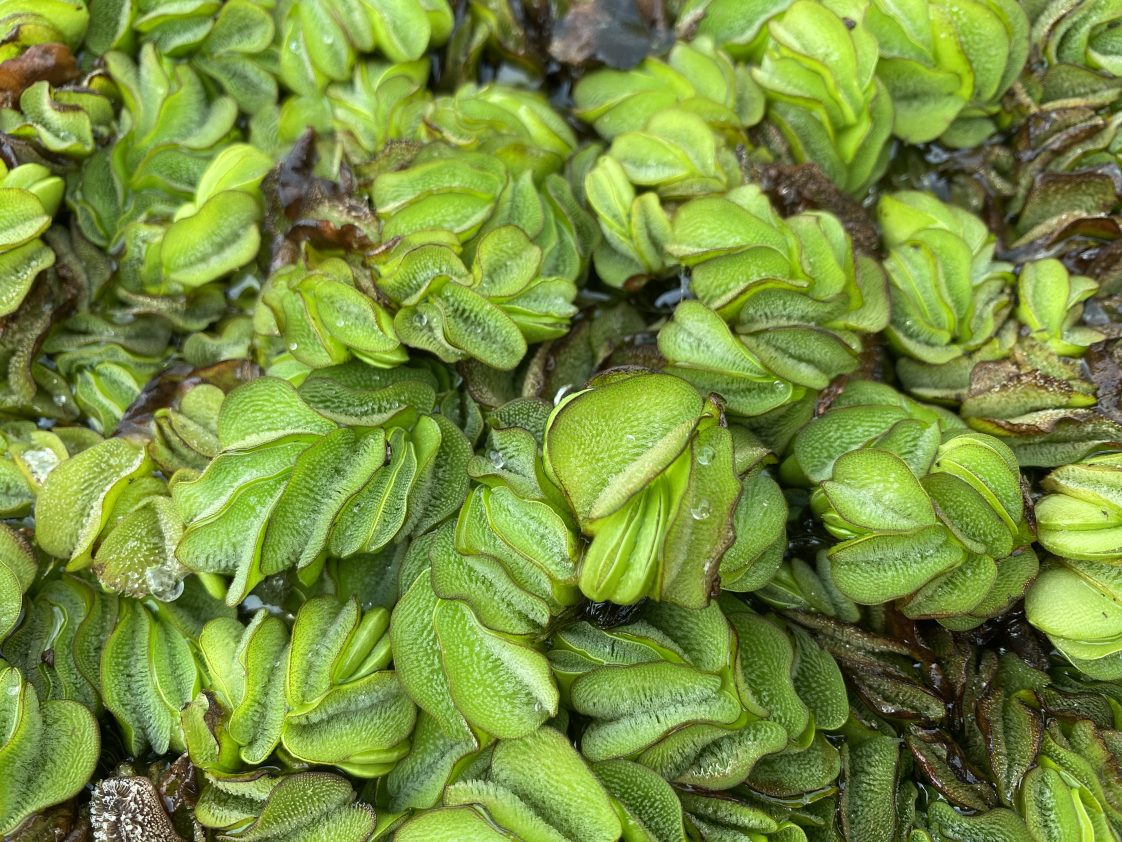
AUBURN UNIVERSITY, Ala. — For the past several years, giant salvinia has been creeping its way through Alabama’s fresh bodies of water. Moving rapidly from the west, this aquatic invasive species creates dense mats that float freely and spread over waterways. It can have detrimental effects, wreaking havoc in water ecosystems and interfering with vessel movement.
Native to Brazil, reports of giant salvinia in the U.S originated in the Carolinas and Texas, but it has moved widely through the Southeast since the early 1990s. As a result, the U.S. Department of Agriculture lists giant salvinia on the federal noxious weed list, which prohibits its sale and transport.
“I have watched giant salvinia spread significantly over the last five years,” said Rusty Wright, an Alabama Cooperative Extension System aquatic resources specialist. “Getting the word out and teaching people how to identify and report sightings is our best course of defense to slow the spread.”
Fern on the Move
This floating fern creates thick mats that are several inches deep and cover standing water. The plant removes oxygen from the water, which kills plant material below the surface. These dense mats also disrupt wildlife habitats and native vegetation of both aquatic species and waterfowl. In some cases, the plant material is so thick even the sunlight cannot seep through.
From green and gold to sometimes appearing brown, this heat-tolerant plant has rounded leaves arranged in groups of three. Floating fronds are located below the surface, and they are the culprit behind natural movement. As a fern, giant salvinia does not produce flowers or fruit.
Giant salvinia is a resilient invader that travels far and fast. After latching onto boats, barges and even equipment exposed to contaminated waters, it can be unknowingly carried across land to clean environments. In fact, its young plants also make use of water currents to journey and grow downstream. Because of this, cleaning boats and equipment is crucial to slowing the spread.
“Properly washing your boats and equipment helps protect your private pond and public waters,” said Wright, also an associate professor in the Auburn University School of Fisheries, Aquaculture and Aquatic Sciences. “This is a simple way of safeguarding marine ecosystems and stopping aquatic hitchhikers and diseases.”
Treatment and Control
Norm Haley, an Alabama Extension forestry, wildlife and natural resources agent with Auburn University, said while total state eradication is no longer possible, treatment and control are achievable.
“When found in private waters, it is best to plan for control via herbicide application,” Haley said. “On public waters, it is best to collect GPS coordinates on the location of the infestation and notify the Alabama Department of Conservation and Natural Resources.”
Fortunately, there are battle-tested herbicides available to treat giant salvinia outbreaks. Wright recommends using a combination of glyphosate and diquat and encourage users to be prepared to make more than one application.
“Glyphosate and diquat are both readily available, for now, to use to remove giant salvinia,” Wright said. “Following the label and adding a good surfactant can really help control the emergent plant, but it is not going to disappear in one treatment.”
With any invasive species, various control methods are being trial tested for effectiveness over time. Biological control agents are living organisms released to be natural predators of invasive species to suppress or slow spread. In recent years, researchers have used salvinia weevils to feed on the giant salvinia over several months, which is effective. However, these weevils only thrive in mild winters. They also can be difficult to acquire for private landowners, making them not the most feasible control method.
More Information
As giant salvinia continues to choke waterways and disrupt ecosystems, public education is the frontline defense. Extension strives to give residents the tools to report and manage giant salvinia.
“Extension as an outreach organization aims to increase awareness and knowledge of proper control methods for giant salvinia, along with many other non-native invasive plants, both aquatic and terrestrial,” Haley said.
To report sightings of giant salvinia, people can contact county Extension offices, the Auburn University Marine Extension and Research Center and the Alabama Department of Conservation and Natural Resources. For more information, the publication, “Aquatic Vegetation Identification & Control,” details herbicide treatment options as well as plant identification. Find this publication at aces.edu.