
Farming


AUBURN UNIVERSITY, Ala. — The holiday season is not only a time for giving gifts. It’s also a time to give back to communities with a joyful spirit. Jeremy Pickens, an assistant professor for Alabama Extension at Auburn University, embodied that spirit of holiday cheer by donating 200 Christmas trees through the Trees for Troops program.
As part of the Christmas Spirit Foundation, donors from across the U.S. provide Trees for Troops with Christmas trees. Then, they are donated to military members who live on bases to brighten their temporary homes with a touch of holiday comfort. In 2024 alone, over 16,000 trees were donated to 93 military bases across the nation.
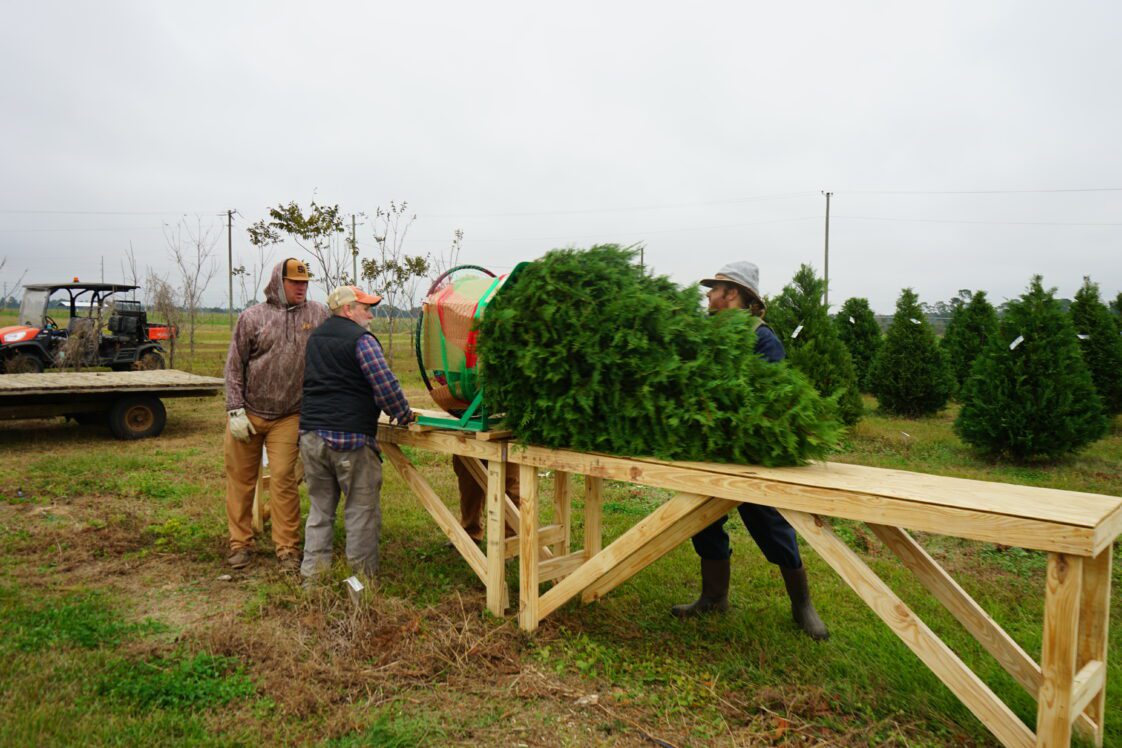
A cut Christmas tree being prepared for transport as part of the Trees for Troops program.
Pickens said he was happy that trees originally planted for research could blossom into tokens of holiday happiness for military families.
“A Christmas tree can make almost anywhere feel like home, even when you are stationed far from your home,” Pickens said. “The idea of contributing to that makes all of us down here at the outlying units feel awesome.”
Sharing Christmas Spirit
Pickens and the team at the Gulf Coast Research and Extension Center conducted a three-year Specialty Crop Block grant for tree production. Funded through the Alabama Department of Agriculture and Industries, the trees were planted to determine tree growth rates and if production could be sped up.
With growers in mind, Pickens and the Alabama Agricultural Experiment Station team continue advancing tree research projects and share their findings through Alabama Extension outreach. However, with the grant winding down, Pickens questioned how to put all those harvest‑ready Christmas trees to use.
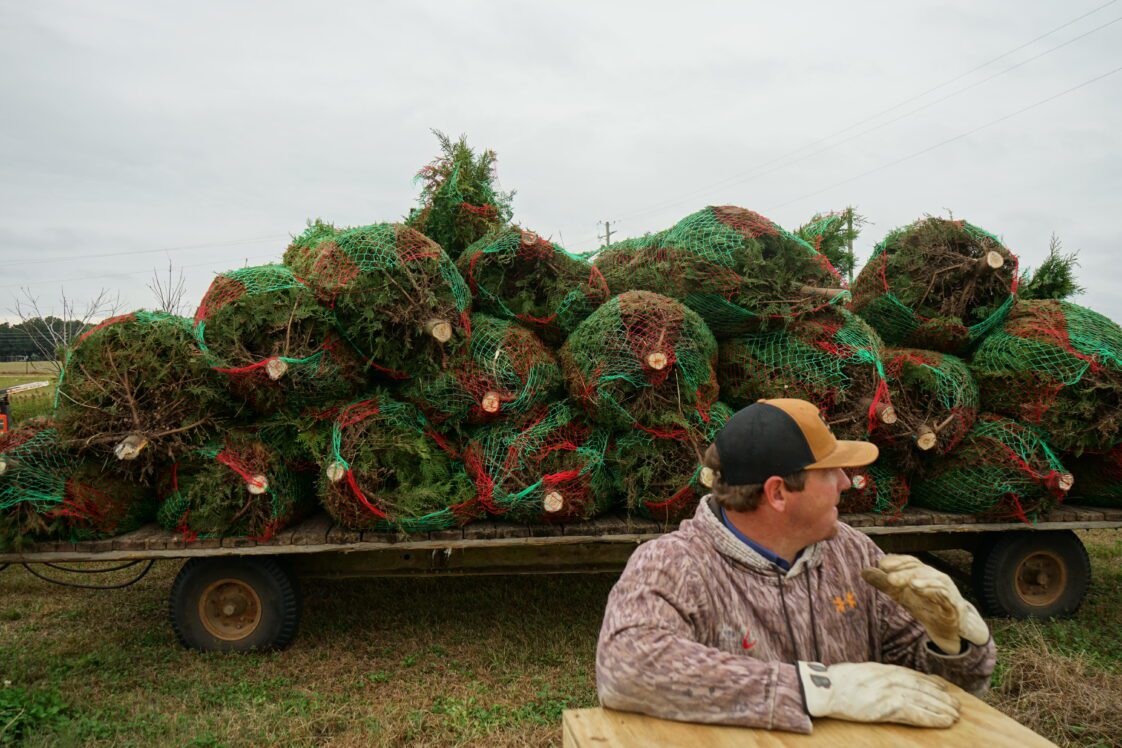
Cut Christmas trees netted and loaded on a trailer for delivery in the Trees for Troops program.
“Last year, I started wondering what the heck I was going to do with 200 Christmas trees. I didn’t want to sell them because I didn’t want to take any business away from our local farms,” Pickens said. “At our annual meeting, Rick Dungey— who heads up Trees for Troops— presented on the program. Halfway through his second slide, I thought, ‘Bingo. That is where our trees are going to go.’”
Jarrod Jones, south regional director of the Alabama Agricultural Experiment Station, said he was excited to find such worthy use of the trees.
“What a unique opportunity for us to donate our Christmas trees to some of our nation’s troops,” Jones said. “We are proud to spread the Christmas spirit.”
Additionally, Fish River Trees— a Christmas tree farm in Fairhope— volunteered to contribute 50 trees to the program. In early December, 250 Christmas trees were transported from the Gulf Coast Research and Extension Center to military families at the Marine Corps Air Station Cherry Point in North Carolina.
Reasons for Research
Before heading to their final destination, those 200 trees provided Pickens and fellow researchers with important information about growing healthy Christmas trees more efficiently and effectively.
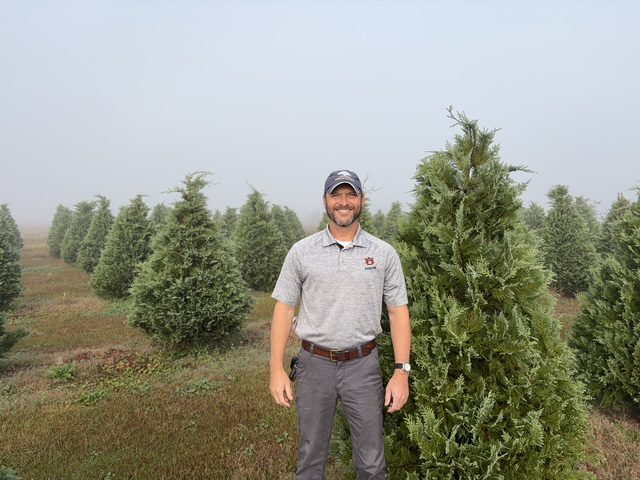
Jeremy Pickens of Alabama Extension with trees that were donated to Trees for Troops after the conclusion of a research project.
As part of the College of Agriculture’s Department of Horticulture, Pickens works closely with growers and producers. While his primary research focuses on ornamental production, he has shifted a lot of that passion into trimming more than just data — now he trims Christmas trees.
“I started working with Christmas tree growers about seven years ago. I am the nursery and greenhouse specialist, and Christmas tree production is very similar to field nurseries,” said Pickens. “During one of my first farm visits, a grower handed me some trimmers and put me to work. I fell in love with it.”
Several years ago, Pickens surveyed Christmas tree growers in Alabama to determine if there was room for improvement in production. When he saw there were opportunities, he and the team analyzed management practices they could test to help growers. With Christmas tree production being a secondary job for many Alabama growers, Pickens plans to continue the tree production research to find practices that save growers time and money.
“We surveyed growers a while back and learned that the time it took to grow a 7- to 8-foot tree varied from farm to farm and ranged from two to five years,” Pickens said. “We also learned that fertilizer practices were all over the place. The growers who grew trees faster fertilized more often. We set a goal to help growers hit a marketable tree in three years.”
Growing Healthier Christmas Trees
As the primary Christmas tree of the southern region, the Leyland Cypress was the chosen species for the three-year research project. As a fast-growing conifer, it is a top choice for choose-and-cut Christmas tree farm operations.
In partnership with the Alabama Department of Agriculture and Industries, Pickens and the Gulf Coast Research and Extension Center team have applied grant funding to study both fertilizer practices and weed management approaches. Passionate about helping producers, Alabama Commissioner of Agriculture and Industries Rick Pate supports projects that improve on‑farm practices.
With the majority of the project happening at the research unit, the team also has some trees at the Ornamental Horticulture Research Center in Mobile. Pickens said the variations in soil types at each location have been striking. Those differences make it clear that their recommendations must be site‑specific.
“At the Gulf Coast Research and Extension Center, we had five nitrogen rates we tested using standard ag grade fertilizer. At the station in Mobile, we fertigated Christmas trees with three different rates,” Pickens said. “We also learned that fertigation allowed us to apply less fertilizer in a more efficient manner.”
Trees for All
Pickens said he is especially proud of the donation made to Trees for Troops. He and all staff of the Alabama Agricultural Experiment hope to continue delivering seasonal goodwill by advancing evergreen research that will ensure healthy, locally grown Christmas trees are available to everyone.
For additional resources on Christmas tree production, visit aces.edu.