
Farming

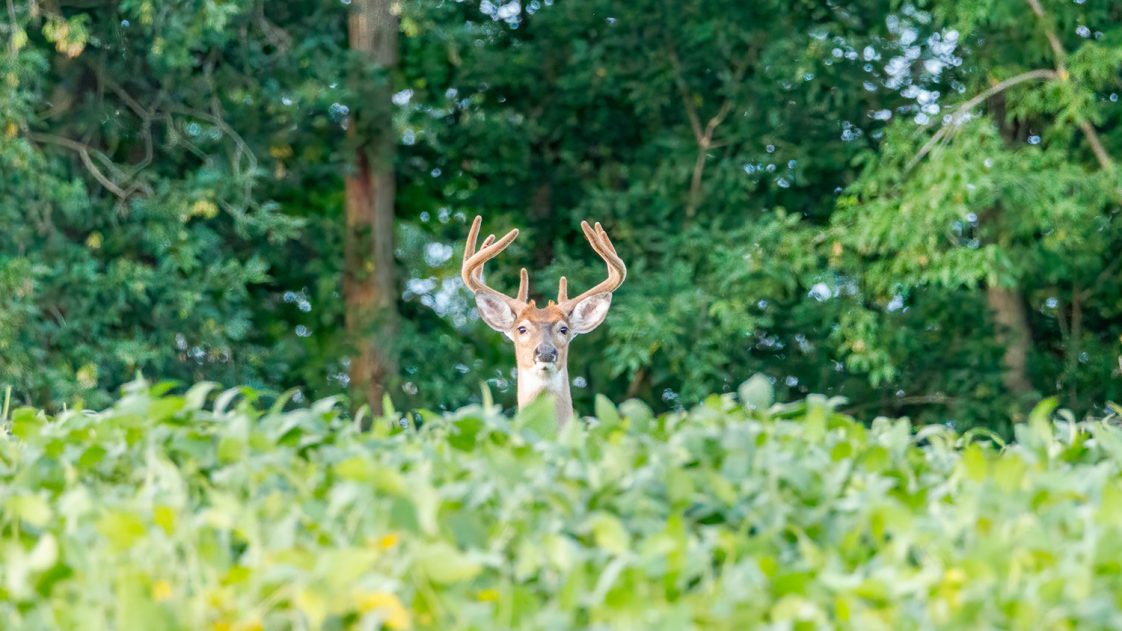
 AUBURN UNIVERSITY, Ala. — What do human hair, sheep fat and rotten eggs have in common? These are all possible solutions being tested for managing Alabama farmers’ deer problem.
From seed selection to pesticide application, row crops farmers work diligently to manage every factor that influences yield. Wildlife damage, however, remains one of the most troublesome aspects to control. In 2023 and 2024, a survey of Alabama farmers showed major impacts to crops across the state. Cotton farmers reported an average of 597 acres affected by deer per respondent, while soybeans growers reported 439 acres affected per respondent. Eros Francisco, an Alabama Extension grain crops agronomist, and the Extension agronomic crops team at Auburn University are working to find solutions for this wildlife damage.
“In recent years, the concern of wildlife pressure in row crops is mounting, especially from deer,” Francisco said. “This project allows us to evaluate what methods are effective and which are not. We are sharing results regionally with our colleagues and with producers through targeted outreach.”
Researching Repellents
In early 2024, a project titled, “Assessing and Evaluating Deer Damage on Crops,” was initiated by the Alabama Farmers Federation Wheat and Feed Grains division. Working with the Alabama Agricultural Experiment Station, the agronomic crops team installed field trials at the Piedmont Research Unit located in Camp Hill, Alabama.
“Inside a 400-acre fenced area with a monitored deer population, our teams worked in two crop cages, comparing crops — one with soybeans and another in cotton — to study how deer respond to row crops and explore ways to reduce damage,” Francisco said.
As mentioned above, human hair, sheep fat and rotten eggs are among the unusual repellent ingredients that the team is evaluating through these trials. Some deer repellents are applied directly to plants in their original composition. Other deterrents come from agricultural waste and by-products, which are applied indirectly or spread around a field perimeter. While the components and application methods differ, all the deterrents attempt to reduce damage in the field.
Currently, the most effective product from the ongoing trial is a spray that has a foliar application. This new and promising product, developed through Auburn research, is still under review and not yet available. Alabama Extension and Auburn University will provide additional details when the product is released.
“In nature, we have about 30 to 45 deer per square mile,” Francisco said. “In the Piedmont Research Unit, there are 150 per square mile, so the pressure is highly increased. Whatever proves effective under that level of pressure is a good sign that the product will likely work well for our growers dealing with typical conditions.”
-
-
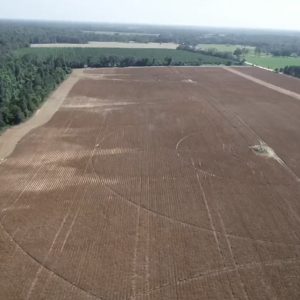
An aerial view of crop
damage caused by deer.
-
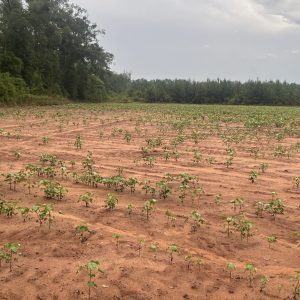
- Deer damage in cotton.
-
-
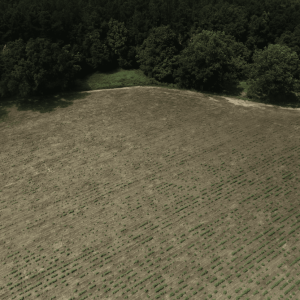
An aerial view of crop
damage caused by deer.
Creating a Boundary
To explore additional solutions, the agronomic crops team is evaluating the viability of boundary crops. To reduce pressure, growers can plant unpalatable crops around their commercial crops. This method protects the more valuable crops planted inside the perimeter.
In separate trials, researchers planted sunn hemp and sesame as boundary crops around soybean fields to evaluate their potential for deterring deer activity. Despite the sesame boundary, the deer consumed soybeans but did not eat the sesame border planted. However, the deer did consume the sunn hemp, which demonstrated its potential as an effective border.
Given these findings, sunn hemp — a summer legume — seems to be the more affordable and successful option of the perimeter crops evaluated. For this strategy to be effective, farmers must plant sunn hemp before the cash crop. When timed correctly, the border crop establishes early growth and attracts deer as it sprouts.
Agronomic Crops Extension Agent Eddie McGriff successfully tested sunn hemp as a boundary crop with a Cherokee County farmer. They planted a 40-foot border around a cotton field. With promising outcomes, the grower only lost 2 acres to deer damage while the deer mainly consumed the boundary crop.
“When you survey cotton and soybean farmers, by far the biggest pests to them are not insects, diseases or nematodes,” McGriff said. “Deer are the biggest pests.”
Actional Approaches
To help farmers respond directly to wildlife pressure, depredation permits were created to allow farmers to protect their crops from wildlife. The Alabama Department of Conservation and Natural Resources issues the permits annually.
Through this program, producers with permits can harvest specified numbers of deer with a firearm during certain time constraints. In addition to depredation permits, farmers also manage deer throughout Alabama’s hunting season. While many producers use this option for its immediate protection, Alabama Extension provides guidance for alternative methods and long-term wildlife management solutions.
Extension Does That!
Even with the help of surveillance and newer technologies, row crop farmers are trying every approach to prevent wildlife from consuming their crops. With that in mind, Alabama Extension and Auburn University professionals are continuing to search for cost-efficient answers that will protect fields.
“Helping farmers understand how to prevent and respond to deer damage in row crops starts with education,” Francisco said. “Alabama Extension does that by translating the research and turning it into applicable solutions for our growers.”
While Extension does work with farmers to improve their operations, that’s just scratching the surface of all the resources available through Alabama Extension. To discover even more about what Extension does, visit aces.edu/discover.