
Farming

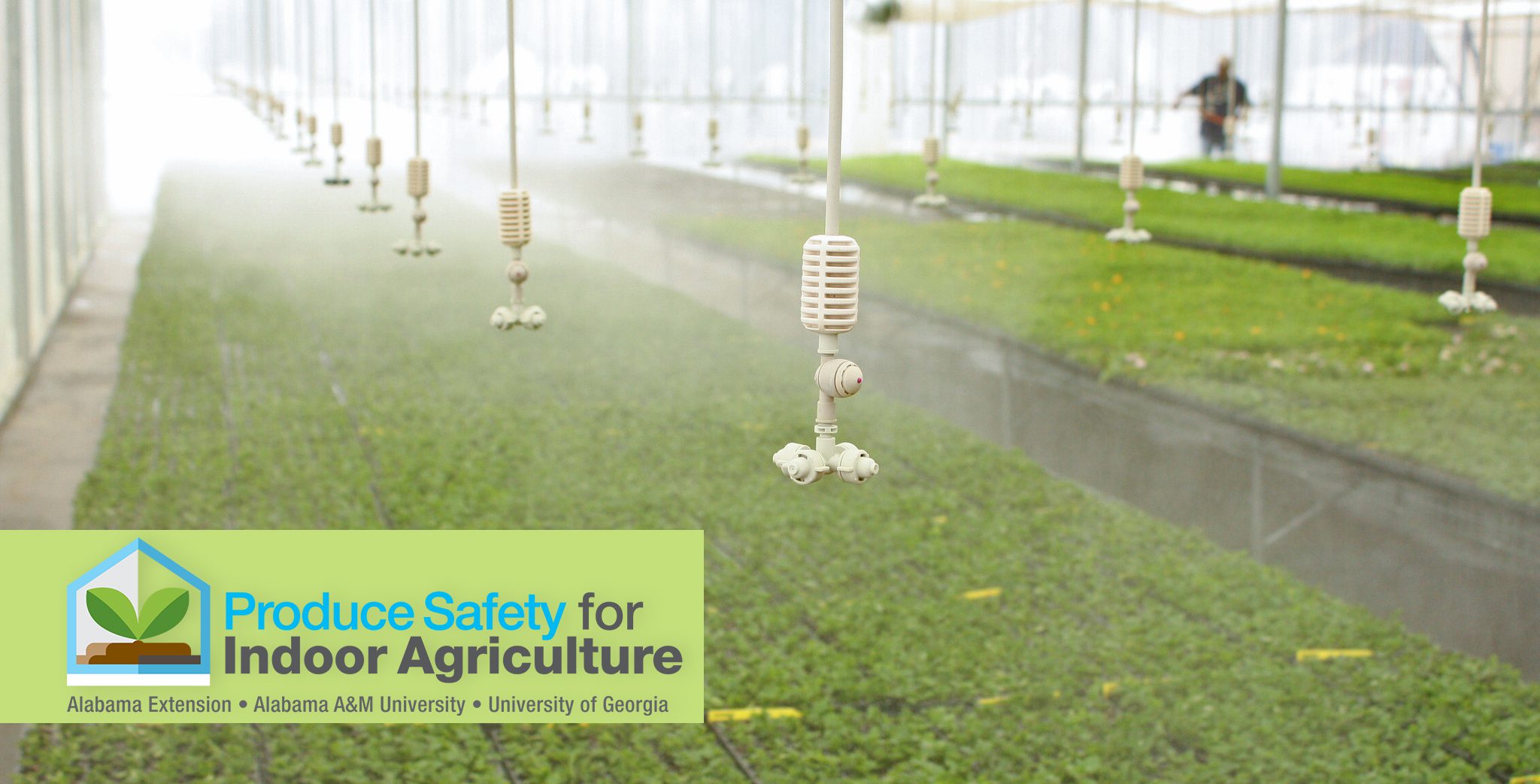
The Produce Safety for Indoor Agriculture program trains indoor agricultural growers on how to identify and implement proper produce safety measures to reduce the risk of food contamination in their operations.
The program is geared toward growers in hydroponic, aquaponic, and other indoor agricultural systems. Providing science-based training materials and educational resources, the trainings address topics such as worker hygiene, water quality, growth media, pest management, harvest and postharvest handling, cleaning and sanitation, food safety planning, and traceability.
How to Participate
Growers, Extension agents, educators, and other industry partners who are interested in training opportunities can contact a member of the project team for more information about upcoming trainings, educational materials, and collaboration opportunities.
Training Modules
Module 1—Introduction
Overview of produce safety risks, contamination sources, and why food safety matters in indoor agriculture.
Module 2a—Basics of Indoor Agriculture Practices
Introduction to hydroponic and aquaponic systems—including nutrient film technique, deep-water-culture, aeroponics, ebb-and-flow, drip, wick, and aquaponic production.
Module 2b—Risk Management Assessment
Guidance on evaluating facility design, layout, equipment, system type, workflow, and potential contamination points.
Module 3—Worker Health & Hygiene
Training requirements, visitor policies, illness reporting, handwashing, hygiene standard operating procedures, and recordkeeping.
Module 4—Growth Media & Raw Materials
Risks associated with growth media, seeds, fertilizers, nutrient solutions, supplier verification, storage, labeling, and traceability.
Module 5—Pests & Animals
Food-safety risks associated with insects, rodents, reptiles, amphibians, domesticated animals, and pest-control programs.
Module 6—Preharvest & Postharvest Water
Water source assessment, tank and line sanitation, recirculated water, water testing locations, treatment options, and documentation.
Module 7—Harvest & Postharvest Practices
Harvest handling, preventing cross contamination, washing, packaging, storing, cooling, transporting, and correcting actions.
Module 8—Cleaning & Sanitizing
Cleaning and sanitizing food-contact surfaces, equipment, containers, tools, tanks, channels, and production areas.
Module 9—Farm Food-Safety Plan & Traceability Program
Key components of a farm food-safety plan, recordkeeping, lot tracking, mock recalls, emergency response, and traceability.
Resources
- Produce Safety for Greenhouse Vegetable Production—Alabama Extension at Auburn University
Team Members
This program is a collaborative effort conducted by the following partners:
Camila Rodrigues (Program Coordinator)
Food Safety and Quality Specialist, Alabama Extension at Auburn University
- Email: crodrigues@auburn.edu
- Phone: 334-758-1107
Armitra Jackson-Davis
Associate Professor of Food Microbiology, Alabama A&M University
- Email: armitra.davis@aamu.edu
Laurel Dunn
Associate Professor and Extension Coordinator, University of Georgia
- Email: laurel.dunn@uga.edu
Rhuanito Ferrarezi
Professor of Controlled Environment Agriculture, University of Georgia
- Email: ferrarezi@uga.edu
Rebecca Catalena
Food Safety and Quality Agent, Alabama Extension at Auburn University
- Email: rjc0026@auburn.edu
Jessica Pizzo
Postdoctoral Fellow, Auburn University
- Email: jzd0148@auburn.edu

Project Funding
This project is supported by the US Department of Agriculture National Institute of Food and Agriculture (USDA NIFA) Food Safety Outreach Program grant no. 22022-70020-37574.
