
Farming

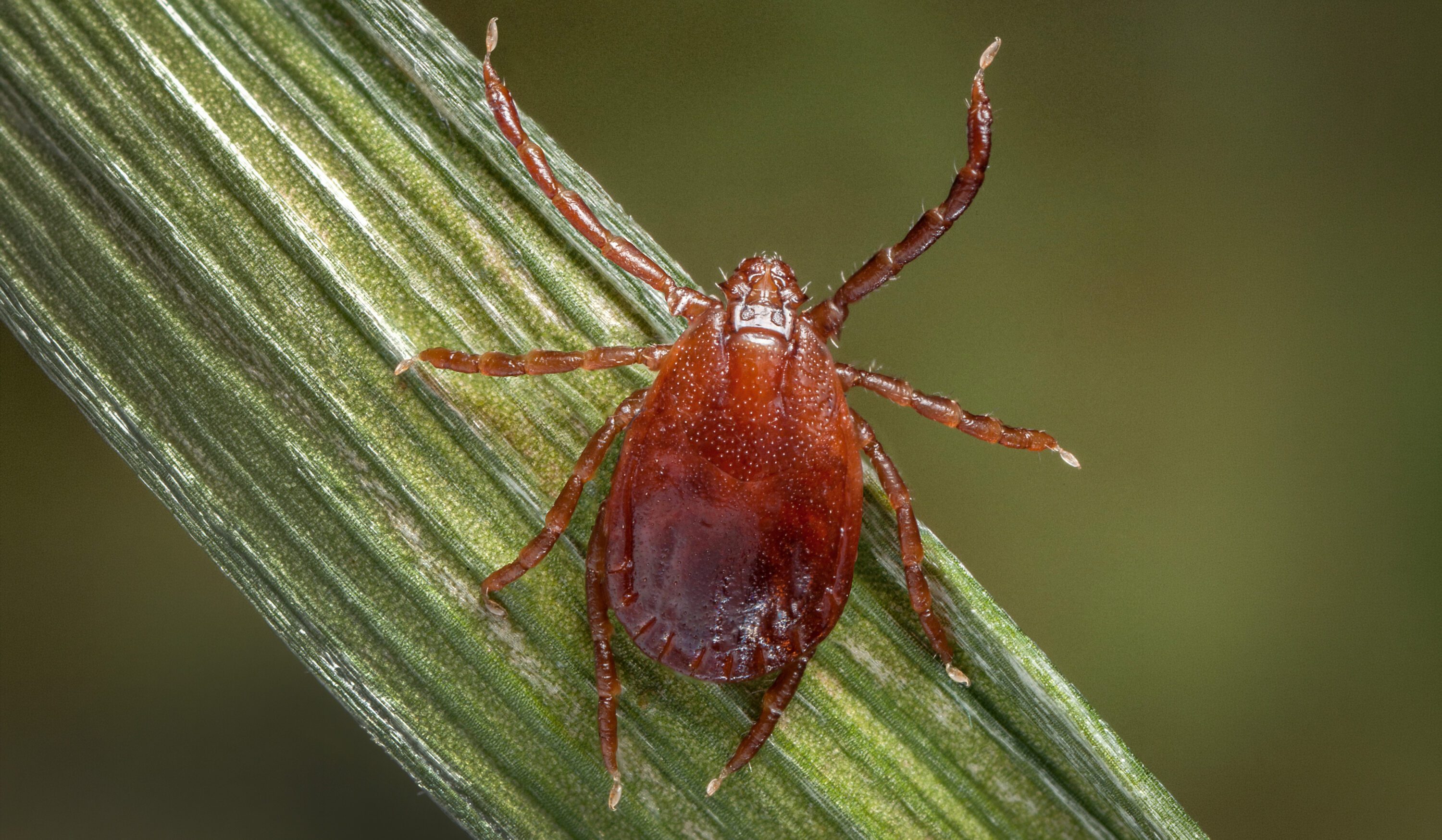
AUBURN UNIVERSITY, Ala. — Alabama livestock and pet owners should be on the lookout for a new pest. Last month, the Asian longhorned tick was detected for the first time in the state on a dog in DeKalb County. While several other tick species are common in Alabama, the reproductive capabilities of this tick create an enhanced health concern for animals.
Xing Ping Hu, an entomologist with Alabama Extension at Auburn University, said the Asian longhorned tick can reproduce both asexually and sexually. In asexual reproduction, one organism is capable of producing offspring without needing another parent.
“At this point, only the asexual form of this tick has been identified in the U.S.,” Hu said. “Because a single female can lay between 1,000 and 2,000 eggs, the Asian longhorned tick can have rapid population growth.”
Likely introduced through imported animals and materials, the Asian longhorned tick was first detected in the U.S. in 2017. Since then, both animal hosts and humans have likely assisted in its spread throughout the country. This tick’s highly adaptable nature and ability to tolerate multiple climates also aids in its population growth.
Key Characteristics
Individually, select features distinguish the Asian longhorned tick from other ticks found in Alabama. While the term “longhorned” does describe a physical characteristic, that feature is not perceptible to the naked eye.
“The ‘longhorned’ part of its name refers to its pair of slightly elongated and laterally flared palps near the mouth,” Hu said. “This feature is only visible under magnification, so it is not a reliable feature to look for in the field.”
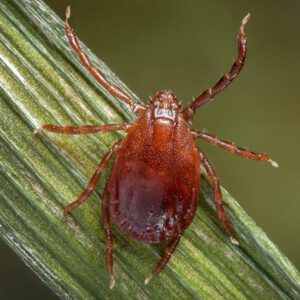
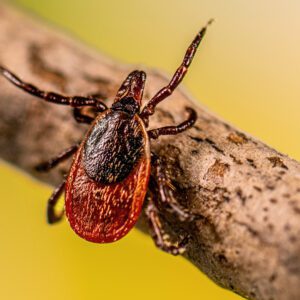
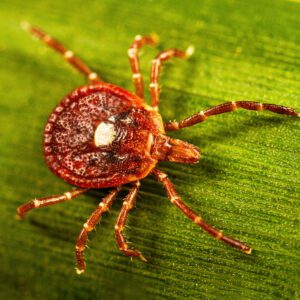
The color of the tick is more reliable for identification. The Asian longhorned tick has a reddish-brown color all over its body, including its legs. In contrast, while the blacklegged tick also has a reddish color on the body, as its name describes, its legs are black. Lone star and American dog ticks both have white markings on their bodies, while the Asian longhorned tick does not.
For livestock producers especially, the color of a tick may be difficult to distinguish out in a field. In those cases, Hu said seeing a large group of small ticks may indicate that they are Asian longhorned ticks.
“The Asian longhorned tick is often found in large clusters on a single host, whereas other common species in Alabama are usually found individually or in small numbers,” Hu said.
-
-
Asian longhorned tick (Haemaphysalis longicornis)
Photo credit: James Gathany, Centers for Disease Control and Prevention
-
-
Blacklegged tick (Ixodes scapularis)
Photo credit: Lauren Bishop, Centers for Disease Control and Prevention
-
-
Lone star tick (Amblyomma americanum)
Photo credit: Lauren Bishop, Centers for Disease Control and Prevention
-
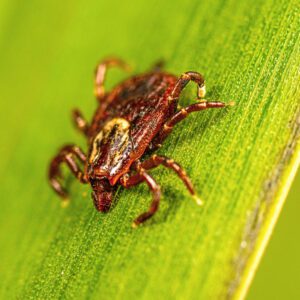
-
American dog tick (Dermacentor variabilis)
Photo credit: Lauren Bishop, Centers for Disease Control and Prevention
Health Threats and Scouting
Dr. Soren Rodning, an Alabama Extension veterinarian at Auburn University, said its rapid growth makes the Asian longhorned tick a double threat for animals.
“Compared to ticks that are more known for disease transmission — like lone star or blacklegged ticks — Asian longhorned ticks are uniquely dangerous because they can both overwhelm animals physically through blood loss and transmit disease,” Rodning said.
Because they reproduce so quickly, Asian longhorned tick infestations are highly visible. This means people can often identify and treat them quickly. However, to accomplish this, people need to routinely inspect their pets or livestock.
If left untreated, Rodning said these ticks often cause systemic illnesses. In large infestations, symptoms and health issues in livestock — especially cattle — can include anemia, weakness, weight loss, jaundice and even death. Pets can exhibit skin irritation, weakness and anemia.
“For scouting purposes, ticks are most active March through November in most regions of the country,” Rodning said. “However, people in the Southeast can expect a longer active season with the potential for nearly year-round vigilance in years with a mild winter.”
Treatment and Control
While the Asian longhorned tick may be new to the state, prevention and treatment of this pest are the same as other ticks. Rodning said an integrated approach is the most effective control option.
“For both livestock and pet owners, the tools are the same, but you have to use them more aggressively and consistently,” Rodning said. “Just like for other ticks, pour-on products, sprays, ear tags and dips can be used. It is best to use these treatments in combination with habitat control and pest monitoring.”
The goal of habitat control is to limit the spaces in which ticks thrive. Depending on the area, this control may be of more importance for livestock producers than it is for pet owners. In pastures, control may include mowing tall grass, removing brush and reducing shaded or wooded edges. Producers may also need to make targeted acaricide (a pesticide that kills mites and ticks) applications or implement prescribed burning where appropriate.
“The arrival of the Asian longhorned tick is more of a population and management problem than it is a treatment problem,” Rodning said. “Livestock producers can work with their local veterinarian to establish a herd-specific management plan.”
For more information, see the Alabama Extension publication, “Managing External Parasites of Beef Cattle in the Southeast.” Producers can find this resource and many others at aces.edu.