
Farm Management

Alabama Extension economists and specialists use different cattle enterprise budgets to assist producers, educators, financial institutions, and industry partners in planning the estimation of costs and returns of cattle operations. Enterprise budgets use broad production assumptions to estimate general production scenarios and potential expenses.
These expenses are compared to potential income for cattle producers based on the expected revenue of feeder and cull animals sold at a projected price using futures contracts and historical local basis data. Enterprise budgets work well for certain cattle enterprises, such as stocker producers, because stocker producers tend to use similar forage and feed production practices and similar husbandry protocols. However, the cow-calf industry in Alabama is a larger and more diverse group of producers that uses numerous production scenarios.
A representative farm model is another way economists can evaluate the costs and profitability potential of an assumed farm structure using specified production practices. To build this representative farm, a group of producers is assembled to determine the characteristics of a hypothetical farm business and come to a consensus of a representative farm, including the equipment needs, production methods, and costs associated with the operation of a given area. A representative farm does not represent any single producer in the group but instead focuses on the collective agreement of the entire group.
Representative farms provide local information that can more accurately reflect the cost of production based on actual practices rather than Extension-recommended practices and cost estimates. Representative farm models are used to construct a representative cost/profit study that describes the operation of a specific size farm in a given region at a specific time. Therefore, by nature, the representative farm is backward, looking to a point in time rather than to future expectations.
This study evaluates three different representative enterprise models: (1) Blackbelt Small Model Farm, (2) Blackbelt Progressive Small Model Farm, and (3) Blackbelt Large Model Farm. Each farm model was built using input from producers, industry professionals, and Extension and university personnel. Producer panels worked as a team to design farm models that they thought best represented the average producer from the Blackbelt region. These model farms are not designed or intended to represent any single producer, nor are they intended to disparage any producer or producer group. These model farms are produced solely as (1) a comparative tool for producers in Alabama to compare production practices between themselves and industry models, (2) to make producers, educators, and industry representatives aware of opportunities to improve profitability opportunities for Alabama cow-calf producers, and (3) to assist educators in designing and presenting programming to assist Alabama cow-calf producers maintain and improve economic sustainability.
Blackbelt Small Model Farm
The representative Blackbelt small herd has thirty brood cows and one bull. The herd has a calving percentage of 80 percent, utilizes perennial pasture, and does not use a calving season. The Blackbelt Small Model Farm had gross returns of $1,036.88 per cow-calf unit, with variable costs of $949.60 per cow-calf unit and total costs of $1,058.59 per cow-calf unit. The net returns per cow for the Blackbelt Small Model Farm for the fall of 2023 were $87.08 for returns over variable cost and -$21.91 for returns over total cost.
Blackbelt Small Model Farm, ANR-3148
Notes: Labor excluded. Columns may not equal 100 because of rounding errors.
| Income | Description | Herd | Per Cow Unit | % |
|---|---|---|---|---|
| Bull calf income | $14,375.00 | $479.17 | 46% | |
| Heifer calf income | $12,937.50 | $431.25 | 42% | |
| Cull cow income | $3,458.00 | $115.27 | 11% | |
| Cull bull income | $330.00 | $11.00 | 1% | |
| Total | $31,100.50 | $1,036.68 | 100% | |
| Expenses | ||||
| Pasture | $5,214.38 | $173.81 | 18% | |
| Feed | $9,580.00 | $319.33 | 34% | |
| Animal health | $210.00 | $7.00 | 1% | |
| Cow replacement cost | $6,483.75 | $216.13 | 23% | |
| Bull replacement cost | $600.00 | $20.00 | 2% | |
| Pasture rental | - | - | 0% | |
| Interest payment on land | $900.00 | $30.00 | 3% | |
| Accounting and legal | - | - | 0% | |
| Phone, utilities, internet | - | - | 0% | |
| Repairs, maintenance, supplies | $3,000.00 | $100.00 | 11% | |
| Fuel and lube | $2,500.00 | $83.33 | 9% | |
| Miscellaneous | - | - | 0% | |
| Total | $28,488.13 | $949.60 | 100% | |
| Profit/loss | $2,612.38 | $87.08 | ||
| Depreciation of equipment and facilities | $3,269.70 | $108.99 | ||
| Profit/loss with depreciation | $(657.33) | $(21.91) | ||
| Profit/loss with only pasture, feed, and health costs | $16,306.13 | $536.54 |
Blackbelt Progressive Small Model Farm
The representative Blackbelt progressive small herd has 30 brood cows and 1 bull. The herd has a calving percentage of 90 percent, utilizes perennial pasture, and overseeded winter annual pastures. This farm does use a defined calving season. The representative Blackbelt Progressive Small Model Farm had gross returns of $1,675.24 per cow-calf unit, with variable costs of $1,579.67 per cow-calf unit and total costs of $1,856.17 per cow-calf unit. The net returns per cow for the Blackbelt Progressive Small Model Farm for the fall of 2023 were $95.57 over variable costs and -$180.93 over total cost.
Blackbelt Progressive Small Model Farm, ANR-3148
Notes: Labor excluded. Columns may not equal 100 because of rounding errors.
| Income | Description | Herd | Per Cow Unit | % |
|---|---|---|---|---|
| Bull calf income | $23,692.50 | $789.75 | 47% | |
| Heifer calf income | $19,125.00 | $637.50 | 38% | |
| Cull cow income | $6,616.35 | $220.55 | 13% | |
| Cull Bull Income | $823.33 | $27.44 | 2% | |
| Excess hay sales (200 rolls) | $15,000.00 | $500.00 | 30% | |
| Total | $50,257.18 | $1,675.24 | 100% | |
| Expenses | ||||
| Pasture | $12,383.75 | $412.79 | 26% | |
| Feed | $8,553.50 | $285.12 | 18% | |
| Animal health | $2,066.20 | $68.87 | 4% | |
| Cow replacement cost | $8,970.00 | $299.00 | 19% | |
| Bull replacement cost | $1,666.67 | $55.56 | 4% | |
| Pasture rental | $1,350.00 | $45.00 | 3% | |
| Interest payment on land | $800.00 | $26.67 | 2% | |
| Accounting and legal | $350.00 | $11.67 | 1% | |
| Phone, utilities, and internet | - | - | 0% | |
| Repairs, maintenance, and supplies | $5,000.00 | $166.67 | 11% | |
| Fuel and lube | $5,000.00 | $166.67 | 11% | |
| Miscellaneous | $1,250.00 | $41.67 | 3% | |
| Total | $47,390.12 | $1,579.67 | 100% | |
| Profit/loss | $2,867.07 | $95.57 | ||
| Depreciation of equipment and facilities | $8,295.04 | $276.50 | ||
| Profit/loss with depreciation | $(5,427.97) | $(180.93) | ||
| Profit/loss with only pasture, feed, and health costs | $29,319.93 | $908.46 |
Blackbelt Large Model Farm
The representative Blackbelt large herd had 350 cows and 17 bulls. This herd had a calving percentage of 86 percent, utilizes summer perennial and winter annual pastures, and does have a defined calving season. The Blackbelt Large Model Farm had gross returns of $1,883.90 per cow-calf unit, with variable costs of $1,608.83 per cow-calf unit and total costs of $1,771.06 per cow-calf unit. The net returns per cow for the Blackbelt Large Model Farm for the fall of 2023 were $275.07 over variable costs and $112.84 over total cost.
Blackbelt Large Model Farm, ANR-3148
Notes: Labor excluded. Columns may not equal 100 because of rounding errors.
| Income | Description | Herd | Per Cow Unit | % |
|---|---|---|---|---|
| Bull calf income | $301,901.25 | $862.58 | 46% | |
| Heifer calf income | $248,062.50 | $708.75 | 38% | |
| Cull cow income | $97,240.50 | $277.83 | 15% | |
| Cull bull income | $12,160.00 | $34.74 | 2% | |
| Total | $659,364.25 | $1,883.90 | 100% | |
| Expenses | ||||
| Pasture | $213,864.50 | $611.04 | 38% | |
| Feed | $113,801.50 | $325.15 | 20% | |
| Animal health | $11,522.98 | $32.92 | 2% | |
| Cow replacement cost | $117,468.75 | $335.63 | 21% | |
| Bull replacement cost | $24,000.00 | $68.57 | 4% | |
| Pasture rental | $42,000.00 | $120.00 | 7% | |
| Interest payment on land | $7,933.33 | $22.67 | 1% | |
| Accounting and legal | $1,500.00 | $4.29 | 0% | |
| Phone, utilities, and internet | - | - | 0% | |
| Repairs, maintenance, and supplies | $15,000.00 | $42.86 | 3% | |
| Fuel and lube | $15,000.00 | $42.86 | 3% | |
| Truck, equipment, and liability insurance | $1,000.00 | $2.86 | ||
| Miscellaneous | - | - | 0% | |
| Total | $563,091.06 | $1,608.83 | 100% | |
| Profit/loss | $96,273.19 | $275.07 | ||
| Depreciation of equipment and facilities | $56,779.00 | $162.23 | ||
| Profit/loss with depreciation | $39,494.19 | $112.84 | ||
| Profit/loss with only pasture, feed, and health costs | $331,698.25 | $914.79 |
Returns and Costs Per Cow-Calf Unit by Representative Farm, ANR-3148
| Farm Model | Gross Returns | Variable Cost | Total Cost | Net Returns Over Variable Costs | Net Returns Over Total Costs |
|---|---|---|---|---|---|
| Blackbelt Small Farm | $1,036.68 | $949.60 | $1,058.59 | $87.08 | -$21.91 |
| Blackbelt Small Progressive Farm | $1,675.24 | $1,579.67 | $1,856.17 | $95.57 | -$180.93 |
| Blackbelt Large Farm | $1,883.90 | $1,608.83 | $1,771.06 | $275.07 | $112.84 |
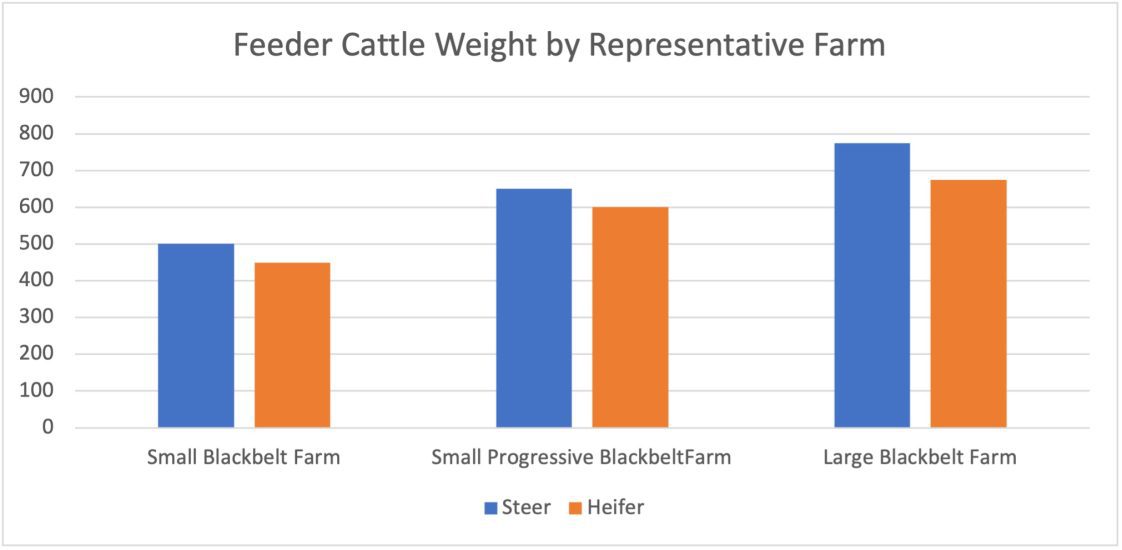
Differences in profit and loss between farms were primarily affected by (1) calf weight, (2) prices received, and (3) variable costs. The Blackbelt Small Model Farm reported lower calf prices and lower calving percentage than the Blackbelt Progressive Small Model Farm and the Blackbelt Large Model Farm. The Blackbelt Progressive Small Model Farm herd had higher variable cost per cow-calf unit than the Blackbelt Small Model Farm. Variable cost differences between the two systems were primarily driven by increased pasture and animal health expenses for the progressive herd.

Variable costs for the Blackbelt Small Model Farm were below the projected national average (obtained from Livestock Marketing Information Center [LMIC] and United States Department of Agriculture [USDA] estimates). Both the Blackbelt Progressive Small Model Farm and the Blackbelt Large Model Farm were above the nationally calculated (LMIC) average for variable costs by $496.40 and $171.38, respectively. This was directly correlated to replacement costs of cattle during a very strong cattle price cycle.
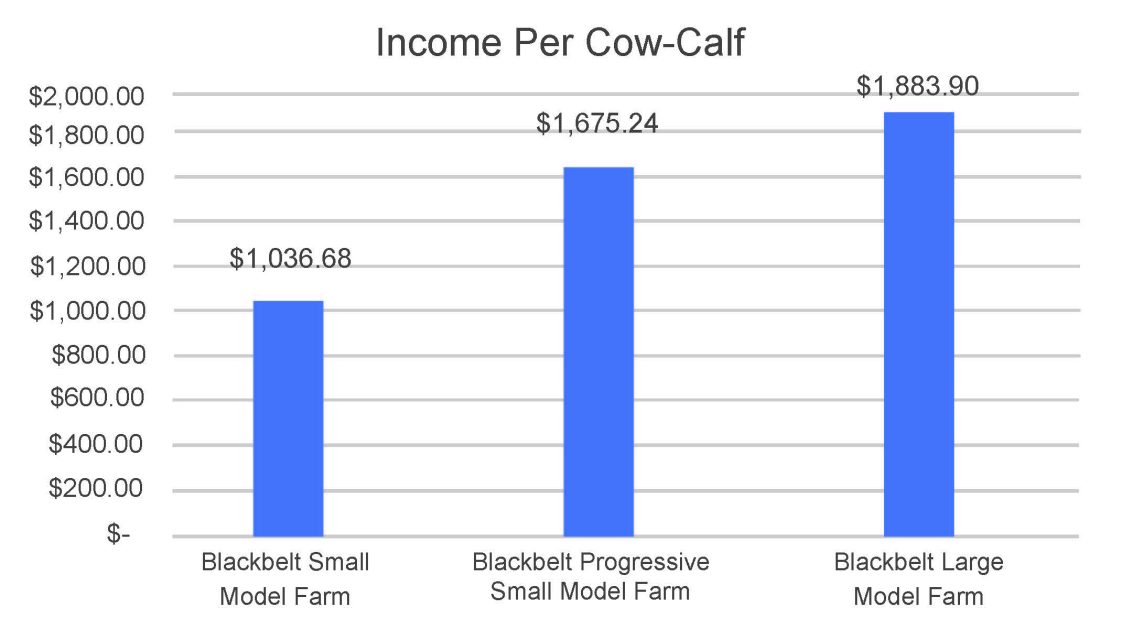
The drivers for income per cow/calf are calving percentage, weight of calves, and price of calves. Smaller farms tended to get lower calf prices and wean lighter calves than the larger producers.
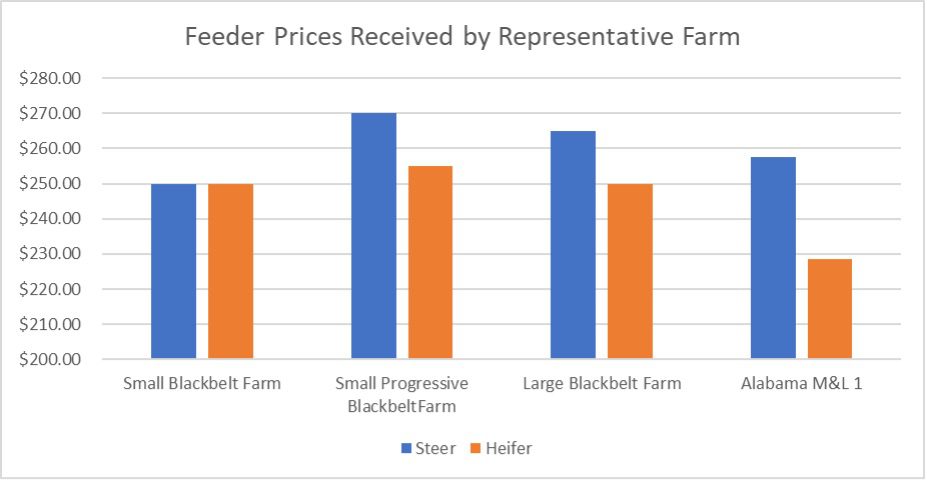
*** Alabama M&L 1 calves refers to feeder calf prices sold through Alabama stockyards as recorded by the USDA Marketing Service in October and November 2024.
Profit Over Pasture, Feed, and Health (Per Cow), ANR-3148
| Farm Model | Pasture Costs | Feed Costs | Health Costs | Profit/Loss |
|---|---|---|---|---|
| Blackbelt Small Model Farm | $173.81 | $319.33 | $7.00 | $536.54 |
| Blackbelt Small Progressive Model Farm | $412.79 | $285.12 | $68.87 | $908.46 |
| Blackbelt Large Model Farm | $611.04 | $325.15 | $32.92 | $914.79 |
Many producers choose not to consider the costs associated with the replacement of breeding stock, insurance, depreciation, interest, and often returns to management. While this is certainly not wise if producers wish to grow their net worth, this is often the minimum that will allow producers to continue farming. The Profit Over Pasture, Feed, and Health (Per Cow) chart shows that all the model farms covered those expenses when only the co-op and vet costs are considered. However, this doesn’t reflect the amount of capital spent on fixed costs, such as machinery, implements, buildings, and other facilities that have a depreciable value. These depreciable assets represent a loss of value due to wear, tear, age, and obsolescence. In other words, they will never be worth today what you paid for them yesterday. It also does not consider development costs of replacements, the cost of machinery repair, fuel and maintenance of vehicles, insurance, accounting, or the opportunity costs associated with dedicated pasture for that purpose.
Labor
Labor was excluded from these representative farms, although data were collected during the information gathering process. The small farms reported no hired labor, whereas the larger farms both reported some day and continuous farm labor requirements. However, both numbers are skewed and difficult to apply with any academic confidence. The small farms chose not to include personal and family labor, while the large farms operated multiple enterprises, requiring labor to be divided among various farm activities. There should always be some allowance for income for all participants in a farming operation (even family). Likewise, labor utilized among various enterprises should be equitably divided (even though it often is not). Each producer should carefully evaluate their labor situation and consider it when calculating their final profit or loss for a given enterprise.
Recommendations for Black Belt Producers
Basic observations from the Blackbelt model farms:
- Reproductive efficiency is an issue on most of our small Blackbelt farms. Weaning percentages fell into the 70s in worst-case scenarios. Producers should consider better recordkeeping, implementation of a breeding season, pregnancy and BSE checks for breeding animals, vaccination, and other progressive health protocols as well as culling of nonproductive animals. Breeding seasons and grouping of animals into similar production stages allow for the most efficient and least cost feeding and health protocol programs at little to no extra expense. Recordkeeping can be as simple as a notebook and pen, with minimum cost that makes it possible for a manager to know which animals are not productive and remove them from the herd. Health protocols are relatively inexpensive and can help improve reproductive efficiency.
- Feed costs (including pasture) are major expenses for livestock producers, and, as such, any protocol that can be adopted to improve grazing production and efficiency likely to be profitable. Prescription fertility plans based on soil sampling, rotational grazing, and weed management have all proven to improve forage stand, quality, and nutritional levels.
- Equipment (including implements), buildings, and facilities represent a large overhead of depreciable items. If producers are attempting to be profitable, minimizing these items should be considered. This is not to say that equipment, buildings, and facilities are not a necessary component of a farming operation because they are.
- Cattle prices drive up income directly and expenses indirectly. Cattle producers should be aware that even as higher feeder cattle prices increase income, they also drive replacement costs higher for both purchased and developed breeding stock.
 Ken Kelley, Extension Agent, Farm and Agribusiness Management, ACES-AFNR-Field; David Daniel, County Extension Director; Max Runge, Extension Professor, Animal Sciences and Forages; and Wendiam Sawadgo, Extension Economist, Assistant Professor, Agricultural Economics and Rural Sociology, all with Auburn University
New June 2025, Blackbelt Cow-Calf Enterprise Cost Study, ANR-3148