
Crop Production

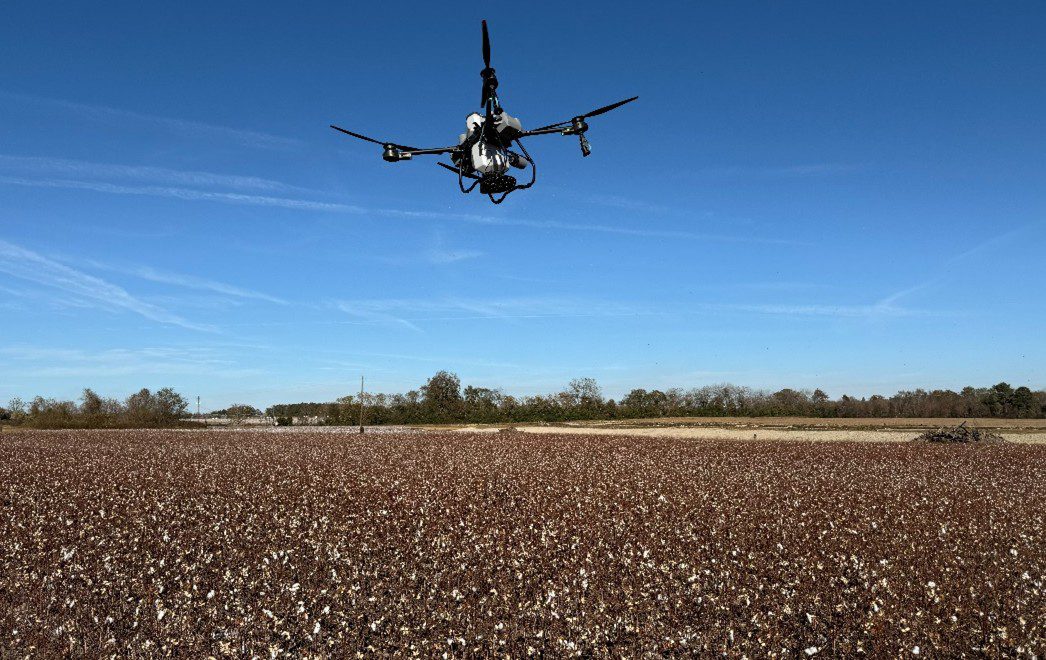
The use of application drones has increased rapidly in agriculture. This includes their fast-growing value in seeding cover crops.
The use of drones to apply pesticides to agricultural fields and crops has grown rapidly in the United States. Consequently, their use for spreading small, solid, dry materials, such as cover crop seeds, granular fertilizer, and pesticides, is also expanding rapidly, as most new drone platforms come with an interchangeable dry-spreading system (figure 1) that can be easily swapped with the liquid-solution tank. While broadcasting granular fertilizer and other dry products is slowly gaining traction, aerial seeding of cover crops is among the most common and fastest-growing drone applications. With advances in drone platforms and technology, the capabilities of drone-based dry-spreading systems are evolving rapidly, leading to increased use for aerial seeding and other dry-material applications in agriculture.
-
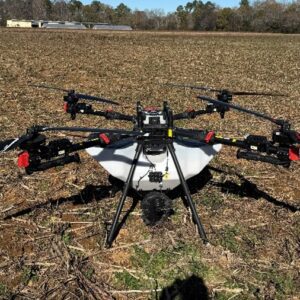
- Figure 1a. An agricultural drone with the dry spreader attachment.
-
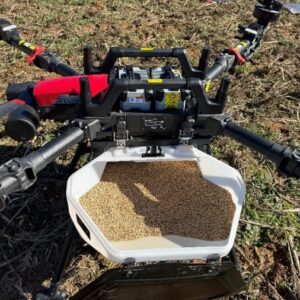
- Figure 1b. An agricultural drone with a tank containing cereal rye seed.
-
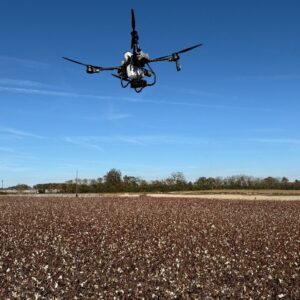
- Figure 2. An agricultural drone broadcasting cereal rye seed in a recently harvested cotton field.
Benefits of Aerial Seeding with Drones
Seeding cover crops with drones offers several advantages over traditional seeding methods, such as using ground-based drills or broadcast spreaders. The following are some of the main advantages:
Application Timing. Cover crops need to be seeded at specific times to maximize their benefits. Drones allow the spreading (broadcasting) of cover crops both before harvest into the standing cash crop and after harvest, thereby providing greater flexibility in application timing.
Minimal Soil Disturbance. Drones can broadcast seeds without traversing fields, thereby avoiding soil compaction and disruption typically associated with drills and other ground machinery.
Increased Accessibility. Drones can be used to spread cover crop seed in fields or certain parts of the fields that are otherwise inaccessible to ground equipment due to terraces or wet conditions.
Transportability. Drones can be easily transported and used by growers who either lack access to traditional seeding equipment or cannot use manned aircraft due to smaller or irregularly shaped fields.
Increased Efficiency. Drones operate at significantly higher speeds than traditional ground equipment, enabling them to cover large areas quickly, even with repeated tank refills and battery replacements.
Overview of Dry Spreading System on Drones
The dry spreading system on most drones comes as a separate attachment and consists of three main components: a tank, a metering mechanism, and a broadcast system. Detailed information on these components is provided below:
Tank/Hopper. The dry tank, also known as a hopper, holds the product (seed) and is typically located near the center of the platform to improve weight distribution. Most hoppers are funnel-shaped to facilitate the release or delivery of products to the metering system (figure 3). The dry tank capacity on the latest drone models ranges from 55 to 220 pounds and is expected to increase with drone size. A weight sensor (or multiple sensors on some models) is usually located between the tank and the main frame, which is used to calibrate and determine the amount of material remaining in the tank during application. Some of the latest drone models also have a small agitator to prevent the material from bridging at the bottom of the tank.
-
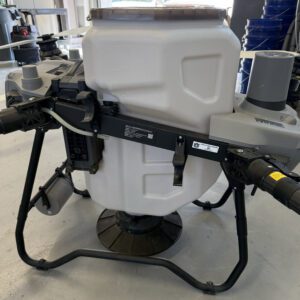
- Figure 3a. Dry tank (hopper) available in different shapes and sizes on commercial agricultural drones: DJI Agras T50.
-
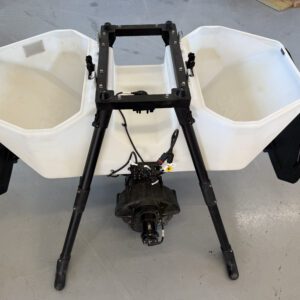
- Figure 3b. Dry tank (hopper) available in different shapes and sizes on commercial agricultural drones: XAG P150.
Metering System. The metering mechanism is located directly underneath the hopper and meters and delivers the target amount of material (seed) to the spreading system. Currently, two types of metering systems (gravity-based hopper metering gate and auger type) are common on the latest drone models (figures 4a and 4b, respectively). The gravity-fed system uses a circular metering gate with slots of different sizes. The gate opening is adjusted to regulate material flow based on the target application rate. In contrast, the auger-type system uses a horizontally mounted auger to meter material from the hopper onto the spreading system. For both systems, different metering gates (with varying openings) and auger sizes (with varying pitch) are available to meter cover crop seed and other dry products of different shapes, sizes, and densities.
-
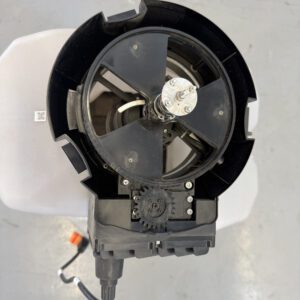
- Figure 4a. A gravity-fed metering gate system available on commercial drones for metering dry materials, including cover crop seed.
-
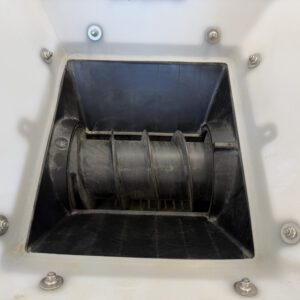
- Figure 4b. An auger-type system available on commercial drones for metering dry materials, including cover crop seed.
Spreading System. The spreading system, located either directly beneath or to the side of the metering mechanism under the tank, helps broadcast the material within the swath. The most common spreading mechanism on commercial drones is a horizontally mounted single rotary disc with straight or angled vanes (figure 5a). The disc size and vanes vary among different drone manufacturers and models. In some drone models, a vertically mounted single- or dual-disc with baffles (figure 5b) is also used to broadcast the material across the swath. In both cases, the rotational speed of the horizontal disc or the oscillation of the vertical spreading system can usually be changed from the remote controller to adjust the spreading swath based on the type of material being spread.
-
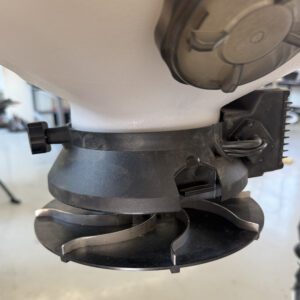
- Figure 5a. Spreading systems available on commercial drones: a single rotary disc with curved vanes mounted under the hopper.
-
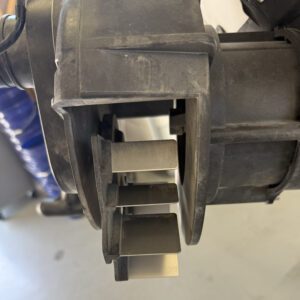
- Figure 5b. Spreading systems available on commercial drones: a vertically mounted disc with baffles that oscillate back and forth.
Seeding Operation and Application Parameters
While drones can be operated in manual mode using the remote controller, most seeding applications are autonomous with minimal operator intervention during flight. The seeding operation involves an operator creating a flight plan for the target area or field and entering the desired application parameters into the remote controller (figure 6) for the cover crop seed or mixture to be spread, taking into account the field and weather conditions. Some of the main parameters for seeding applications are as follows:
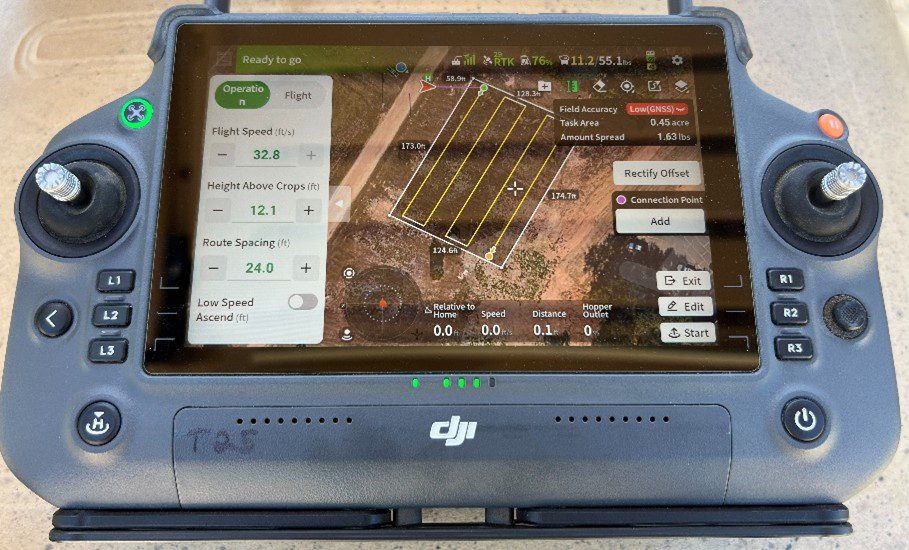
Figure 6. Controller screen showing the flight plan and user-entered application parameters such as route spacing, flight speed, and application height specific to a seeding operation.
Application Rate. The application rate is the target seeding rate in pounds per acre (pounds per acre) for the cover crop seed to be broadcast. The nominal application rates for aerial seeding with drones range from 20 to 60 pounds per acre and can vary depending on the species or cover crop mix. The rates applied with larger drones can also be higher due to greater tank and spreading capacity.
Flight Height. The flight height is the drone’s altitude above the crop or the ground. Nominal flight height ranges between 10 and 20 feet based on field or crop conditions, but can also be higher in some cases to avoid obstructions in the field or due to the varying topography.
Flight Speed. Flight speed is the drone’s speed during the application, usually entered in feet per second (ft/s). Most seeding operations are conducted at maximum speed to maximize field efficiency; however, some operators prefer to reduce flight speed to improve product spreading, depending on other field and environmental factors. The maximum speed of current agricultural drones ranges from 20 to 65 feet per second (14 to 44 miles per hour), depending on the model.
Route Spacing. This represents the pass-to-pass distance for the drone during the seeding operation and is based on the effective spread swath for material being applied. The route spacing, or spread swath, can range from 15 to 30 feet (or greater on newer models), depending on the material type and other operational parameters, specifically flight height and spinner-disc speed, and must be determined through proper calibration procedures.
Disc Speed. The disc speed is the speed of the spinner-disc in rotations per minute (rpm) for drones equipped with horizontal rotary disc spreaders. The spinner-disc speed can range from 400 to 1300 rpm, depending on the drone manufacturer and model. Higher disc speeds generally increase swath width, and vice versa. In some drone models, the disc speed is fixed or automatically adjusted based on other operational parameters and the material being spread.
During the flight, the display on the controller also provides real-time information on some parameters such as hopper gate opening (or flow rate), tank level, battery life, and the amount of material spread, so operators can monitor the seeding application, observe the material remaining in the tank, and determine when to change the batteries. Through the controller, the operator can also modify or visualize other drone settings, such as take-off and landing positions and the drone’s location within the field during seeding. Most drones also have a front-mounted camera that provides the drone’s field of view to the operator on the controller display during flight.
Considerations for Cover Crop Seeding with Drones
With the increasing availability of newer drones and improvements in their capabilities, their use for seeding cover crops (and other dry materials) is likely to continue to expand. Operators should consider the following for effective aerial seeding of cover crops with drones:
Seeding Rate. While newer drone models can handle higher application rates, drones tend to be more efficient for spreading cover crops at seeding rates (usually ranging from 20 to 60 pounds per acre), which are generally lower than those of traditional methods, such as a drill. This also makes drones more advantageous for spreading cover crop seed that is typically applied at lower rates, such as clover and brassicas. Before application, the actual seeding rate applied by the drone must be verified and compared with the target rate to avoid under- or overapplication. In some cases, aerial seeding rates may need to be increased by 20 percent to 50 percent to compensate for surface predation by birds and rodents or for lower emergence rates.
Drone Calibration. Spreading different types of cover crop seed or mixes—varying in shape and size—requires proper calibration of the metering and spreading mechanism to ensure accurate and uniform application. For the material being applied, a proper static flow rate calibration should be performed to ensure the accuracy of the applied rate, while standard pan testing is recommended to determine operational parameters such as flight height and speed, spinner-disc speed, etc., that ensure uniform material distribution within the swath. Similarly, proper calibration is important for determining an effective spread swath that ensures that the material is spread at the desired rate and uniformly across the swath.
Cover Crop Mixes. In general, it is easier to calibrate a drone for a single cover crop species, such as cereal rye, ryegrass, or clover, due to similar physical properties and to ensure an effective application. Therefore, spreading certain cover crop mixes with drones may pose challenges due to differences in their physical properties (seed size, weight, and density), resulting in inefficient application. Proper drone calibration to ensure an accurate seeding rate of a cover crop mix may also be challenging in such situations. Hence, it may be more appropriate to spread each species separately to ensure uniform application, even though it will add significant time and effort to the spreading operation.
Timing and Soil Moisture. With drones, cover crop seeds are broadcast onto the soil surface or into a standing cash crop; therefore, proper seed-to-soil contact is important to ensure timely and uniform emergence. This can be accomplished either by incorporating the seed with light tillage or by broadcasting the seed before a forecasted rain event. Adequate soil moisture is crucial for the successful establishment of a cover crop seed applied with a drone.
Tank Refills. Commercial seeding applications with drones require multiple tank refills throughout the day. While pouring material directly into the tank from 50-pound bags is an option used by some operators, it is better to develop your own easy-to-use system or invest in a dry-material tending system that makes refilling easier and more efficient. A large tender tank and a pneumatic-type conveying system are common and popular options among custom drone operators.
Payload and Battery Capacity. While newer drones can currently carry loads of up to 220 pounds per flight, one of the biggest limitations of drones is their limited battery life, often requiring a battery swap after 5 to 10 minutes. Therefore, completely filling the tank may not be advantageous in most cases and would also drain the battery quickly. The ideal situation is to refill the tank to a level based on the target seeding rate, so the tank refill and battery replacement can be completed simultaneously. Another important consideration is to use a suitable generator (of sufficient size and capacity) that can charge the batteries quickly and efficiently, preventing uncharged batteries from becoming a bottleneck during the spreading operation.
Weather Conditions. While newer drones can safely operate in high wind speeds, the propensity for seed drift increases considerably under such conditions, affecting spreading swath and distribution. The small, lighter seeds, such as radish and clover, can also easily drift away even at low wind speeds; therefore, operators must be vigilant about the weather and use drones to spread only when effective, uniform seeding applications are possible under prevailing conditions.
Seeding Costs and Incentives. Custom seeding rates for drones usually range from $10 to $20 per acre (excluding seed) but can vary by state and even among operators. In some cases, it may be more expensive per acre to seed with drones than to drill, but it may be more advantageous in small, irregular fields. Many USDA NRCS programs offer incentives for planting cover crops, including seeding with drones, that can help offset some of the associated costs. Growers and operators should check their state-specific guidelines to determine if drone seeding is allowed and covered under those programs.

Simerjeet Virk, Extension Specialist, Associate Professor, Biosystems Engineering; Jacob Sizemore, Graduate Student, Biosystems Engineering; Audrey Gamble, Associate Professor, Crop, Soil, and Environmental Sciences; and Steve Li, Extension Specialist, Associate Professor, Crop, Soil, and Environmental Sciences, all with Auburn University
New July 2026, Use of Drones for Aerial Seeding of Cover Crops, ANR-3279
For more information, contact your county Extension office. Visit aces.edu/directory.
Trade and brand names used in this publication are given for information purposes only. No guarantee, endorsement, or discrimination among comparable products is intended or implied by the Alabama Cooperative Extension System.