
Crop Production

Another planting season is just around the corner for most of Alabama. In fact, a few corn planters are already rolling across fields in the southeastern part of the state.
With high input costs and low commodity prices, this is going to be another challenging year for growers. Taking the time to properly set up and calibrate every piece of equipment on the farm will go a long way to ensure the best use of crop inputs.
Planter Seeding-Rate Issues in Trials
Every year, Alabama Extension at Auburn University conducts numerous on-farm planter trials. Extension staff collect a lot of data on the performance about different planter types.
While reviewing the 2025 data across studies, one notable finding was the amount of seeding rate issues by various planters, particularly over-seeding. The data in the table below shows this for a few trials in corn and cotton.
Seeding Rate Issues
| Crop and Target Seeding Rate (seeds/acre) | Plant Population (plants/acre) | Over-Seeding (seeds/acre) | Cost of Extra Seed ($/acre) |
|---|---|---|---|
| Corn at 24,000 | 25,943 | 1,943 | 6 |
| Corn at 28,000 | 31,749 | 3,749 | 12 |
| Corn at 32,000 | 33,140 | 1,140 | 4 |
| Cotton at 21,000 | 23,710 | 2,710 | 8 |
| Cotton at 28,200 | 31,308 | 3,108 | 9 |
| Cotton at 37,600 | 42,907 | 5,307 | 15 |
A quick cost analysis, using nominal seed prices for a bag of corn and cotton seed, suggested these mistakes cost $4 to $15 per acre. In some cases, the cost was even higher. This is quite significant.
While seeding rate issues are common during planting, they can be easily avoided by spending the time and effort to properly calibrate the planters to deliver the desired seeding rate. In years like these, it’s important to do whatever possible to minimize costly planting mistakes.
How to Avoid Seeding-Rate Issues
Here are a few suggestions to avoid or address seeding rate issues during planting:
- Seed meters. Most seeding-rate issues are generally related to seed meters.
- Inspect and replace. While performing a pre-planting inspection on the planter, make sure to properly inspect the seed meters and replace worn or damaged parts, including brushes, seals, singulators, and other metering components.
- Testing. Check seed meters on a planter test stand and verify their metering performance, including singulation, skips, and multiples. Most dealers offer some sort of seed meter testing at a reasonable price. This is a good way to find and eliminate any seeding rate issues caused by improper seed meter setup, or to identify parts that may need to be replaced.
- Crop kits. Ensure that the correct crop kit — which can include seed plate, brush, singulator, and knockout wheel as applicable for the crop type — is installed in each seed meter. This can sometimes be easily overlooked when switching between crops.
- Calibration. With the planter being static and lifted, calibrate by catching the seed dispensed by each row unit and verify against the target rate. This is easier to do for hydraulic- or electric-drive planters using the in-cab monitor. For ground-drive planters, this is accomplished by catching seeds for a specified number of ground-wheel rotations and doing the math to calculate the applied seeding rate or seeds per foot length of the row. This takes some time and effort, but it is important and highly recommended.
- Settings. For ground drive planters, the operator’s manual provides gear ratios for drive and driven shafts to attain different seeding rates. These are usually a good starting point but not exact settings that the planter needs to be set to. These settings should be verified by checking the applied seeding rate. Then, make adjustments by changing the gear ratio as needed to achieve the desired seeds per acre or foot length of the row.
- Vacuum pressure. Improper vacuum pressure is another major cause for seed metering issues. Vacuum settings can vary by variety/hybrid due to differences in seed size and weight. Therefore, vacuum settings need to be adjusted when changing crop varieties/hybrids. Again, vacuum settings in the operator’s manual are recommended to be used as a starting point rather than exact settings.
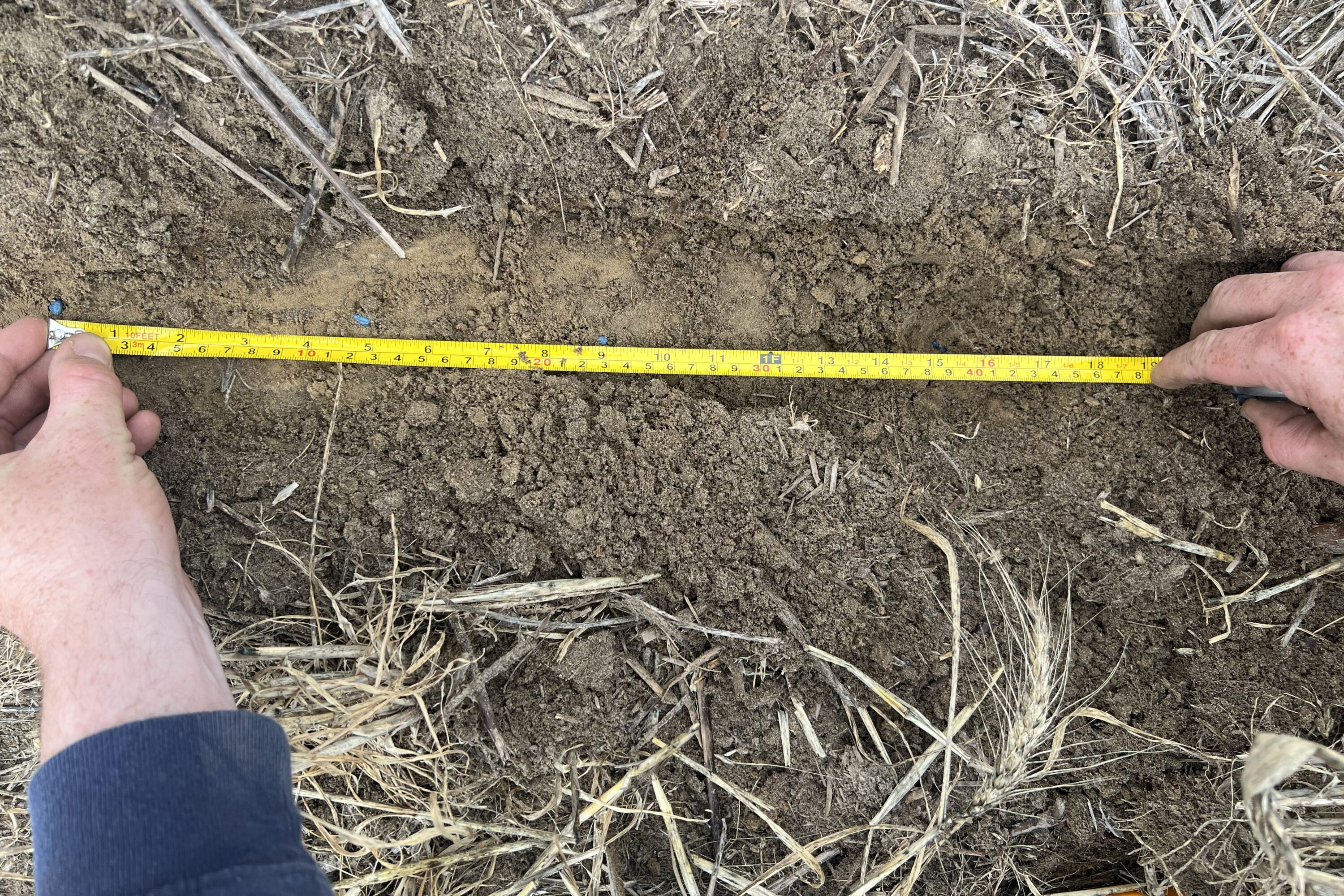
- Verify in the field. When out in the field, verify the applied seeding rate by digging behind each row unit and measuring the seed spacing and seeds per foot length of the row. Remember, this is not a one-and-done deal; regular checks during the planting season, especially when changing between crops or varieties/hybrids, are highly recommended.
- Seed monitors. Regardless of the planter type or drive, an Alabama Extension specialist recommends that every grower invest in a quality seed monitor that can provide real-time planting feedback — including applied seeding rate, singulation, skips/multiples, and spacing quality — for each row unit. This is one of the best investments in planting technology and pays off immediately.
- Stand counts. Although this happens after planting, make sure to perform stand counts after crop emergence to determine the plant population (plants per acre). This is a great way to check if the applied seeding rate was closer to the target rate and if the planter performed as expected. It is surprising how many growers skip this step and do not know their emerged plant population.