
Crop Production


Learn the distribution, life cycle, pest status, and management of this pest of Alabama soybeans.
First described in 1831, the three-cornered alfalfa hopper (Hemiptera: Membracidae, Spissistilus festinus Say) is commonly found in soybeans across the southeastern United States. The species prefers to feed on leguminous crops and can damage other crops, such as cotton. Understanding the life cycle, pest status, and management strategies for the three-cornered alfalfa hopper is crucial for soybean farmers to protect their crops and ensure maximized yield potential.
Distribution and Life Cycle
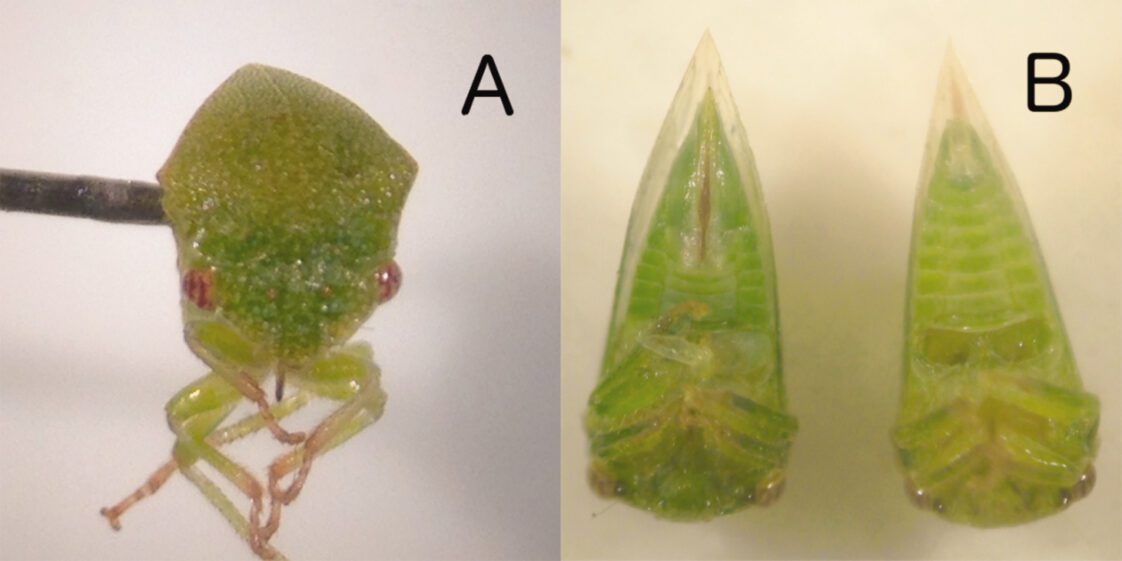
Figure 1. Front (A) and ventral (B) view of adult three-cornered alfalfa hoppers.
The three-cornered alfalfa hopper has a transcontinental native range from Canada to Central America and the West Indies. The range includes most soybean-producing states; however, most damaging populations have been confined to the southeastern United States. They are prevalent in the midsouthern and southeastern states where an abundance of preferred host plants provide ideal habitats for breeding and development.
The three-cornered alfalfa hopper has a wide and varied range of feeding and reproductive host plants, with a preference for leguminous plants, such as alfalfa, bean, cowpea, peanut, soybean, and sweet clover. The host range also includes cotton, tomato, sugarcane, potato, bermudagrass, Johnson grass, wheat, barley, oats, bur clover, red clover, mesquite, and dandelion. Three-cornered alfalfa hoppers can overwinter and reproduce on various alternative hosts, including weeds, pine, and vetch.
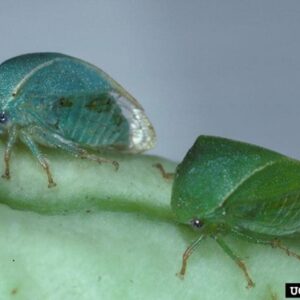
Adults of the three-cornered alfalfa hopper are 6 to 7 millimeters long, wedge shaped, and light green in color, with a protruding, elongated pronotum extending to the tip of the abdomen. The common name “three-cornered” comes from a distinguishing feature: when viewed from the front, three corners are visible: one at each “shoulder” and one from the apex of the pronotum. Males can be differentiated from females by the red or orange tint on the dorsal crest of the pronotum and the lack of an ovipositor. Females are also marginally larger than males. Adults are typically found slightly above the plant canopy or within about 12 inches of the soil. Three-cornered alfalfa hoppers are hemimetabolous insects with three life stages: eggs, nymphs, and adults.
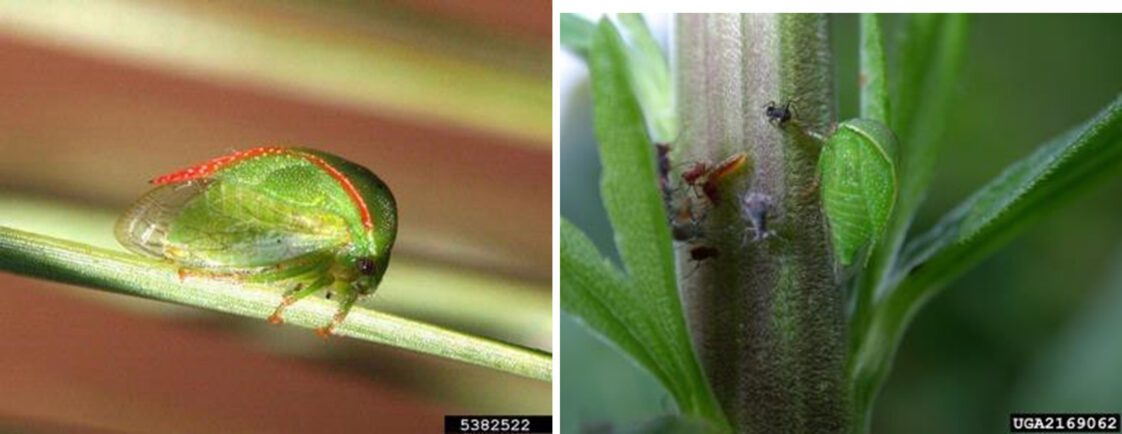
Figure 2. Adult three-cornered alfalfa hoppers.
Three-cornered alfalfa hopper nymphs are wedge shaped with light green to straw-colored bodies with white legs, antennae, eyes, and abdomen. Nymphs also have a characteristic prominent series of spinelike protrusions across their back. The nymphal stage cycles through four to six instars, with five being the most common, depending on nutrition and environmental conditions. The first and second instars are 1.6 to 2.1 millimeters long, the third instars are about 2.9 millimeters, with final four to six instars averaging 4.6 millimeters long. As nymphs mature, they grow progressively greener and more mobile.
Females of the three-cornered alfalfa hopper lay eggs inside plant tissue of host plants. In soybeans, oviposition occurs near the base of the main stem in the early season and in softer tissues, such as nodes and terminals, as the season progresses. Eggs are white and oblong, ranging from 0.9 to 1.3 millimeters in length. One end of the egg is slightly larger and covered in hairlike projections (papillae) believed to secure the egg within plant tissue. The number of eggs deposited depends on the host species, but generally six eggs are laid in a slit in soybeans.
Pest Status
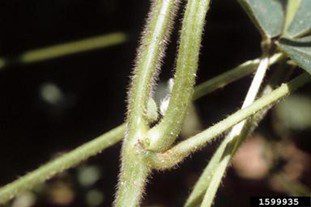
Figure 3. Three-cornered alfalfa hopper nymph on a soybean stem.
Adults of the three-cornered alfalfa hopper undergo reproductive diapause in the winter, overwintering in grass and other vegetation. Eggs overwinter inside plant tissue from oviposition. Adults and nymphs both migrate into fields from vegetation and weeds on the edges of crop fields in late spring and early summer. Three-cornered alfalfa hoppers have multiple generations per year, depending on host availability and climate.
Adult females reach sexual maturity in 7 to 14 days, mate, and lay eggs. Females live an average of 38 days after their first mating, while males die soon after. Egg-laying females can be found with an average of 21 to 30 eggs within the ovaries at any one time and produce up to 220 eggs in a reproductive period of 38 days. The incubation period lasts 6 to 27 days, with an average of 16.5 days from oviposition to eclosion. The first three instars are each typically completed in 3 to 5 days, and the fourth and fifth instars each last 4 to 8 days. The total nymphal time varies from 18 to 69 days, depending on environmental variables, such as temperature, host plant quality, humidity, and population density within the stand.
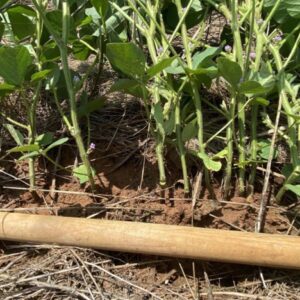
Adults and nymphs of the three-cornered alfalfa hopper are phloem feeders with two feeding behaviors. The first feeding behavior consists of sporadic probing and consumption of phloem sap. The second feeding habit is characterized by a continuous series of punctures around the circumference of a stem, which can induce a gall-like growth, commonly referred to as stem girdling. Feeding for a prolonged period may result in plant death or girdling in young soybean stands. Stem girdling may lead to lodging, stem breakage, and overall stand reduction later in the season. This damage is primarily caused by late instar nymphs and adults. The temporary changes on girdled stems have long-term adverse effects on plant leaves and stems. During late vegetative and early reproductive stages in soybeans, three-cornered alfalfa hopper feeding habits shift to pedicels, peduncles, petioles of leaves, pods, and small lateral branches. Oviposition slits can also damage stem tissue and be harmful to plants when oviposition in a stem is numerous.
Management
The most detrimental damage by three-cornered alfalfa hoppers occurs from early season feeding on young vegetative structures, primarily the main stem. Adults are best sampled using a sweep net, as they move quickly and fly away when disturbed. Plant stands should be scouted before the V7 growth stage to monitor pest populations, as these are the most susceptible girdling stages. Plant bases and lower stems may be visually inspected for early detection and to access levels of damage from girdling. Field borders should be included in monitoring as adults and nymphs may overwinter in border vegetation and later migrate into fields. Fields with no-till practices and high levels of crop residue, organic matter, or cover crops should be closely monitored due to the high risk of infestation. Early detection is key to suppressing damage to young stands. Infestations and damage can be worse in dry springs when fewer alternative hosts are present on field borders.
The highest level of feeding injury is contributed by third, fourth, and fifth instar nymphs, and chemical applications should be made during these nymphal stages to suppress populations. Organophosphates and pyrethroids have historically been effective in reducing populations of three-cornered alfalfa hoppers. Applications without long residuals may allow adults to reinfest soybean stands shortly after, if not monitored appropriately. Populations may also be reduced or eliminated by mowing and managing weedy field borders where pest populations may overwinter or reproduce before migrating into soybean fields.
-
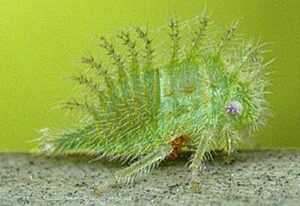
- Figure 4. Three-cornered alfalfa hopper nymph.
-
- Figure 5. Three-cornered alfalfa hopper damage on soybeans.
-
- Figure 6. Adult three-cornered alfalfa hoppers.
Avoiding early plant dates when populations in adjacent vegetation are high will reduce pest pressure on young stands of soybeans. Three-cornered alfalfa hopper plant losses may also be mitigated by increasing seeding rates at planting. Some cover crops, such as California poppy, creeping red fescue, fawn tall fescue, hard fescue, and orchard grass, will not support three-cornered alfalfa hopper survival or reproduction. Using these cover crops in the crop field or adjacent to it can help reduce infestations of adults. Current recommended thresholds and insecticide options can be found in the Alabama Soybean IPM Guide (IPM-0413) on the Alabama Extension website at www.aces.edu.
 Megan Woodall, Graduate Research Assistant, and Scott H. Graham, Extension Specialist, Assistant Professor, both in Entomology and Plant Pathology, Auburn University
New November 2025, Pests of Alabama Soybeans: Three-Cornered Alfalfa Hopper, ANR-3178