
Crop Production

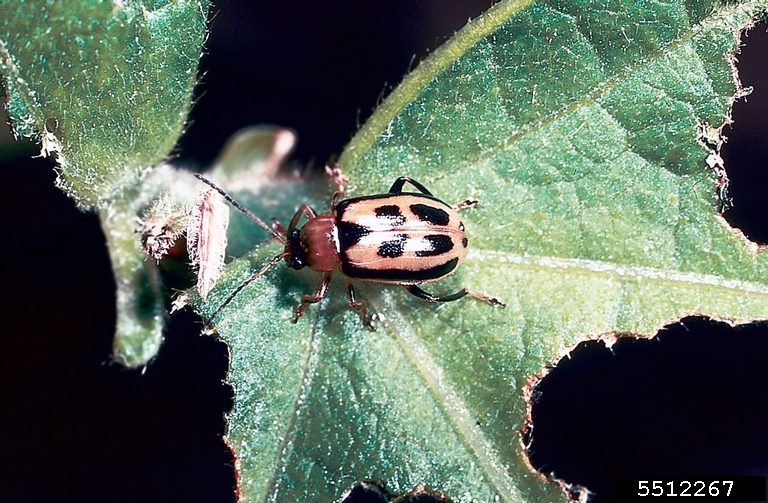
Bean leaf beetles (Cerotoma trifurcata Förster) are a pest commonly found in Alabama soybeans. It belongs to the family Chrysomelidae and the order Coleoptera. Bean leaf beetles may feed on root nodules (larvae), cotyledons, leaves, and pods. This pest is also a vector of bean pod mottle virus in the southeastern United States.
Distribution and Life Cycle
Bean leaf beetles are native to North America and are found at varying levels in soybean-producing areas across Alabama. These beetles have a wide host range, with a preference for legumes, including soybeans, green beans, and clover. They will occasionally feed on stinging nettle and cucurbits (pumpkins and cucumbers).
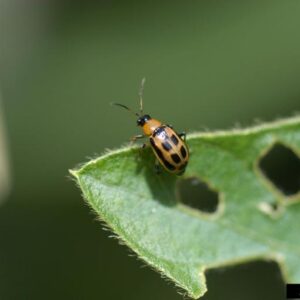
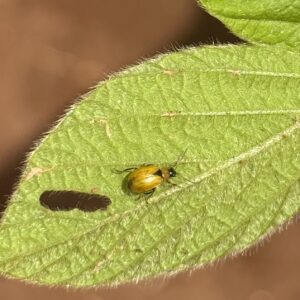
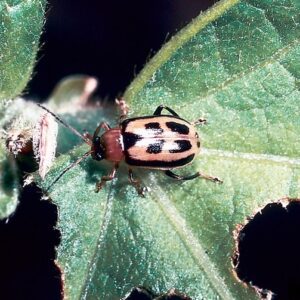
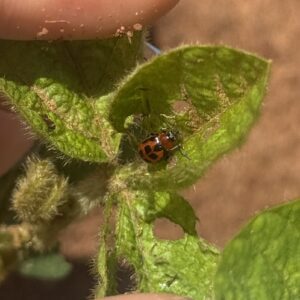
Adults are oval shaped, about 0.2 inches in length and are often dark yellow with black markings on the elytra (forewings) and black border on the outside edge. However, bean leaf beetles come in a variety of colors including green, yellow, orange, and red. The most distinguishable characteristic is a black triangle at the top of the wings near the “neck” region. Four rectangular black markings are usually found on the forewings, but this is not always the case. Some bean leaf beetles have only a black triangle with no other markings.
-
-
Figure 1. Adult bean leaf beetle.
(Photo credit: Ward Upham,
Kansas State University, Bugwood. org.)
-
-
Figure 2. Adult bean leaf beetle with
distinguishing triangle at “neck.”
-
-
Figure 3. Adult bean leaf beetle with
distinguishing triangle, forewing markings,
and black border.
(Photo Credit: Kansas Department of
Agriculture, Bugwood.org)
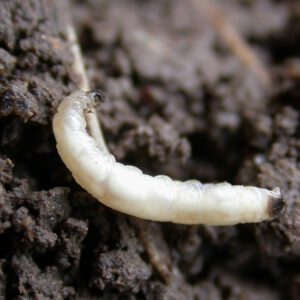
The larvae are white, cylindrical, and have a brown head and a brown plate on the last abdominal segment, similar in appearance to corn rootworm larvae. Larvae are found in the soil, usually around the base of soybean plants, and can reach a length of ⅜ inch. Eggs are typically laid within 1.5 inches of the soil surface and within 2 inches of the soybean seedling stem. They are orange and spindle shaped in appearance.
Adult bean leaf beetles overwinter in crop residues and leaf debris. Emergence begins in the spring when temperatures reach 50 to 55 degrees F. In some southern ranges, populations may not require overwintering due to favorable conditions. After emergence, beetles will disperse to other host species (alfalfa, clover, or other legumes) and mate before migrating into fields and laying eggs as soybean seedlings emerge. A single female bean leaf beetle can lay up to 250 eggs in her lifetime. Depending on temperature, eggs hatch in approximately 7 days, and larvae feed on soybean roots for up to 3 weeks before pupating. The life cycle from egg to adult requires 674 to 740 degree days (DD). In the southern United States, bean leaf beetles may produce three generations per year.
-
-
Figure 4. Adult bean leaf beetle
feeding on young leaves.
-
-
Figure 5. Bean leaf larvae in soil
within the soil.
(Photo credit: J. Obermeyer,
Purdue University, Bugwood.org)
-
-
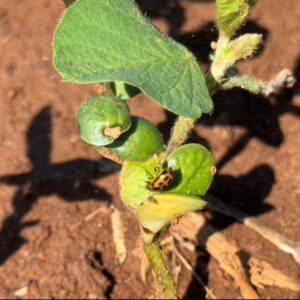
Figure 6. Adult bean leaf beetle
feeding on cotyledons.
Pest Status
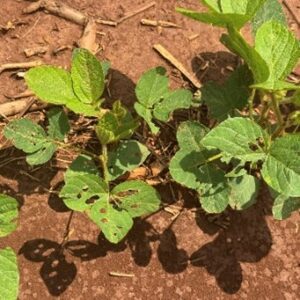
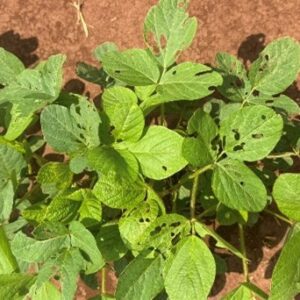
Larvae feed on root nodules of soybean plants, which is typically offset by additional nodule production. With high infestations (19 larvae per plant), feeding may reduce pod and leaf nitrogen content. Adults feed primarily on cotyledons, leaves, and pods of soybeans. Damage consists of sporadic, round holes in the tissues between leaf veins. This damage is generally distinct in comparison to the jagged edge feeding patterns produced by caterpillars and grasshoppers. Bean leaf beetle populations can often be found aggregated along field edges.
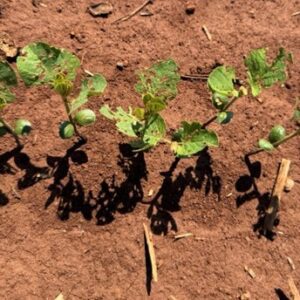
Although no economic significance is associated with larval root feeding, defoliation from feeding on early vegetative stages (V1 to V3; approximately 14 days) may delay canopy development and reduce yield. Overwintering adults and first-generation beetles cause the most economic injury by feeding on young vegetative stages. This feeding is often responsible for stand reduction and virus transmission (bean pod mottle virus, cowpea mosaic virus, southern bean mosaic virus). Bean pod mottle virus is primarily vectored by bean leaf beetles, which may cause severe systemic mottling and reduced seed size and pod set within the affected plant.
-
-
Figure 7a. Bean leaf beetle defoliation
on young soybean stands.
-
-
Figure 7b. Bean leaf beetle defoliation
on young soybean stands.
-
-
Figure 7c. Bean leaf beetle defoliation
on young soybean stands.
Management
Adults are best sampled using a sweep net, as they avoid disturbance in the field. Once populations have established within the field, soybean stands should be visually monitored for bean leaf beetle defoliation patterns throughout the season and can be broken into two sections of treatment: prebloom and pod set to maturity. Once populations have been identified within the stand, routine monitoring for defoliating patterns (sporadic round holes in tissues between veins) should be implemented. During the prebloom period, applications should be made if 35 percent defoliation occurs. In pod set to maturity, applications should be made if defoliation reaches 20 percent.
Current recommended thresholds and insecticide options can be found in the Extension publication Alabama Soybean IPM Guide (IPM-0413), available at www.aces.edu.
 Megan Woodall, Graduate Research Assistant, and Scott H. Graham, Extension Specialist, Assistant Professor, both in Entomology and Plant Pathology, Auburn University
New November 2025, Pests of Alabama Soybeans: Bean Leaf Beetle, ANR-3199