
Crop Production

Whether you are a commercial grower or home gardener, no one should pay for or apply fertilizer that is not needed. The following information provides an overview of soil testing procedures and demonstrates how test results translate into practical fertilizer applications.
Soil Testing
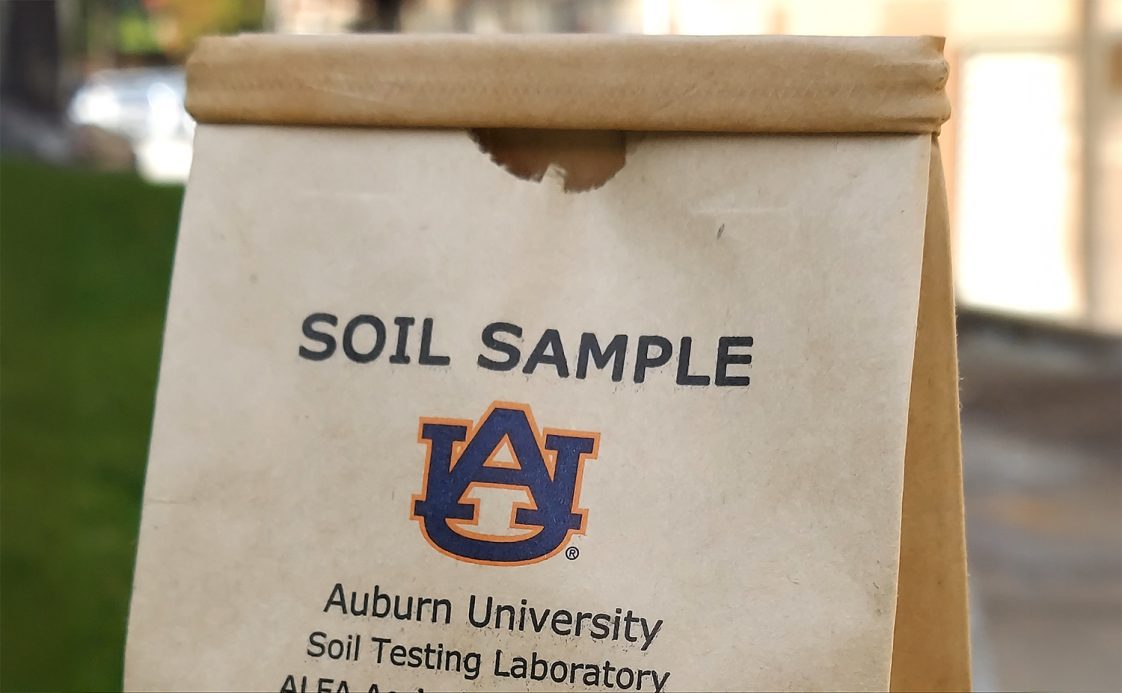
Before applying fertilizer, it is important to first perform a soil test to find out how much and what type of fertilizer is needed, if any at all. Soil samples can be sent to the Auburn University Soil, Forage, and Water Testing Laboratory for testing at a cost of $10 per sample. The Alabama Cooperative Extension System publication, Home Soil Testing: Taking a Sample, describes how to collect and send a soil sample for testing. There is also a video of this procedure on the Alabama Extension YouTube channel.
From this simple procedure, you will get recommendations of what nutrients—such as nitrogen, phosphorus, potassium, calcium, and magnesium—your soil needs, as well as and possible lime requirements and what time of year to apply the fertilizer. When your soil test results come back, it will detail what type and how many pounds of different nutrients to apply on a per-acre basis. It also provides these recommendations per 1,000 square feet for those with plots that are less than 1 acre. For clarity, the following information provides fertilizer information on a per-acre basis. One acre is 43,560 square feet if you would like to calculate how many acres you are planting. There is also fertilizer calculators on the Soil, Forage, and Water Testing Laboratory’s website that are easy to use once you have the soil test results. Find those calculators at aaes.auburn.edu/soil-forage-water-testing-lab/.
Calculating Fertilizer Applications
You may have noticed that there are numbers written on fertilizer bags, such 8-8-8, 10-10-10, 13-13-13, and 17-17-17. However, what do these numbers mean? These numbers represent the percentages of nitrogen, phosphorus, and potassium that are in that specific bag. A 50-pound bag of 13-13-13 fertilizer does not have 50 pounds of nitrogen, phosphorus, and potassium. Instead, that bag has 6.5 pounds of each nutrient (50 x 0.13 = 6.5).
Example 1
If your soil test results recommended 80 pounds of nitrogen, 80 pounds of phosphorus, and 80 pounds of potassium per acre, what fertilizer materials should be applied? Since nitrogen, potassium, and phosphorus are all needed, a complete fertilizer—such as 8-8-8, 10-10-10, 13-13-13, or 17-17-17—will work, but different amounts of each are needed.
Simply divide the pounds of fertilizer needed, in this case 80 pounds, by the percentage of the nutrient in the bag. If 8-8-8 is used, dividing 80 pounds by 8 percent (0.08) will give the answer of 1,000 pounds. That means 1,000 pounds of 8-8-8 is required to fertilize 1 acre with 80 pounds of nitrogen, phosphorus, and potassium. If 13-13-13 is used, dividing 80 pounds by 13 percent (0.13) will give the answer of 615 pounds. That means 615 pounds of 13-13-13 are required to fertilize 1 acre with 80 pounds of nitrogen, phosphorus, and potassium. If you were to calculate this with 10-10-10 and 17-17-17, you would calculate them the same way. It would take 800 pounds of 10-10-10 or 471 pounds of 17-17-17 to obtain the desired 80 pounds of nitrogen, phosphorus, and potassium per acre (80/0.10 = 800 and 80/0.17 = 471).
These calculations will tell you not only how much to apply but will also help you decide on the most economical fertilizer. If you need 1,000 pounds of 8-8-8 or 615 pounds of 13-13-13 per acre, simply check prices to see what these fertilizers will cost per pound and calculate how much is needed for your plot. This is not always true, but usually the fertilizers that have the highest amount of nutrients cost more per bag, but you need less bags per acre. Therefore, the highest cost per bag may end up the most economical.
Example 2
What if your soil test results recommend 120 pounds of nitrogen but no phosphorus or potassium. It is common to have a soil test with this type of recommendation. This means you have proper amounts of phosphorus and potassium in your soils and do not need any more of these elements for proper plant growth. Applying fertilizers such as 8-8-8 or 13-13-13 would be applying unneeded nutrients. Applying more than needed will not cause the plants to grow any better and will cost you more money. Fertilizer materials with nutrient contents such as 34-0-0 are common to find and just what this example needs.
Divide the pounds of fertilizer per acre needed, in this case 120 pounds, by the percentage of nutrient being used. If 34-0-0 is used, dividing 120 pounds by 34 percent (0.34) will give the answer of 353 pounds. This field would need 353 pounds of 34-0-0 per acre to obtain the recommended 120 pounds of nitrogen. If only nitrogen was needed, it is much more economical to use a nitrogen-only fertilizer, such as 34-0-0, instead of a complete fertilizer. In this example, if someone used a complete fertilizer, such as 13-13-13, to supply the 120 pounds of actual nitrogen per acre, then 923 pounds of fertilizer would have been applied per acre. This would have been much more costly for the applicator and would have applied more elements than needed.
Call several suppliers and find out what fertilizer materials are selling for in your area and compare prices per acre not prices per bag. Since more bags of one product may be needed than another, the cheapest price per bag may not be the most economical.