
Crop Production

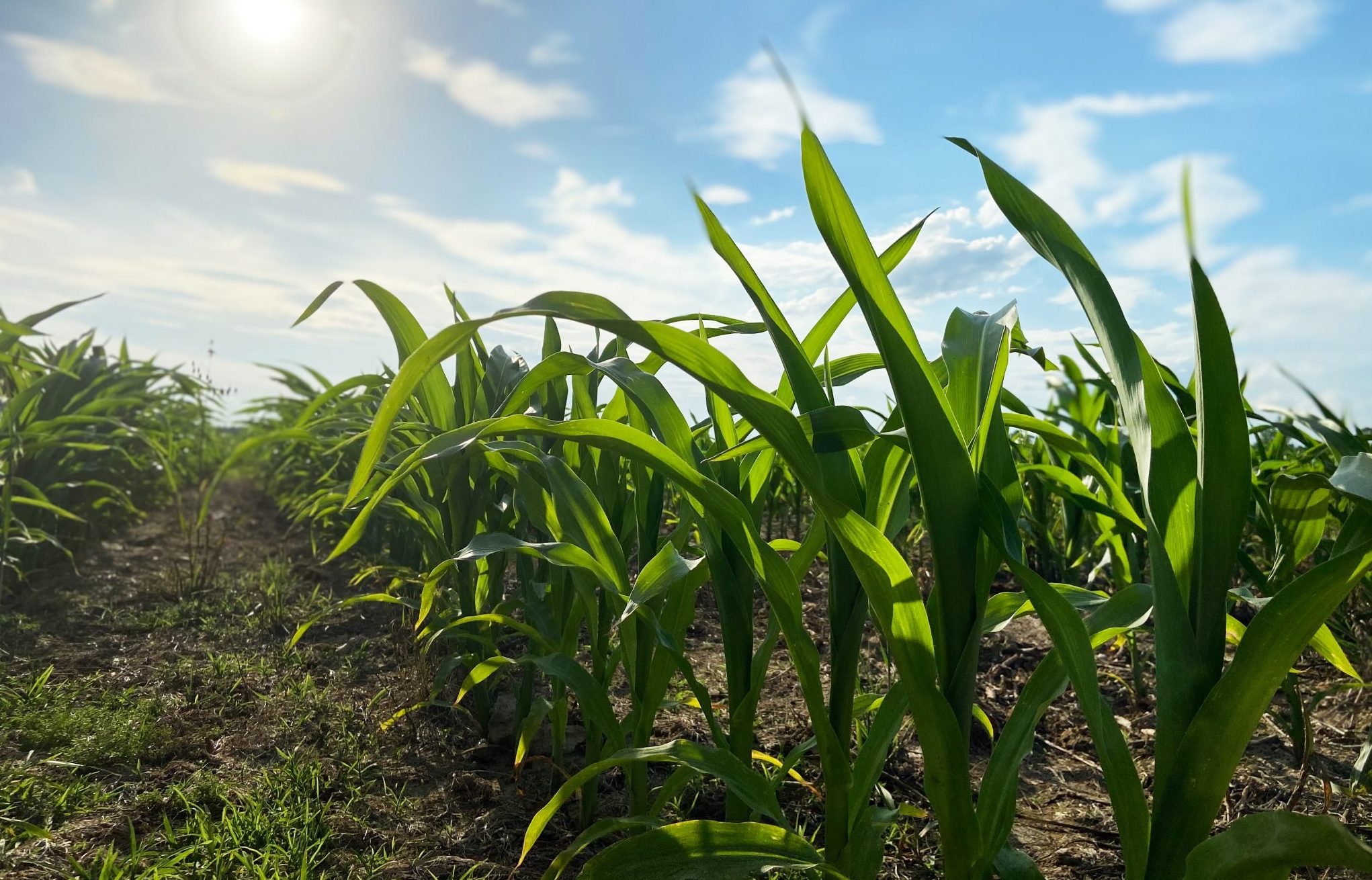
With warmer weather and soil temperatures reaching 55 degrees Fahrenheit, growers throughout the state are ready to put corn seed in the ground. Soil temperature, planting date, and field uniformity are factors in germination, growth, and overall yield. Planting when conditions are favorable increases the likelihood of only having to plant each field once.
Additionally, there are early season insect management practices to consider when planting corn. Fields planted behind cover crops in no-till or reduced tillage are at highest risk for seedling insect pressure. A long-standing integrated pest management (IPM) recommendation is to terminate winter vegetation at least 3 to 4 weeks before planting. This eliminates the green bridge that allows insects to survive from winter covers to the planted crop.
It is also important to consider the field’s history. Issues with soil insects are more often recorded in fields that were previously in pasture or a conservation reserve program (CRP).
-
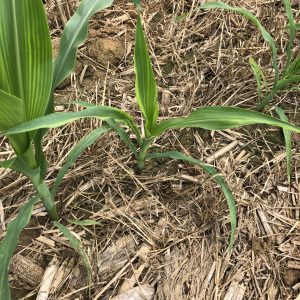
- Suckered corn plant showing symptoms of stink bug feeding.
-
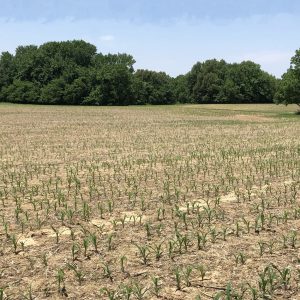
- Wireworm infestation resulting in a replant.
-
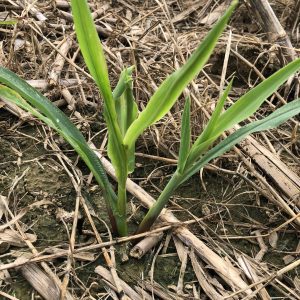
- Suckered corn plant showing symptoms of stink bug feeding.
Below Ground Pests
Below ground pests attack germinating and seedling corn by feeding on the roots or stems at the soil line. Potential pests include billbugs, wireworms, corn rootworms, sugarcane beetles, and white grubs. Generally, these pests are uncommon in Alabama corn fields, because most corn is planted with an insecticide seed treatment (IST). When an IST is not used, the fields that are at higher risk (no-till/reduced tillage) are more likely to experience infestations that would reach damaging levels if untreated.
Treatment Options
Unfortunately, there are no rescue options for managing these soil insects. Thus, using an IST is recommended in most situations. Commonly used ISTs include Poncho (clothianidin) or Cruiser (thiamethoxam). These treatments are offered at low (250), medium (500), or high (1250) rates. Additionally, many pyrethroid insecticides are labeled as liquid in-furrow treatments and granular terbufos (Counter) is also available.
Seed treatment rates and/or additional in-furrow treatments should be considered based on field risk. Higher seed treatment rates may be needed if wireworms or sugar cane beetles are present in large numbers.
Western corn rootworm has been documented in north Alabama and is now suspected in some areas of south Alabama. If western corn rootworms are present, hybrids containing corn rootworm Bt genes may be needed. Note that these genes do not have activity on southern corn rootworm.
Above Ground Pests
Other pests such as stink bugs, armyworms, and cutworms may clip plants at or near the soil level, causing stand loss. Stink bugs are typically more problematic to seedling corn planted next to wheat or following a legume cover crop. Armyworms or cutworms tend to be worse following no-till and/or high residue cover fields.
Treatment Options
Pyrethroids applied at-plant generally provide good control of armyworms and cutworms. Consider this treatment in high-risk fields.
Although challenging, scouting for stink bugs is beneficial. Stink bugs in seedling corn may be difficult to find because they can hide behind leaves or drop off plants. Scouting early and often is recommended. Check multiple areas of each field as stink bugs tend to be worse on field edges.
Symptoms of damage include suckered plants with multiple stalks. Also check for buggy whip symptom, where one side of the plant grows faster than the other and the tips of the leaves get tangled in the whorl. Threshold is 10 percent damaged or infested plants.
Prior to tassel, the brown stink bug is the dominate species. The southern green species moves in at tassel. Because the brown species is hard to kill, using the highest labeled rate of a pyrethroid is recommended.
Bt Corn
Most available hybrids contain two or three Bt traits for control of corn borers, corn earworms, and other caterpillar pests. These traits have efficacy on seedling caterpillars. However, they generally do not prevent stand loss because caterpillars must ingest a lot of plant material before receiving a large enough dose for control. Thus, Bt corn should not be relied on to prevent stand loss from cutworms or armyworms. Use of a pyrethroid at-plant usually provides good control of armyworms and cutworms.
It is also important to consider Bt refuge requirements. Refuge compliance is critical to delay resistance in both corn and cotton. In Alabama, corn growers are required to plant refuges of non-Bt corn with percentages based on number of traits in the Bt corn. Corn hybrids with two or more traits require 20 percent refuge of non-Bt corn. For instance, when planting 200 acres of corn in an area, forty acres must be non-Bt. This includes refuge-in-the-bag (RIB) products. Details about placement and arrangement of refuges may vary. Consult with your seed dealer about refuge structure.
Trade and brand names used in this publication are given for information purposes only. No guarantee, endorsement, or discrimination among comparable products is intended or implied by the Alabama Cooperative Extension System.