
Crop Production

AUBURN UNIVERSITY, Ala. — Finding the right combination of crop management applications and marketing strategies that result in a profitable season is an annual quandary for Alabama farmers. For the past two years, it is a question that researchers from Alabama Extension at Auburn University have tried to tackle through the TAPS program.
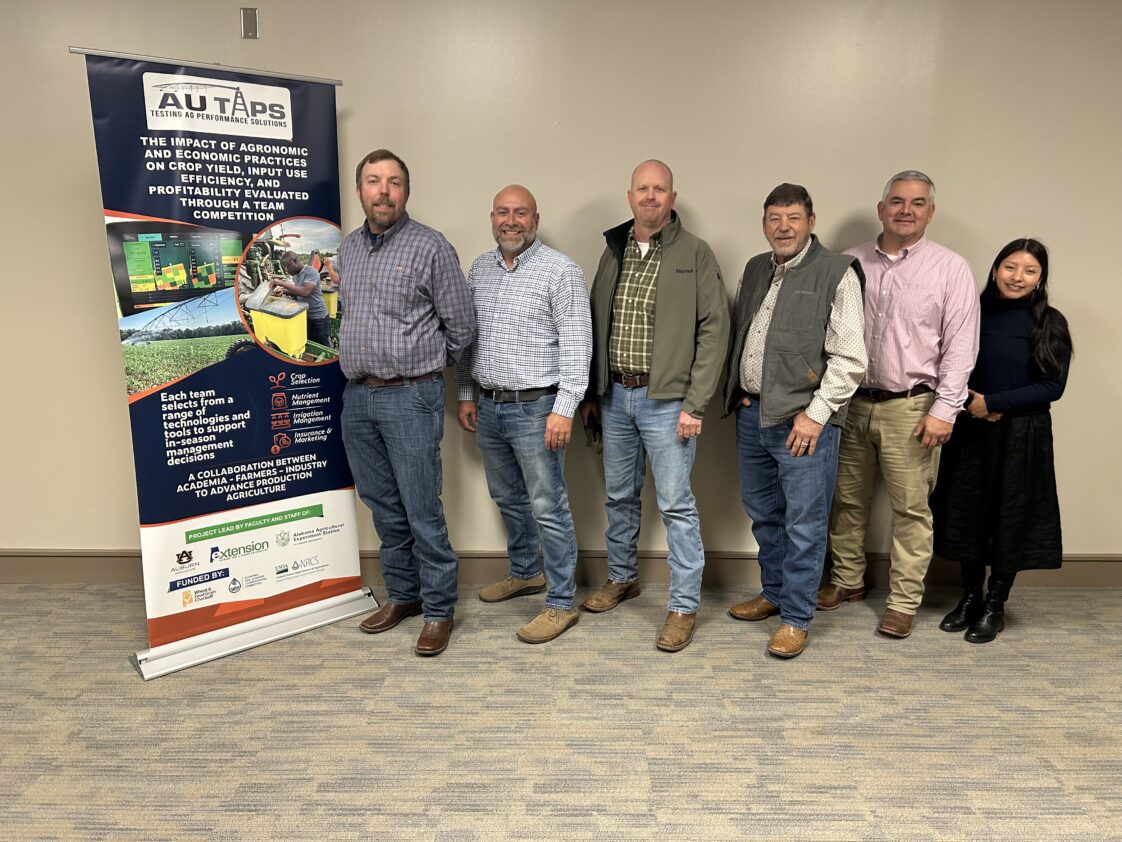
Eight teams participated in TAPS in 2025. Contestants present at the Dec. 9 meeting include, from left, Adam Temple of Houston County, Jeremy Wilson of Talladega County, Shep Morris of Macon County and Robert Walters of Lee County. Additionally, Alabama Extension agents Aaron Wells and Roshell Rosales Aguilar represented the Extension team that participated in the contest.
TAPS stands for Testing Ag Performance Solutions. In 2025, eight teams participated in the research contest. Each team was assigned plots of land at the E.V. Smith Research Center in Shorter, Alabama. Teams selected corn seed type, seeding rate, irrigation schedule and fertilization type, which were administered by research center staff in the Farm Services Unit. The contestants also made marketing decisions on crop insurance and sales.
TAPS is administered by a multidisciplinary team that includes Auburn University College of Agriculture faculty in the departments of Crop, Soil and Environmental Sciences, as well as Agricultural Economics and Rural Sociology. Brenda Ortiz, a specialist with Alabama Extension and professor or crop, soil and environmental sciences, leads the team.
“While this is not a traditional study, there is a big advantage to doing something like this because our participating farmers really get to see the impact of different decisions,” Ortiz said. “They can see themselves and other farmers reflected in those management strategies.”
TAPS Results
On Dec. 9, researchers, Extension staff and farmers gathered at the Alabama Farmers Federation in Montgomery to analyze this year’s TAPS results.
Irrigation rates and nitrogen applications varied widely across teams. Overall, the results showed yields more than 150 bushels per acre across the range of nitrogen and irrigation rates. That was a significant improvement over the control yield of about 80 bushels an acre. The control did not receive any irrigation or fertilization.
“One possible conclusion from this year’s results is that there is potential to maintain competitive yields with more moderate usage of nitrogen and irrigation,” Ortiz said. “That could mean farmers can save money on input costs and still harvest a bumper crop.”
For marketing, five teams chose to sell all grain on the harvest date of Sept. 9, while three teams chose to book a portion of sales at different parts of the growing season. Results showed it paid to have a diverse marketing strategy. Corn price at harvest was $3.90 per bushel. The three teams that booked earlier all secured a higher average sale price, ranging from $3.93 per bushel to $4.15 per bushel.
Weather Issues
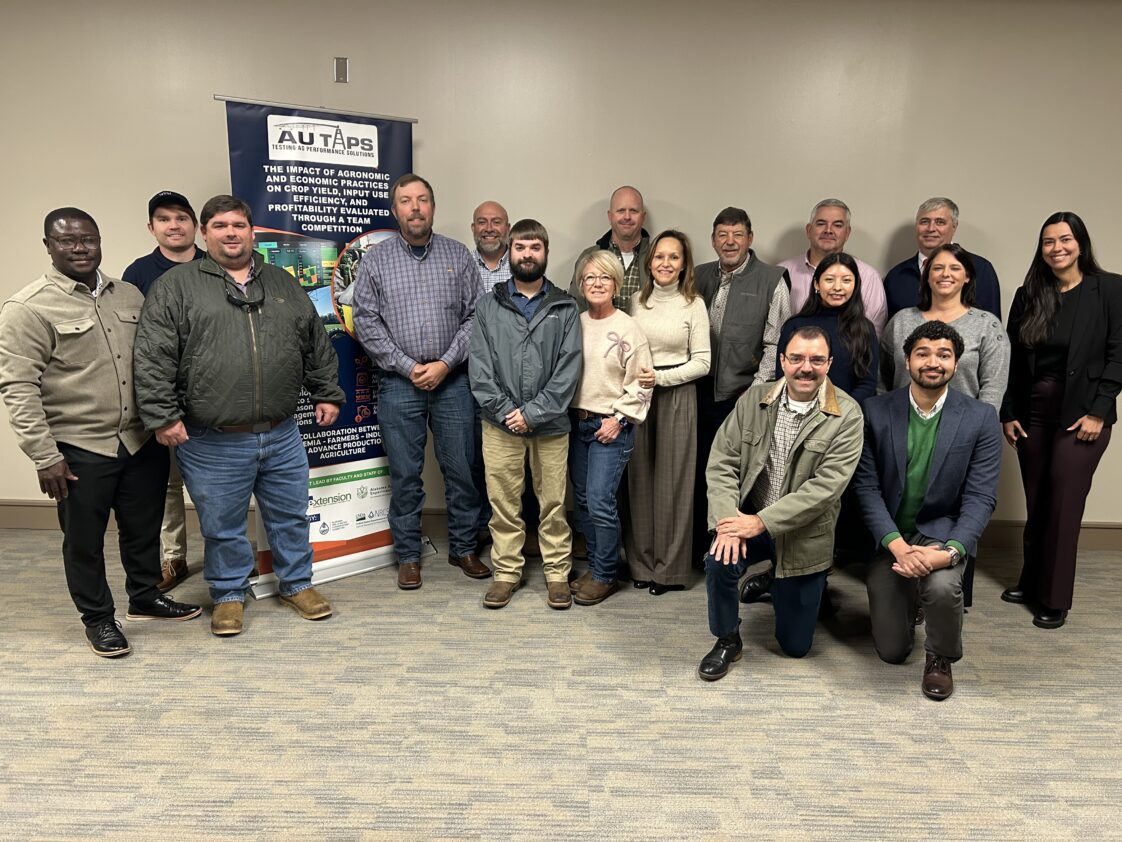
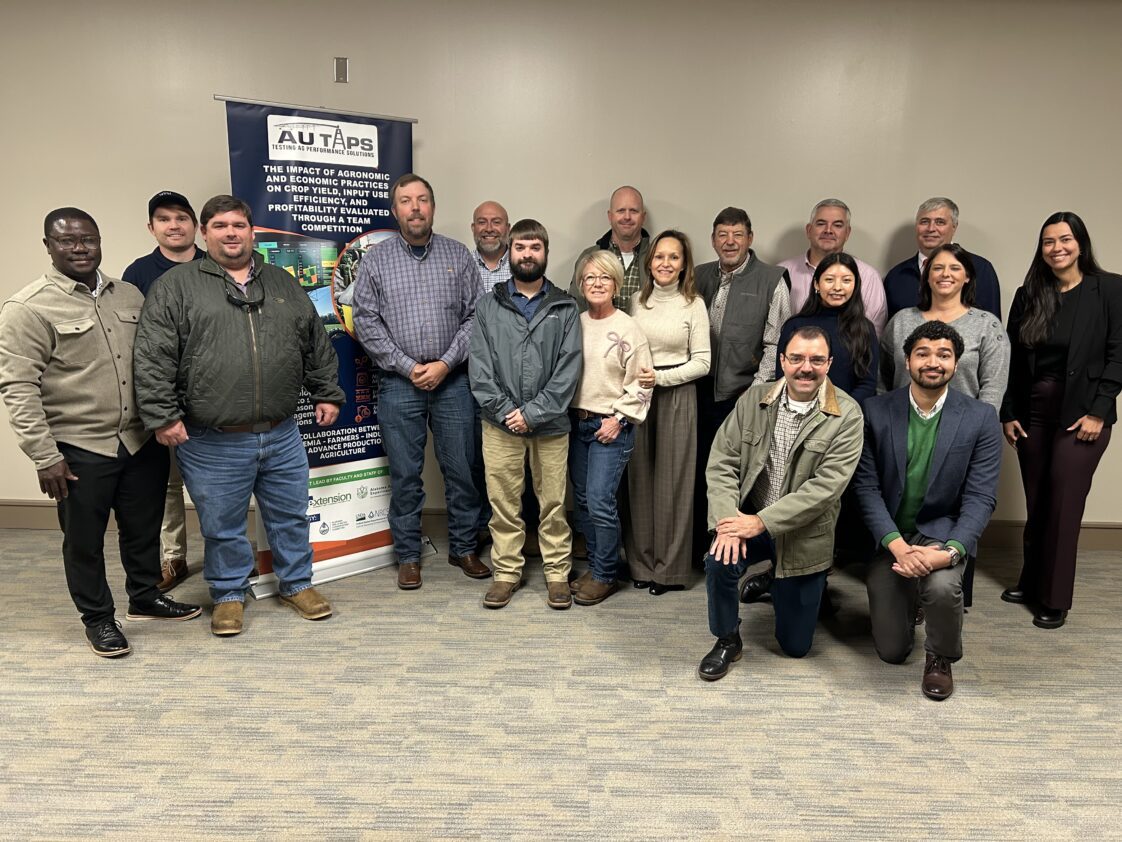
A group of Extension staff, researchers and farmers who gathered to discuss the TAPS results at the Alabama Farmers Federation home office in Montgomery on Dec. 9.
While discussing TAPS results, rainfall was a major topic of the conversation. Participating farmers from south Alabama admitted to choosing higher irrigation rates because they were experiencing drier conditions. Conversely, farmers from central Alabama chose lower irrigation rates because they received ample rainfall at their farms throughout spring.
The field at E.V. Smith Research Center received so much rain in spring that portions flooded after the planting date of March 27. Because of weather issues complicating data evaluation, this year’s TAPS contest ended with all participants receiving a monetary prize.
“The reality of farming is that things don’t always go as planned,” Ortiz said. “For TAPS, these teams are making weekly decisions about irrigation rates, and that takes time and effort. We’re extremely appreciative of these farmers working with us throughout the season on this program, and we hope it will continue to grow in the future.”
In the coming years, Ortiz said she hopes to increase the number of teams participating in TAPS.
TAPS Program and Partners
TAPS is a national initiative with participating universities across the country. To administer various irrigation and fertilization rates across portions of a field, precision agriculture technologies are required.
“We couldn’t do this contest without the support of our partners,” Ortiz said. “They help to provide the technology, products and services needed.”
For 2025, grants were awarded from the Alabama Wheat and Feed Grain Producers and the Alabama Soil and Water Conservation Committee. Partial funding was also provided by the Conservation Innovation Grant through the U.S. Department of Agriculture’s Natural Resources Conservation Service. Additionally, numerous staff from Alabama Extension and Auburn’s College of Agriculture provide time to making TAPS happen.
“The staff of the Farm Services Unit at E.V. Smith Research Center is dedicated to establishing and managing these trials, and we’re so thankful for their work,” Ortiz said. “Plus, there are undergraduate and graduate students and visiting scholars whose efforts are essential to this project’s success.”
The full TAPS reports from 2025 and 2024 are available online through the College of Agriculture’s website at agriculture.auburn.edu.