
Crop Production

High tunnels can offer advantages for fruit crop growers. Learn about growing seasons, marketing periods, protection, and more.
The numerous benefits of growing high-value fruit crops under high tunnels include the following:
- An extended season of fruit production
- Longer marketing period for the crop beyond cultivar selection
- Protected production, including a reduced risk of weather damage to the crop
- Reduced risk of pest and disease damage to the crop as pesticide need is reduced and fruit can be grown out of the normal cycle of the pest
- Increased potential for sustainable and organic production
- Increased profitability by capitalizing on high consumer interest and low product availability in early and late season markets
Fruit crops, such as peaches (figure 1), plums, and cherries, have the potential for out-of-season and organic production when grown in a high tunnel, especially when dwarfing rootstocks are being used in the production system.
Brambles, especially primocane blackberries and raspberries, have shown great potential for extended fall berry production in high tunnels (figures 2 and 3). Primocane blackberries produce fruit in the autumn on canes formed during the current season. In warmer climates, pruning of canes is applied to manage flowering and delay bloom until September to overcome the high summer temperatures during flowering and fruit set. High tunnel bramble production has shown yield increases over field production, with primocane-bearing raspberries producing a fall crop two to three times as great as that expected from field production, in addition to summer crop production. Harvest in the fall has been extended at least 3 weeks later than that normally expected for field production.
-
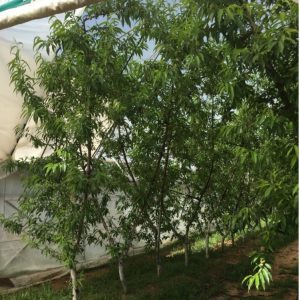
- Figure 1. Peaches grown under a high tunnel.
-
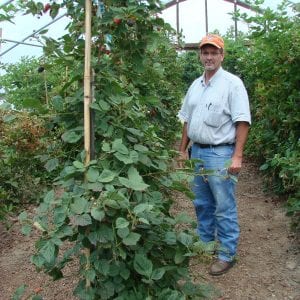
- Figure 2. Blackberries grown under a high tunnel.
-
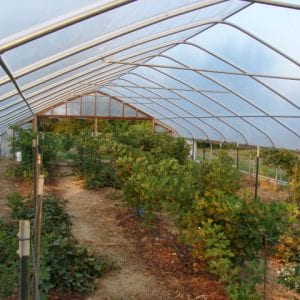
- Figure 3. Primocane blackberries grown under high tunnel.
-
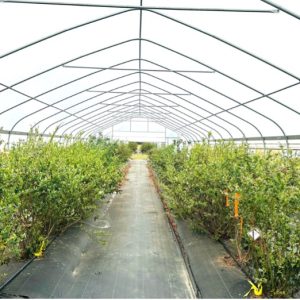
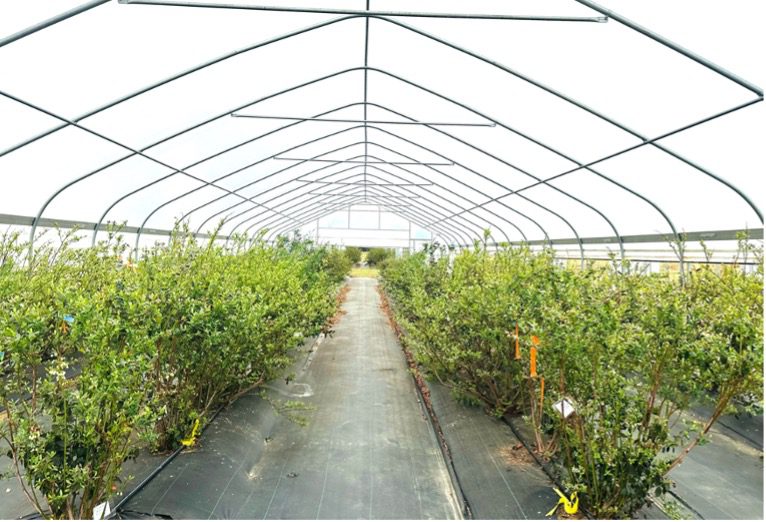
- Figure 4. Southern highbush blueberries grown under high tunnel.
Blackberry production in high tunnels is gaining in popularity in some states. There can be a significant price premium for the large-sized fruit produced in high tunnels in metro areas. However, blackberries are found in rural communities on most acreages and homesteads, driving down demand and price. Input costs are high for blackberries because they require a trellis and unique management practices. It is best to dedicate the entire tunnel to blackberry production, as there is an increase in yield due to a longer production season and increased fruit size. Blackberries are a perennial crop and thus occupy the high tunnel all year, but are only productive for a few months. It is difficult to use the space between rows to further extract value from a high tunnel of blackberries. They share many of the same diseases as tomatoes and peppers; therefore, those crops should not be introduced into a tunnel of blackberries to minimize disease pressure. Also, the tall blackberry canopy greatly limits airflow and light to crops grown between rows, which is detrimental to these crops. A single high tunnel of brambles cannot generate a living wage, as a tunnel of vegetables would and should be considered supplemental income only.
Blueberries receive a high price on the market, but the price does fluctuate throughout the year due to variations in supply. High tunnel technology is currently being explored for the feasibility of inducing early flowering and ripening in southern highbush blueberries (figure 4). A profuse fruit set resulted in a yield increase and, consequently, higher returns to the growers. Research is underway at Auburn University to investigate the effect of the high tunnel production system on the growth and productivity of southern highbush blueberry cultivars.
Although tunnels will not significantly alter the harvest season of apple and grape crops, the high tunnel system could still provide protection from hail, minimize disease incidence, and reduce the risk of spring frost damage.
 Elina Coneva, Extension Specialist, Professor, Horticulture, Auburn University
Revised September 2025, Choosing a Fruit Crop for High Tunnel Production, ANR-2730