
Beef

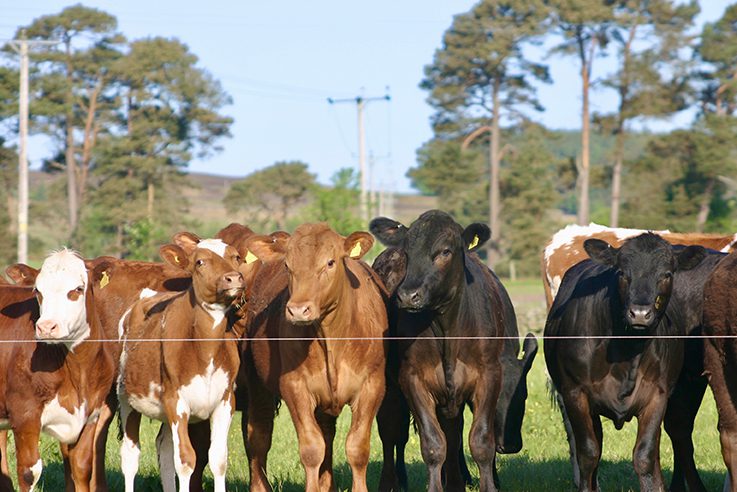
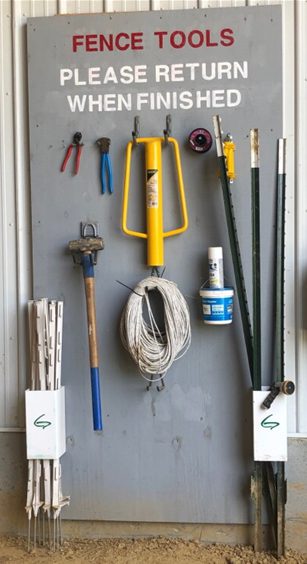
Most intensive grazing methods can be accomplished using basic temporary fencing tools. For example, reels, polywire or polytape, step-in posts or ring-top posts, fence energizers, gate handles, and insulators are common items needed for a successful temporary fence. A sturdy, permanent perimeter fence is recommended to provide further security and ensure animal safety.
“Grazing management is an exercise in decision making,” Don Ball, former Extension Specialist and Professor Emeritus, Auburn University, “Forage and Livestock Quotes and Concepts, Volume 2.”
Reels
 There are many brands of reels, and each brand offers different types of reels. There are reels of all sizes at an extensive price range. There are also geared reels, where every time the handle is cranked, the reel spins multiple times. For instance, when turning the handle on some reels once, the wheel spins three times. The geared reels are great for efficiency and are typically preferred when working with large acreage. However, geared reels are heavier, so if you plan to reel them up frequently or have a lot of wire on them and weight is a concern, this might not be the best option. They will also be harder to hang because a sturdier base will be required to support the added weight.
The size of the reel comes into consideration when determining the amount of land you need to cover. If you have multiple acres, you will probably benefit from a larger reel. If you are only doing a gate or a small strip, consider a smaller size that is light enough to hang on a temporary post and easy to manipulate daily.
Optional features for temporary electric fencing reels can improve convenience, safety, and efficiency when managing grazing systems. A brake system allows the operator to control wire tension and prevent unintentional unwinding when moving or storing the reel. A wire guard helps keep the polywire or tape neatly wound, reducing tangles and extending the life of the fencing material. A sturdy hook or mounting point can make it easier to attach the reel to posts, vehicles, or fence stands during setup. Additional options, such as insulated handles for safe operation and ergonomic grips for comfort, may also enhance ease of use. Selecting a reel with the right combination of these features can make temporary fencing setup and maintenance more efficient in pasture management.
Reels can be expensive, depending on what kind you purchase. They are an extremely useful tool and save a lot of money in tangled wire. To avoid such a big investment as you get started, a basic reel is sufficient, or try an extension cord reel. With time and experience, you can find the best fit for your needs.
Polywire or Polytape
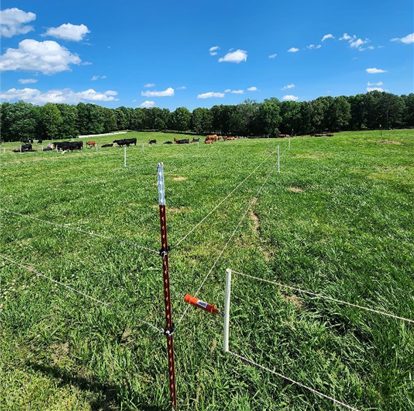 Most polywire consists of 6 or 9 strands of stainless steel wire that is either braided or twisted with plastic (poly) strands to form either string, rope, or tape. There are many different colors, diameters, and lengths to consider. It is important to obtain a sufficiently long spool of wire to cover the entire acreage of the pasture without needing to tie wires together. The more wires are tied together, the higher the potential for breaking the connection between wires, allowing the current to be carried through the fence. Color is mostly up to your discretion; however, it is important to consider what is easiest for your livestock to see. The most typical colors are white and yellow. Yellow is often difficult to see, but is preferred by some people because it blends with the landscape, making it more aesthetically pleasing.
When buying a polyfence, consider your species. Cattle can be successfully contained using polywire, which requires only a single or double strand. Horses have a hard time seeing polywire and polytape is often preferred. Polytape is a flat woven tape, ½ to 1 inch wide, laced with 4 to 8 conductive metal threads. It is mostly used for horses but can also be used for other livestock; however, it is not often preferred as it easily gets tangled. Small ruminants, such as sheep and goats, are known for being hard to keep in a fence. They require multiple strands of polywire, preferably 3 to 5 strands that reach close to the ground. Another option for small ruminants is tight polynetting. Polynetting is composed of multistrand polywire with struts spaced approximately every 12 inches and built-in posts spaced approximately every 12.5 feet, forming a netting. For small ruminants, consider how much land you will be covering and how often you will be moving the fence. Polynetting is typically harder to move than regular polywire on a reel. Polynetting is also more expensive when compared on a yard-to-yard basis, yet it includes posts and wire, so this should be considered in your decision. Smaller polynetting with roughly 3-inch squares is also available and preferred by most poultry systems.
Several tools are available to connect existing electric fences to polywire in temporary fencing systems. Fence connectors or jumper leads provide a simple and reliable way to transfer current from a permanent fence to a temporary line, ensuring consistent voltage across the system. Alligator clips or spring gate handles can also be used for quick attachment and removal, making it easy to adjust or relocate temporary fences as grazing needs change.
Handles
 There are two main categories of handles: electric (live) handles and dead handles. Electric handles are made with a steel hook, and spring handles with a plastic handle, and dead handles are made entirely of plastic. There are now handles that can be used as either electric or dead handles, featuring both a steel and plastic hook. It is important to map out where you need the live handles to have a continuous circuit of electricity. It can also be helpful to have dead handles on places you may be moving frequently.
Posts
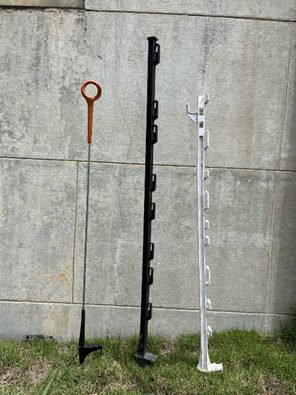
Like the rest of the equipment, posts are available in many options. When purchasing posts, consider your species, the size of your animals, your soil type, and how often the posts will be moved. Cattle do not require a specific kind of post. They can be contained with a single wire most of the time; therefore, you can use a ring-top tread-in post. Multiwire tread-in posts will be necessary for small ruminants if using polywire. Ensure that you can have a low wire within approximately 6 inches of the ground and that the space between the wire catches is narrow, eliminating large gaps. Most step-in posts are relatively the same height; different animals may require the top strand to be higher than others, but they successfully contain most livestock. One problem with the post height is that wildlife, such as deer, will still be able to jump over it. If you have a lot of wildlife near your pasture, it is beneficial to have flexible step-in posts that will not snap when hit or bent. Flexibility is not always preferred; if a post is being used in a corner or where something like a reel or gate handle will be hanging on it, it may be better to have a sturdier post. If posts need to last longer in the sun, look for those that are UV rated.
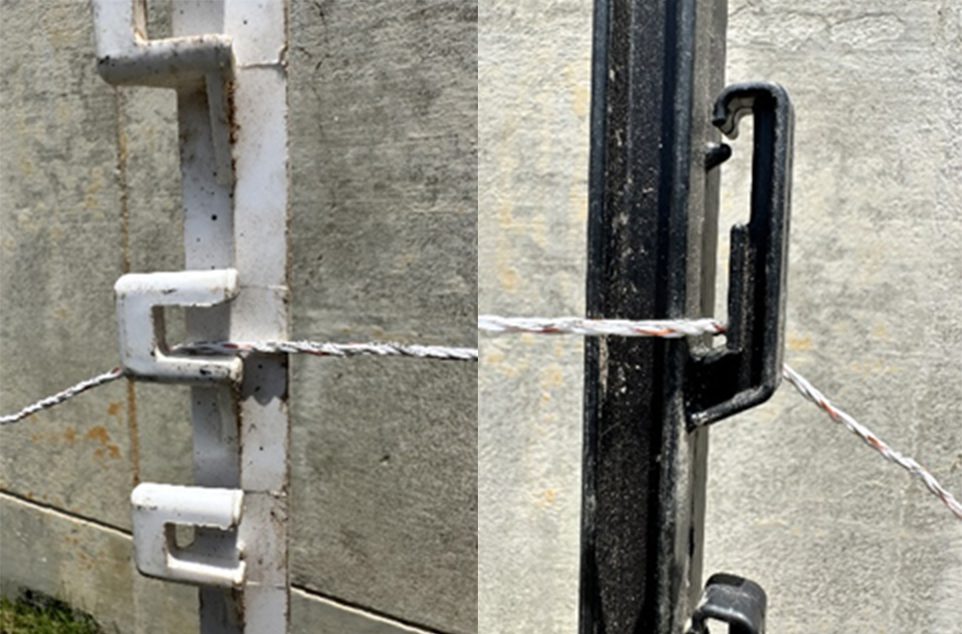 Different posts have various wire catches, and it is up to the user’s discretion to choose which one to use. Some are like hooks where you do not have to touch the wire, and some have a notch that keeps the wire in place. Those with hooks are often preferred when needing to move them frequently. You can move the post and wire without ever having to turn the fence off. However, posts with the nonrelease catch are often preferred in semipermanent scenarios, as the wire is less likely to accidentally come off the posts.
Another consideration when purchasing step-in posts is the step itself. Some have a smaller step-in foot, which is undesirable for many people. There are also different stakes; some have two stakes, while others have only one stake going into the ground. Depending on the soil type, some ground is harder to dig into for posts. Therefore, if you have harder ground, it is typically preferable to have a large, durable step-in foot and only one stake that needs to be driven into the ground. When you have soft or sandy soil, you have more flexibility with the types of posts you can use.
Posts are also made of different materials. The best ones for temporary electric fencing are made of fiberglass or plastic. Some posts are made with metal and can often cause shorts in the fence.
Energizers
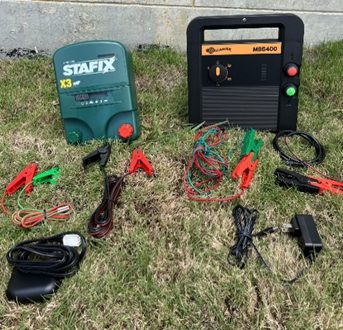 When comparing which energizer to purchase, consider that the acreage listed on the box is not always an accurate measure of the energizer needed for an operation. Rather, it is more important to consider the length of your fence, how many strands the fence has, the class of livestock you need to contain, and the power source of your energizer.
Grounding
Grounding is an important step in building temporary fencing. Grounding an electric fence provides an outlet for the charge on the fence to be dispersed safely to the ground; hence, the term “grounding.” Keeping a good grounding source provides support for the fence to keep “flowing” and providing a charge.
This can often be accomplished with grounding rods. A variety of sizes and types of grounding rods are available to purchase. The important aspect of grounding rods is their location in relation to your fence. Fences utilizing solar charges are more flexible in selecting the ground rod location compared to an energizer plugged into a power source. Select an area away from metal buildings or structures and choose an area in which the soil is most likely to remain moist throughout the year. Moist soil provides a better ground because the water in the soil can carry the current away and disperse it throughout the soil. Also, ensure that you have a good ground connection from your charger to your grounding rod. This can be accomplished using a single, yet strong piece of wire secured to the grounding terminal and grounding rod itself. The use of grounding clamps can help ensure a good grounding connection. A rule of thumb is that for every joule of power produced by the energizer, the system requires a minimum of 3 feet of grounding rod. Typically, more than one grounding rod should be used, with each rod at least 3 feet in the ground, and the space between the rods should be at least twice the length of the rods themselves.
Testers
Testers are expensive tools. Some cheaper options indicate whether the fence is conducting electricity or not; the most costly options quantify the conductivity, relay when and where a short is in the fence, and can turn the fence on and off. You can pick how expensive a tester you want to start with, but it is important to be able to ensure that the fence is conducting enough electricity to keep animals in.
For more information and tutorials, refer to these temporary fencing equipment videos available on YouTube:
- Temporary Fencing: Can it Work for Me? Part One by Kim Mullenix
- Temporary Fencing: Can it Work for Me? Part Two by Kent Stanford
- Electric Netting: Tips and Tricks
 Mason Henson, Graduate Student, and Leanne Dillard, Extension Specialist, Associate Professor, both in Animal Sciences and Forages; and Kent Stanford, Extension Specialist, Associate Professor, Crop, Soil, and Environmental Sciences, all with Auburn University
New January 2026, Temporary Electric Fencing Equipment, ANR-3203