
Animals

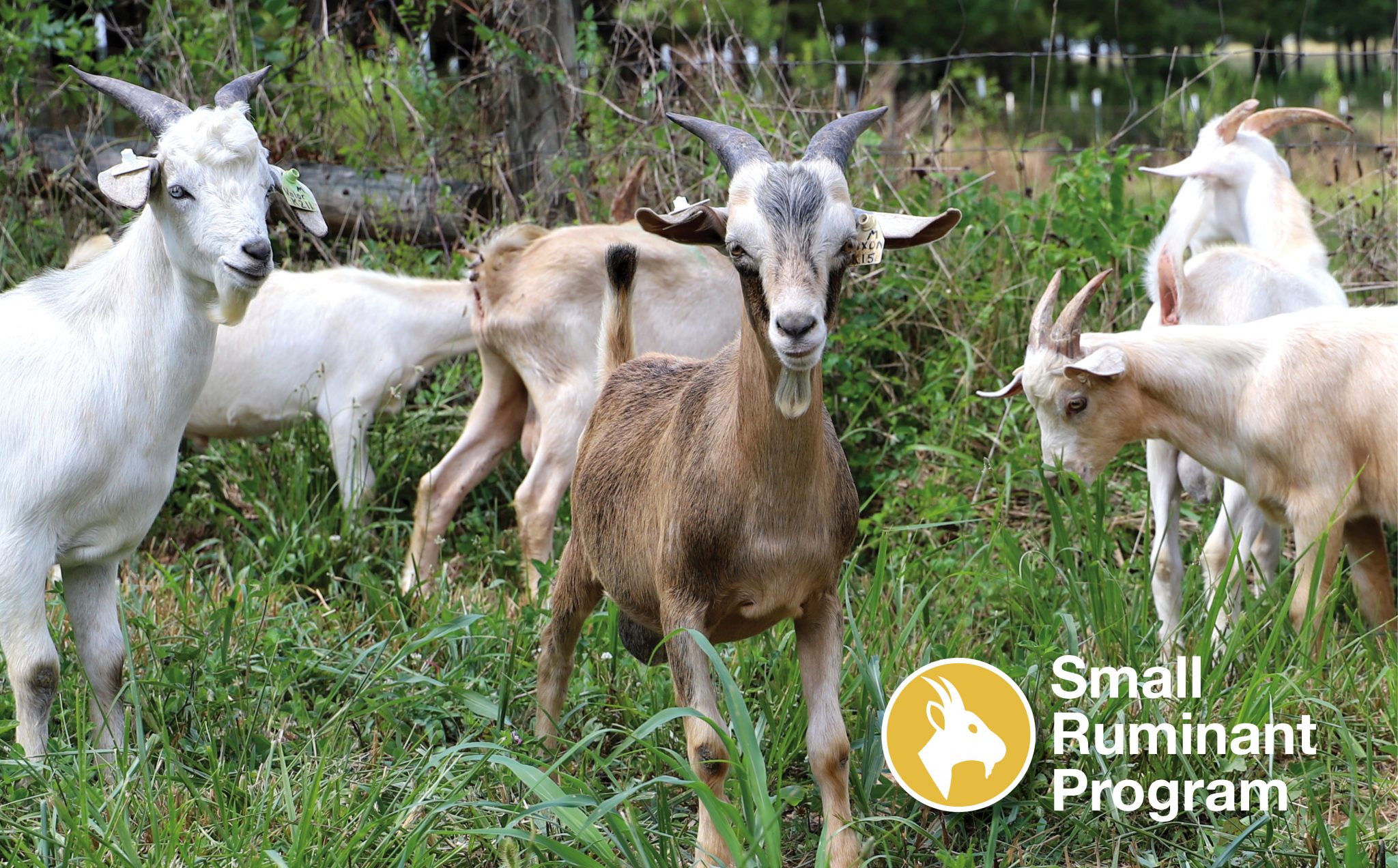
The Small Ruminant Program supports landowners, livestock farmers, and small-scale producers by optimizing the health, productivity, and sustainability of their goat and sheep operations. By focusing on best management practices, the program addresses nutrition, disease prevention, breeding, and herd management to ensure the well-being of small ruminants. In addition, it emphasizes the importance of effective marketing strategies to help producers maximize profitability and connect with local and regional markets. The Small Ruminant Program also promotes sustainable agricultural practices, particularly through integrating livestock with agroforestry systems like silvopasture. This approach combines timber, forage, and livestock production to create a more resilient and ecologically balanced farming system, benefiting both the environment and the producer.
Program Delivery Options
Best management practices are delivered through hands-on workshops, field demonstrations, online, and through other resources. These resources empower participants with the knowledge and skills needed to implement effective best management practices.
By fostering collaboration among farmers, researchers, and industry experts, the Small Ruminant Program also strengthens local food systems, enhances economic opportunities, and promotes environmental stewardship.
Study Update
A project of the Small Ruminant Program is the Breeding for Sustainable Control of Gastrointestinal Parasites in Meat Goats study. This study addresses one of the most significant challenges faced by small ruminant producers: gastrointestinal parasites. These parasites, particularly the barber pole worm (Haemonchus contortus), are a major threat to the health and productivity of goats and sheep. Loss of health and productivity leads to economic losses and increased reliance on chemical dewormers, which contribute to parasite resistance over time.
The project strives to provide sustainable, long-term solutions by focusing on selective breeding strategies using selection tools, such as fecal egg counts and FAMACHA score. These tools enhance the natural resistance of meat goats to these parasites. Additionally, the project establishes an Extension and research demonstration study at Alabama A&M University’s Winfield Thomas Agricultural Research Station (WTARS). The WTARS is a hub for innovative research, hands-on training, and the dissemination of best practices to small ruminant producers.
The Breeding for Sustainable Control of Gastrointestinal Parasites in Meat Goats project not only advances the scientific understanding of parasite resistance but also provides practical tools and resources for producers to implement these strategies on their own farms. By combining cutting-edge research with practical, producer-focused education, the project empowers small ruminant communities to overcome the challenges of parasite management while promoting the long-term sustainability and viability of their operations.
Expanded Project Goals
The three-year demonstration project, running from 2022 to 2025, is a collaborative effort led by the Alabama Cooperative Extension System at Alabama A&M University (AAMU). It is funded by an 1890 Capacity Building Grant (No. 2022-38821-37257) through the US Department of Agriculture’s National Institute of Food and Agriculture. Below are the updated and expanded project goals, along with additional details about its implementation and impact.
Project Goals
Establish Three Demonstration Sites in Alabama
- The project establishes demonstration sites at the WTARS in Hazel Green (northern Alabama), Escambia (southwestern Alabama), and Cuba (eastern Alabama). These sites serve as educational hubs for small ruminant producers to learn about integrated parasite control and breeding management.
- The Escambia and Cuba sites, located in Alabama’s Black Belt region, are being developed in collaboration with two farmers’ cooperatives: the Southeastern Goat Cooperative of Alabama and the East Alabama Black Belt Farmers’ Cooperative. These partnerships aim to ensure that the project reaches a diverse audience of producers.
Introduce an Improved Genetic Breeding Program
- The program emphasizes selective breeding for traits such as parasite resistance, weight gain, and reproductive efficiency to provide producers with genetically superior animals to improve herd productivity and sustainability.
Demonstrate the Benefits of Breeding for Parasite Management
- The study showcases how selective breeding and proper management practices can reduce reliance on chemical dewormers, mitigate parasite resistance, and improve overall herd health.
- Producers are learning how to integrate breeding strategies with other sustainable practices, such as rotational grazing and pasture management, to create a holistic approach to parasite control.
Train Producers and Students in Key Techniques
- The project will provide hands-on training for animal science students at AAMU and small ruminant producers in essential techniques for parasite management, including FAMACHA scoring, fecal egg count analysis, and animal selection.
- Additional training will focus on breeding management, such as culling, record-keeping, and genetic selection, to help producers make informed decisions that enhance herd performance and profitability.
Promote Sustainable Agriculture and Economic Development
- By reducing the economic burden of parasite-related losses and chemical treatments, the project aims to increase the profitability and sustainability of small ruminant operations.
- The project also seeks to strengthen local food systems and create economic opportunities for small ruminant producers in the Southeast.
Project Implementation
The demonstration project is being implemented through a collaborative effort led by Alabama Extension and AAMU staff, including the following:
- Felix Uchenna Samuel—Animal Science Specialist, Alabama Extension at AAMU
- Karnita Garner—Environmental Specialist, Alabama Extension at AAMU
- Ernst Cebert—Research Associate Professor, Department of Plant and Soil Science, and WTARS Manager
The project leverages the expertise of these professionals to ensure that research findings are effectively translated into practical, actionable strategies for producers. Additionally, the collaboration with farmers’ cooperatives ensures that the project addresses the unique needs of small-scale producers in the region.
Meat Goat Demonstration Project
In addition to the breeding and parasite management project, AAMU has also conducted the Meat Goat Demonstration Project, funded by USDA NIFA. This project explored the use of meat goats for sustainable land management and parasite control on forested lands. Key findings and activities included the following:
Rotational browsing and stocking rates. The project investigated how rotational browsing and varying stocking rates impact understory vegetation, soil health, and gastrointestinal parasite loads in goats. Results demonstrated that rotational browsing could improve forage quality, reduce parasite burdens, and enhance soil fertility.
Invasive plant control. The project utilized Kiko goats to control invasive plant species, such as Chinese privet, bush honeysuckle, kudzu, thorny olive, mimosa, tree of heaven, and paulownia. Goats were effective in reducing understory growth, providing a natural and cost-effective method for land management.
Educational outreach. Findings from this project were shared with producers through workshops, field days, and Extension publications, highlighting the dual benefits of using goats for vegetation control and meat production.
Impacts and Future Directions
The combined efforts of the Breeding for Sustainable Control of Gastrointestinal Parasites in Meat Goats and the Meat Goat Demonstration Project are transforming small ruminant production in the Southeast. By integrating research, education, and outreach, these initiatives equip producers with the tools and knowledge needed to overcome challenges and achieve long-term success. Looking ahead, the project team plans to accomplish the following:
- Expand outreach efforts to reach more small ruminant producers.
- Develop additional resources, such as online courses and mobile apps, to make information more accessible.
- Continue research on innovative breeding and management practices to further enhance the sustainability and profitability of small ruminant production.
Through these efforts, the project is not only improving the health and productivity of goats and sheep but also contributing to the resilience and economic vitality of rural communities across the southeastern United States.