
Forestry & Wildlife

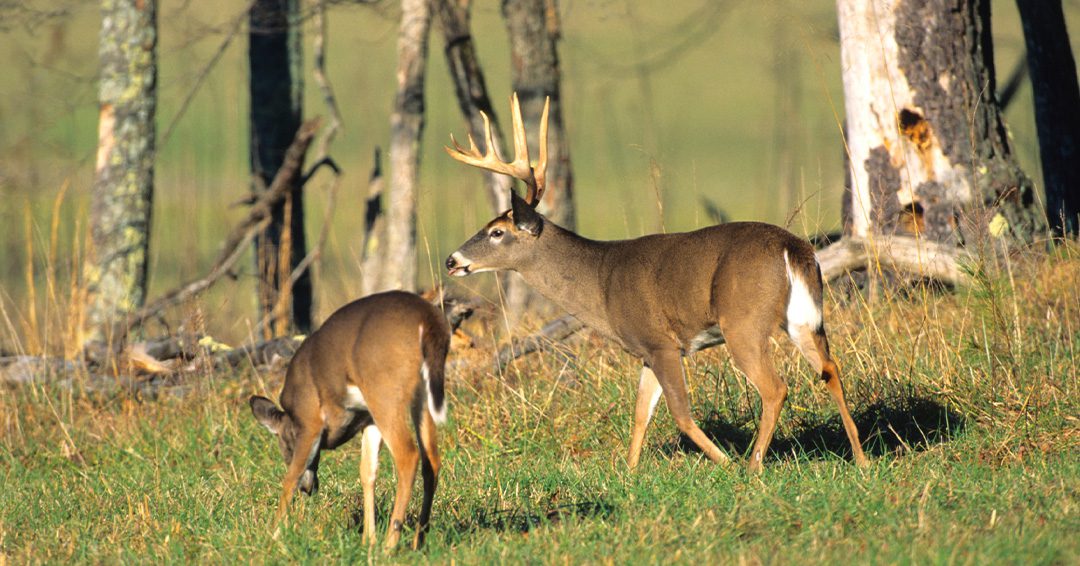
Many hunters know the thrill of harvesting a large-antlered deer, and many landowners focus on the production of those big bucks. While good nutrition, habitat management and harvest management are important considerations, a deer’s age is often a key, overlooked factor when deciding which deer to harvest. By letting young deer age to maturity, hunters and landowners alike can help establish bigger bucks for future hunting seasons.
Age and Antler Correlations
Managing deer has a lot to do with allowing bucks to reach maturity to improve the chances of larger antlers. Mark Smith, an Alabama Extension agent in forestry, wildlife and natural resources at Auburn University, said by not harvesting a deer when it’s 1.5 to 2 years old, hunters can increase its antler growth up to about 40 percent by the next hunting season.
“Age is the easiest thing you can control that has the greatest impact on antler growth,” Smith said. “If you let deer grow older, you’re going to increase antler development dramatically.”
Antler growth increases drastically between ages 1.5 to 4.5. Early on, deer are putting more resources toward body growth rather than their antlers. However, as they reach maturity, their growth focus starts shifting from body maintenance and more toward antler development.
Determining a deer’s age takes a little more effort than just looking at the antler size, which is not always a good indicator for age. Some young bucks that are only a couple of years old can have six, eight or even 10 antler points. It is important to monitor other age indicators to estimate how old a buck may be.
How to Best Tell a Deer’s Age
It can be difficult to determine a deer’s actual age. The easiest way is to look at their teeth — specifically tooth wear and replacement — once they have been harvested to use as a measure for its age. Much like humans, the teeth of a newborn deer eventually are replaced by adult teeth. This knowledge can be used to reliably estimate fawn age groups. Once deer have their full set of adult teeth, age is primarily determined by tooth wear, with older deer showing a greater amount of wear. However, estimating deer age by tooth wear is not an exact science, as tooth wear can vary from deer to deer and can only be estimated once a deer has been harvested. In many management scenarios, it is important to be able to estimate the age of live deer, but knowing their age by tooth wear and replacement is a great starting point to better understanding deer age on the property.
“Hunters who are serious about deer management invest a lot of time to data collection,” Smith said. “Observing deer with patience can help landowners improve their understanding of deer age.”
Another way to determine a deer’s age is their body conformation. For example, Smith said that fully mature bucks not only are larger in body size but also develop some common characteristics — such as big broad shoulders, sagging belly and a fuller looking body compared to younger bucks. While still not an exact science, overall body conformation can give hunters and landowners an idea that the deer is probably in an older age class.
“Adaptive management is a repetitive process where you’re improving over time,” Smith said. “When you invest time to learn about those animals, that’s where you really become a good deer manager or steward of the resource.”
Other Factors that Affect Antler Size
While age is an important consideration for antler size, there are many factors that can affect the size of a deer and its antlers.
Where a deer is born, and sometimes even what time of year they are born, can have an impact. Smith said studies indicate that deer born earlier in fawning season or early summer tend to grow larger antlers on average than deer that are born late summer. That is because deer born earlier have more time to consume valuable nutrients.
“There will be some individual variations as they go through life, but where and when a deer is born can cause them to vary in size significantly,” Smith said.
Genetics also have a major impact on antler size and is something that cannot be controlled effectively in wild, free-range populations. If two deer are born in the same area, have the same nutrients and are from the same doe, they will likely have a similar antler size. One common misconception is that a person can simply feed deer more to grow larger antlers. While nutrition does play a part, it is not the factor that helps to increase antler size. Letting deer mature is the best way for them to reach their full genetic potential.
Key Takeaways for Landowners
If bigger antlers are the goal, dedicate the time needed to better understand the deer on your hunting property and know what deer look like at certain ages. Also, if others are hunting on your property, spend some time teaching them about estimating the age of live deer and why it is important to let deer mature rather than just going for large antlers.
“Don’t be afraid to invest the time into learning,” Smith said. “Also, don’t be afraid to make a mistake. Mistakes are going to happen, but that is how you learn.”
Alabama Extension takes the expertise of Auburn University and Alabama A&M University to the people, offering practical ways to better homes, farms, people and the world. For more information on deer management and best practices, visit aces.edu or contact the Cooperative Extension service or system in your state.