
Forestry

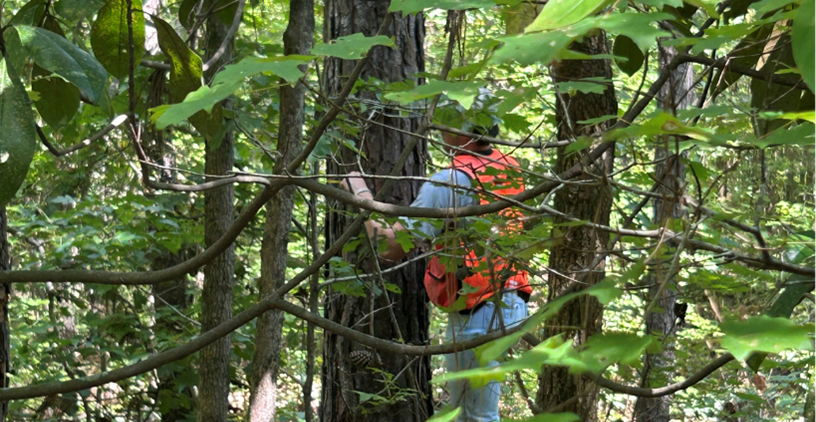
Pine bark beetles are small insects that can cause serious damage to pine trees in Alabama. While they are tiny, their impact can be large, especially when their populations increase.
Three bark beetle species are commonly found in Alabama:
- Southern pine beetle (Dendroctonus frontalis)
- Black turpentine beetle (Dendroctonus terebrans)
- Ips engraver beetle (Ips spp.)
All three live and feed under the bark of pine trees but differ in size, aggressiveness, and attack patterns. Correctly identifying each species is the first step in developing a management plan.
Bark Beetle Damage
Bark beetles tunnel just beneath the bark and feed on the tree’s inner layer called the phloem. This layer moves nutrients through the tree. When beetles destroy it, the tree can no longer transport food and water and eventually dies. Some bark beetles also carry blue-stain fungi. These fungi stain the wood blue-grey and speed up tree decline. Beetle activity usually begins in the spring and increases as temperatures rise. Most beetles attack trees that are stressed by drought, flooding, overcrowding, or storm damage. During outbreaks, however, even healthy trees can be attacked.
Early Signs of Bark Beetle Attack
- Small blobs of sap called pitch tubes on the bark may look like popcorn. Can be white, pink, or reddish brown and range in size from a pea to a dime.
- Fine sawdust-like material in bark crevices or at the base of trees called frass from beetles boring into the tree.
- Small entry holes in the bark.
- Needles changing color from green to yellow, then red or brown.
- Crown thinning.
Southern Pine Beetle (SPB)
The southern pine beetle is the most destructive pine beetle in the southeastern United States. Southern pine beetles kill trees by attacking in large numbers at the same time, overwhelming the trees’ natural defense. This allows them to kill completely healthy trees, unlike most other bark beetles that tend to attack stressed trees. Outbreaks can rapidly kill large areas of pine forest. SPB commonly attacks loblolly, shortleaf, and Virginia pine, but it can attack most southern pines.
Click on the images below to see them at full scale.
-
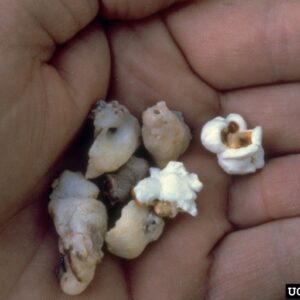
- Figure 1a. SPB pitch tubes compared to popcorn. (Photo credit: USDA Forest Service, Region 8, Southern, Bugwood.org)
-
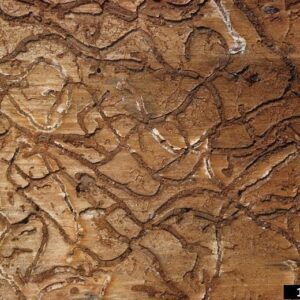
- Figure 1b. S-shaped galleries produced by SPB beneath bark. (Photo credit: by Roger Anderson, Duke University, Bugwood.org)
-
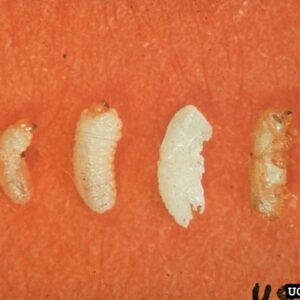
- Figure 1c. SPB life stages. (Photo by USDA Forest Service – Region 8 – Southern, USDA Forest Service, Bugwood.org)
Signs of SPB
- Needles turning yellow, then red, then brown (often starting at the top).
- Evidence of attacks mid to upper trunk, but can be throughout.
- Small white to reddish pitch tubes on the main trunk that often look like popcorn.
- Fine reddish dust in bark crevices or at the base of trees.
- Infestations that spread outward in spots from tree to tree. Spread can be quick in a stand.
- Very small reddish-brown beetle (2 to 4 millimeters or about the size of a grain of rice).
- S-shaped galleries beneath the bark where the adult lay their eggs. These eggs hatch into the destructive larvae that feed on the phloem.
- Tiny round exit holes that can be seen when the beetles have matured and left the tree. Exit holes are usually cleaner, larger, more numerous, and easier to see than entry holes.
- Increased woodpecker activity. All pine beetles can attract woodpeckers, but are more common with SPB infestations.
Click on the images below to see them at full scale.
-
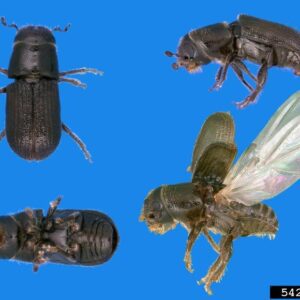
- Figure 2a. Adult beetle. (Photo credit: Erich G. Vallery, USDA Forest Service, SRS-4552, Bugwood.org)
-
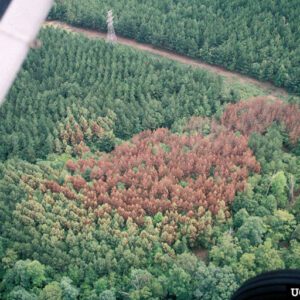
- Figure 2b. SPB infestation spot. (Photo credit: by Andrew J. Boone, South Carolina Forestry Commission, Bugwood.org)
Managing SPB
Prevention relies heavily on silvicultural practices such as thinning overstocked stands to maintain vigor. During outbreaks, active management with cut-and-leave or cut-and-remove strategies is recommended. Since SPB can attack healthy trees, extra vigilance and monitoring are important in the spring and summer months.
IPS Engraver Beetles
Ips engraver beetles (Ips avulsus, I. grandicollis, and I. calligraphus) are common in Alabama. They usually attack weakened or recently damaged trees, such as those damaged by storms, drought, or logging operations. Ips infestations are usually smaller and less aggressive than SPB infestations but can still cause significant mortality in stressed stands or during drought years. Populations of Ips beetles can increase rapidly when it is warm, and they can produce multiple generations in a single year.
Signs of IPS
- Fine reddish-brown boring dust in bark crevices and at tree base.
- Needle discoloration is patchy or scattered.
- Evidence of attacks to the mid to upper trunk, branches, and sometimes slash or logging debris.
- Reddish-brown pitch tubes often smaller and less abundant than those produced by SPB.
- Distinct H-, Y-, or I-shaped galleries.
- Adults are small (3 to 6 millimeters), brownish beetles with a distinct scooped out rear with 3 to 6 toothlike spines on each side.
Click on the images below to see them at full scale.
-
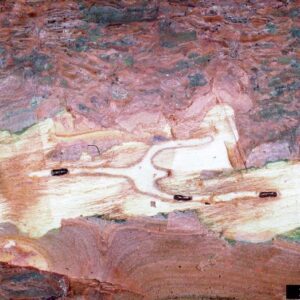
- Figure 3. Galleries created by Ips calligraphus (Photo credit: Lacy L. Hyche, Auburn University, Bugwood.org)
-
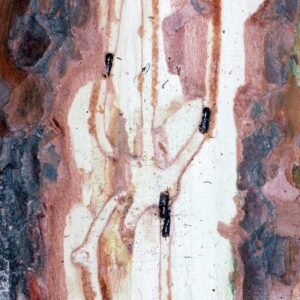
- Figure 4. Galleries created by Ips calligraphus (Photo credit: Lacy L. Hyche, Auburn University, Bugwood.org)
The number of spines on the abdomen helps identify the beetle, and where the tree is infested can also provide clues about the species. It is not uncommon for all three species to be present in the landscape or on a single tree.
Ips avulsus
- Also called the small southern pine engraver.
- The smallest at approximately 3 millimeters long.
- Three-spined.
- Mainly found at the top of trees on thinner branches and creates the smaller I galleries.
Ips grandicollis
- Also called the eastern five-spined engraver.
- Approximately 4 millimeters long.
- Tends to infest the upper trunk or smaller trees.
Ips calligraphus
- Also called eastern six-spined engraver.
- Largest of the three species at approximately 5 millimeters long.
- Prefers the main trunk and large, heavy branches.
Click on the images below to see them at full scale.
-
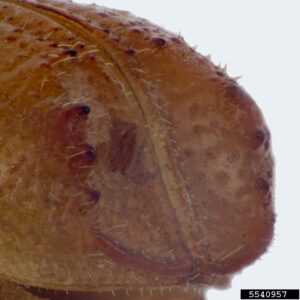
- Figure 5. Ips avulsus (Photo credit. Joseph Benzel, Screening Aids, USDA APHIS)
-
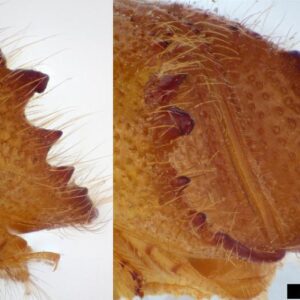
- Figure 6. Ips grandicollis (Photo credit: Joseph Benzel, Screening Aids, USDA APHIS)
-
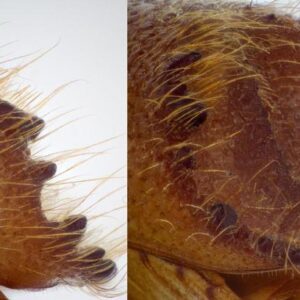
- Figure 7. Adult Ips calligraphus beetles with scooped out abdomen and spines. (Photo credit: Joseph Benzel, Screening Aids, USDA APHIS PPQ, Bugwood.org)
Managing Ips Beetles
To manage Ips beetles, storm-damaged wood should be salvaged as soon as possible. Also remove slash and logging debris as they provide breeding material for these beetles.
Black Turpentine Beetle (BTB)
The black turpentine beetle is the largest bark beetle affecting southern pines. Unlike the southern pine beetle, BTB is not usually aggressive and rarely kills healthy trees. Instead, it attacks stressed or injured pines, and repeated or heavy infestations can weaken stands. BTB usually becomes a problem after thinning, logging injury, prescribed fire, or mechanical damage to tree bases.
Signs of BTB
- Evidence of attacks usually observed within the bottom 8 feet of the trunk.
- Large, white to reddish-brown pitch tubes that are more than an inch in diameter.
- Coarse boring dust at the base of trees.
- Wide galleries under the bark that are irregular, shorter, not distinct, and look like broad patches instead of the narrow tunnels seen with SPB and Ips.
- Adults that are 6 to 10 millimeters long and reddishbrown to black in color.
Click on the images below to see them at full scale.
-
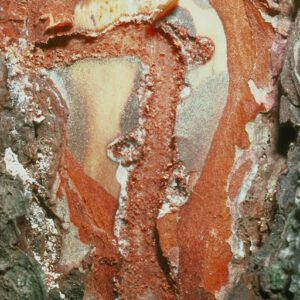
- Figure 8b. BTB galleries (Photo credit: Ronald F. Billings, Texas A&M Forest Service, Bugwood.org)
-
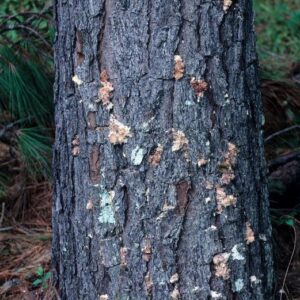
- Figure 8a. Large BTB pitch tubes at the base of pine tree (Photo credit: Lacy L. Hyche, Auburn University, Bugwood.org)
-
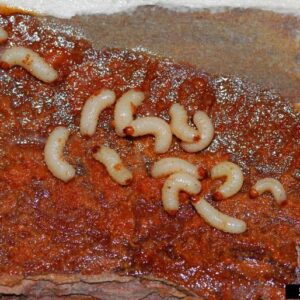
- Figure 9a. BTB larvae ( Photo credit: Erich G. Vallery, USDA Forest Service, SRS-4552, Bugwood.org)
-
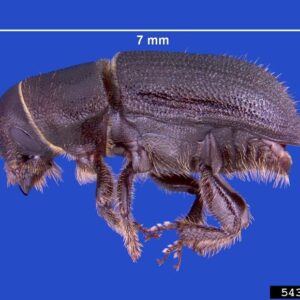
- Figure 9b. Adult BTB ( Photo credit: Erich G. Vallery, USDA Forest Service, SRS-4552, Bugwood.org)
Managing BTB
Prevention is key to managing BTB damage. Be careful to avoid wounding bases of trees during logging and other activities, and to maintain tree vigor since BTB is attracted to wounded or freshly cut trees.
Broad Management Recommendations
- Keep trees healthy. Thin dense stands, reduce overcrowding, and promote a mix of tree species. Healthy trees are less attractive to all pine beetles.
- Monitor regularly. Look for early signs such as pitch tubes, frass, or discolored needles. Early detection is key, as timely management can protect individual trees and reduce the spread of infestations across the forest.
- Remove infested trees quickly. All three beetles spread from weakened trees, so cutting, chipping, or debarking infested trees helps stop the spread.
- Seek assistance. Contact your local forester or the Alabama Cooperative Extension System if you require help with a suspected beetle problem.
- Consider preventative programs. The Alabama Forestry Commission offers cost-share assistance for proactive measures and provides management guidance to landowners.
Click on the images below to see them at full scale.
-
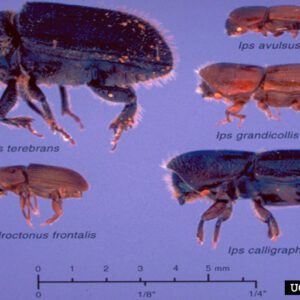
- Figure 10a. Size differences among beetles that infest southern pines (Photo credit: John L. Foltz, University of Florida, Bugwood.org)
-
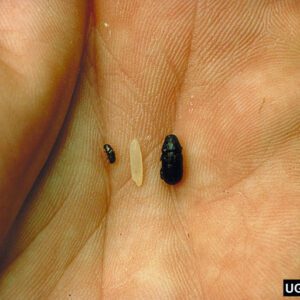
- Figure 10b. A comparison of SPB, a rice grain, and BTB (Photo credit: Southern Forest Insect Work Conference, Bugwood.org)
Table 1. Quick Comparison Guide of Pine Bark Beetles
| Feature | Southern Pine Beetle (SPB) | Ips Engraver Beetles (Ips spp.) | Black Turpentine Beetle (BTB) |
|---|---|---|---|
| Beetle size | Very small: 2–4 mm | Small to medium: 3–6 mm | Largest: 6–10 mm |
| Color | Reddish-brown to dark brown | Reddish-brown | Dark reddish-brown to black |
| Pitch tubes | Small, reddish-brown to white | Small, reddish-brown; often in bark crevices | Large, pinkish-white; about size of a dime or larger |
| Gallery pattern under bark | S-shaped, winding galleries packed with frass | Distinct H-, Y-, or I-shaped galleries | Large, irregular galleries; not as distinct |
| Preferred attack site on tree | Mid to upper trunk (but can be throughout) | Mid to upper trunk; sometimes slash or logging debris | Lower trunk, especially within 8 feet of the ground |
| Tree symptoms | Needle discoloration (yellow → red → brown), top-down | Needle discoloration patchy, often scattered | Pitch tubes low on trunk, resin flow, often localized |
| Frass | Fine boring dust, reddish | Fine reddish dust in bark crevices or around base | Coarse boring dust at base of tree |
| Infestation pattern | Spot infestations spreading outward in stands | Often in storm-damaged trees, slash, or stressed trees | Usually individual stressed or injured trees |
| Aggressiveness | Most aggressive; can kill healthy trees | Opportunistic; usually secondary invaders | Less aggressive; usually attacks stressed or damaged trees |
| Key distinguishing feature | Tiny beetle; winding S-shaped galleries | Galleries in neat Y-, H-, or I-shapes | Largest beetle; big pitch tubes low on trunk |
 Annakay Newell, Extension Specialist, Assistant Professor, Forestry, Wildlife, and Environment, Auburn University.
New April 2026, Bark Beetles Threatening Alabama’s Forests, FOR-2200