
Home & Family


New Principles of Parenting Series
The Principles of Parenting series provides tips and information to support positive parenting and child development.
The big muscles of our bodies include our legs, backs, arms, and neck. These muscles help us stand up, walk, balance, and do what we want to do. Big muscle strength is a building block for future wellness. The development of physical strength, starting when infants learn to roll over, grows the parts of our brain associated with perception and gives us confidence.
Large Muscle Skills
Part of being ready to learn means that young children can control the movements of their bodies. Children who can control their large muscles and physical movements are less likely to hurt themselves when playing. Children who can hop, skip, run, and climb can find many ways to entertain themselves. They may also enjoy more chances for social play with other children.
Children develop these skills at different rates, in steps sometimes called milestones. Children do not automatically develop good physical skills. These skills require both physical growth and practice. For example, toddlers’ muscles are not developed enough to be able to skip. Some older preschoolers can use one foot at a time for skipping, but they need to practice to do it well. Most children learn best when they have the chance to practice and the encouragement of caring adults.
To develop good physical skills, infants, toddlers, and preschoolers need the chance to be physically active every day. The National Association for the Education of Young Children recommends that toddlers and preschoolers have 60 to 90 minutes of free play outdoors every day. This can be spread out in smaller bits of time throughout the day, but make sure they get time to practice their big muscle movement. Growing stronger helps young children develop confidence.
The large muscle skills and abilities are important for healthy growing.
- Running
- Hopping
- Jumping
- Skipping
- Climbing
- Galloping
- Balancing
- Walking backwards
- Dancing
- Swimming and running in water
From Infants to Preschoolers
 Give babies opportunities to reach, grab, roll, scoot, and crawl.
- Make safe spaces for crawling babies to move around, climb, and explore.
- Take time to play simple physical activities and games like peekaboo with infants.
As infants become mobile toddlers, encourage them to move. Make sure they have the freedom to move.
- Remove forbidden objects and furniture with sharp corners so toddlers can play safely.
- Find padding or bumpers for sharp corners at the level of a toddler’s head.
- Use baby gates wherever there are stairs—toddlers move fast!
- Create zones where toddlers can move freely but safely.
- Allow toddlers to practice walking. Do not always use a stroller to go places. Walk slowly with them.
If you are worried about them running away, you can put a walking harness on them (but do not yank it, of course).
You can encourage older preschoolers to do more complicated movements that involve balance:
- Skipping. Skipping is really hard for young children because they have to balance on one foot and move their body forward while they swing their arms. It is hard. You try it.
- Pretending to be something like a flamingo that involves balancing on one foot or doing beginning yoga poses. Do not encourage extreme bending.
- Creating a jumping path. Inside, you can create a trail of cushions around your living room. Double up on some cushions and vary the spacing to make it more challenging. Make sure the child will not slip or hit something dangerous. Now they can try to walk across the cushions. Younger children can start on their hands and knees and then progress to walking.
Activities to Make Moving Fun
Encourage movement that is fun.
- Count steps and help your beginning walker jump as they step.
- Sing or say nursery rhymes with movement:
- “I’m a Little Teacup”
- “The Wheels on the Bus”
- “Pat a Cake, Pat a Cake”
- Encourage dancing and singing—you can do it too!
Outdoor Activities for the Whole Family
 Outdoors, you can do things together as a family:
- Play soccer or basketball
- Toss plastic disks
- Play catch
- Blow and chase bubbles
- Ride tricycles
- Walk around the neighborhood
- Play outdoor games.
You can teach older children games you used to play too. Sometimes what’s old is new.
- Freeze tag
- Red rover
- Red light, green light
Children with Possible Developmental Delay
It is important for all children to have the opportunity to develop their big muscle strength. If your child cannot do what others their age can do, you can help them.
- A young child who cannot catch yet can learn to play with a ball by rolling it back and forth.
- Children with less strength can use soft or plush balls.
- Children who do not balance as well can hold on to push-toys or hold on to your hand.
- You can push young children on a swing to help them develop core strength. Make sure they can hang on.
- Give children a chance to walk when you are not in a rush.
Children who are developing at different rates still need the recommended movement time or more. Much like adults, children have different levels of coordination and strength. However, big muscles contribute to overall well-being.
Stop and Think
- What games did you play as a preschool child?
- What was fun?
- What opportunities did physical play give you?
- Share your experiences with your children and teach them how to play. See if they can create their own games.
Children’s Outdoor Safety
The outdoors is the perfect place for your children to be active and learn about the world around them. However, the outdoors also exposes children to risks. As a parent, your child’s fun is top priority, but you also know how to keep them safe. Here are some fun activities that have risks of accidents and injuries that can be prevented.
Did You Know?
Outdoors risks change as your child ages.
Fun Outdoor Activities
- Playing sports
- Biking or riding a tricycle
- Spending time around water
- Camping and hiking
- Digging and making things
- Playing in the sun
- Playing with pets and animals
Did You Know?
Children experience fewer accidents than they used to because of all our safety knowledge.
- Use safety equipment for organized sports and bicycle/tricycle riding.
- Be careful around pools, ponds, and beaches. Toddlers can move fast and easily get in trouble in shallow water or at the beach.
- Change your approach as the seasons change. In summer, watch out for sunburns, ticks, mosquitos, dehydration, and overheating.
 Street safety. Preschool and elementary school children do not have good depth perception and cannot calculate speed well. They may chase a ball across the street, for example. Make sure they do not run out between cars or cross the street when they should not.
Equipment safety. Preschool-aged children should not drive adult equipment such as big bicycles, scooters, farm equipment, lawn mowers, ATVs, or other vehicles. They are too fast and big for them to manage.
Pets and animals. Make sure your preschool-aged child knows not to approach a strange animal or pick up animals in nature. They should also know how to be gentle with their own animals. If you have pets, ensure that they are safe to be around young children.
Digging. Tunneling can be fun, but make sure children do not dig or tunnel too deeply.
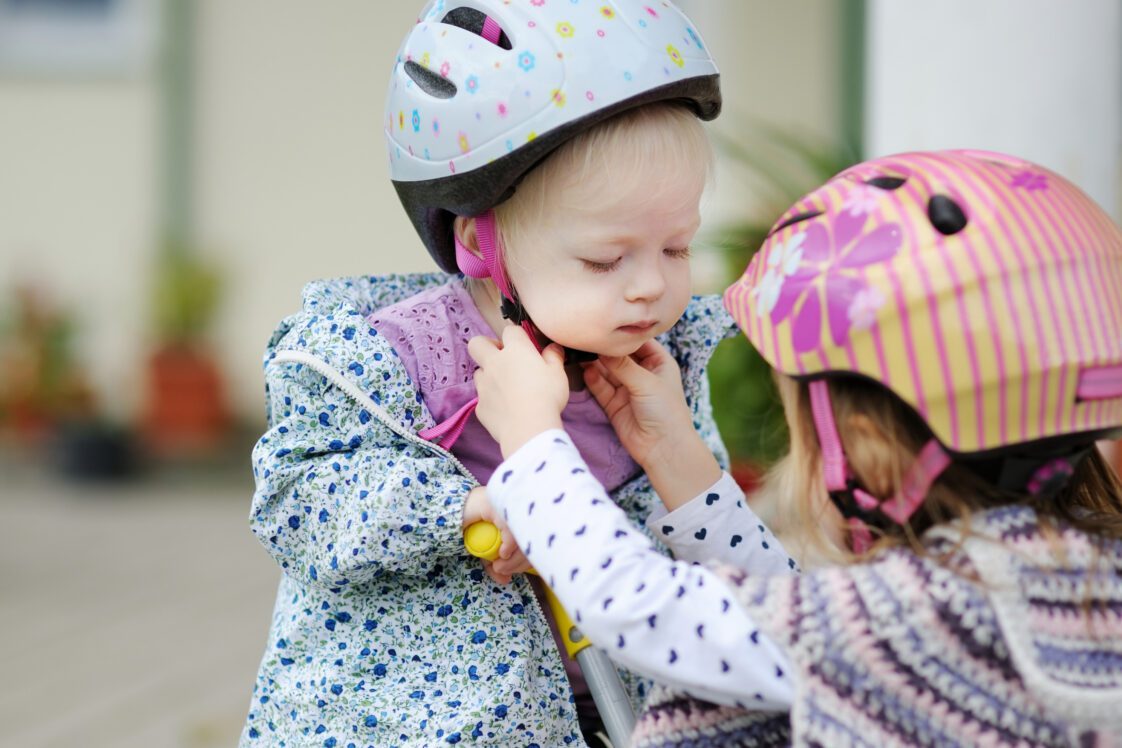
If you have children of multiple ages, let the older child show the younger child how to be safe, like wearing bicycle helmets. The younger child will be motivated to be like the older ones they want to copy.
Growing big muscle strength can be fun and essential to overall growth. Children who are developing at a slower pace may need more deliberate support.
Your physician will know if your child needs extra support. Encouraging big muscle growth will help other parts of their development too. As preschool-aged children learn and grow, make sure to provide learning opportunities and ensure that children get at least the minimum amount of free play time every day to help them grow healthy and strong.
You can read more about developmental milestones on the Centers for Disease Control and Prevention (CDC) website. You can gain tips on supporting your child’s growth at Just In Time Parenting at https://jitp.info/.
 Silvia Vilches, Extension Specialist, Associate Professor, Human Development and Family Studies; Leigh Akins, Extension Agent, Family and Child Development; and Jenna Wettstein, Undergraduate Research Assistant, Human Development and Family Science, all with Auburn University
New November 2025, Big Muscle Skills: Playing and Growing with Young Children, FCS-2889