
Fire

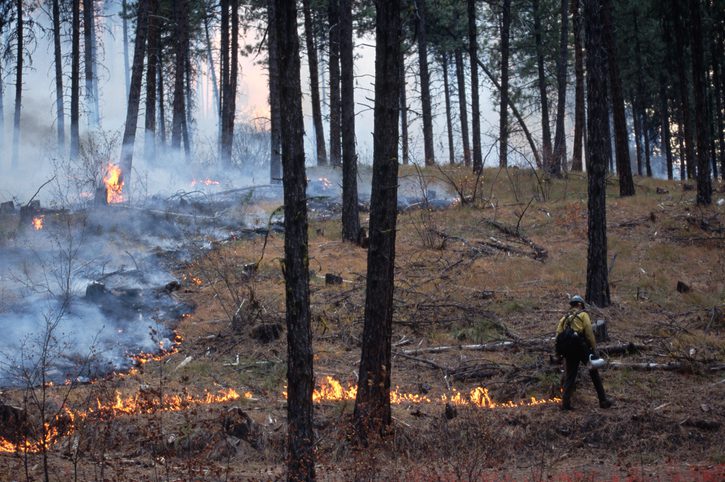
Fire is a natural part of many ecosystems, shaping plant communities and cycling nutrients. In southern Alabama’s woodlands of longleaf pines and saw palmettos, frequent fires contribute to preservation of vital habitat and prevent establishment of mid-story species that can be a causative factor to canopy fires, a large contributor to tree and forest mortality.
However, not all fires are the same. Prescribed burns, intentionally set under controlled conditions, differ significantly from wildfires in their impact on plants and soil health, especially nutrient degradation.
The Role of Fire in Nutrient Cycling
Fires influence key primary and secondary macronutrients. Macronutrients are elements. They provide the nutrition plants need for adequate growth and are required in relatively large amounts. Primary macronutrients are nitrogen (N), phosphorus (P), and potassium (K), while secondary macronutrients include calcium (C), magnesium (Mg), and sulfur (S). Absent these, site productivity of an area can be impacted.
These nutrients are often bound in understory plants and soils of a forest, taking days to decades to degrade and become bioavailable. Fire can accelerate the time required to break down plants and dead materials as well as increase the rates of mineralization through its impacts to soil microbes. This allows nutrients to become available at a faster rate.
Depending on fire intensity and frequency, nutrients can also be lost through volatilization, erosion, oxidation, or leaching. The extent of degradation depends largely on fire temperature and duration. Topographical characteristics of the landscape, such as aspect and slope, can play an additional role. In the flatter southern region of Alabama, topography is a lesser concern.
Table 1.
| Elements, Molecules, and Materials | Sensitivity Rating | Threshold Temperature (C°) |
|---|---|---|
| Water | Sensitive | 100 |
| Lignin and Cellulose | Sensitive | 130-190 |
| Nitrogen and Sulfur | Sensitive | 200-375 |
| Potassium and Phosphorus | Moderately Sensitive | 774 |
| Magnesium | Relatively Insensitive | 1,107 |
| Calcium | Relatively Insensitive | 1,484 |
Prescribed Burns: Controlled and Strategic
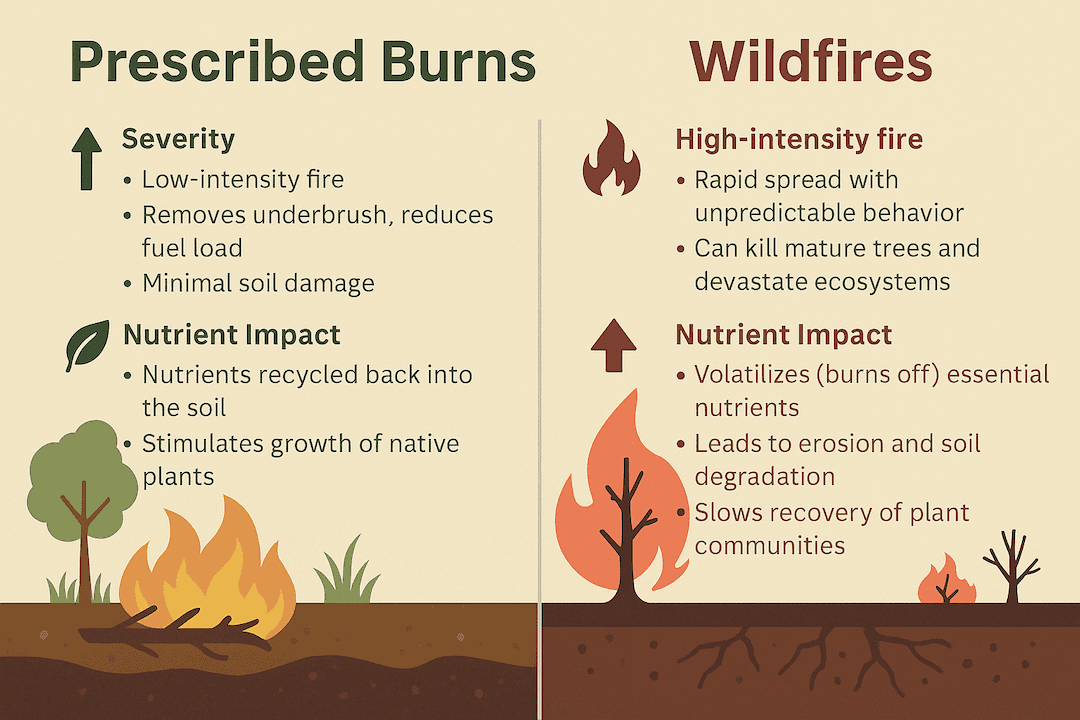
Prescribed fires are given great consideration before implementation. Ideally, a planned burn will be low to moderate in intensity and typically occur under optimal weather and fuel conditions. Because they burn cooler and more evenly, they tend to preserve more soil structure and organic matter. While some nutrients are lost to volatilization, many remain in the ash and quickly return to the soil, promoting plant regrowth.
Additionally, prescribed burns are often repeated over time, maintaining a nutrient balance in the ecosystem and reducing the risk of high-intensity wildfires. This method encourages nutrient cycling without long-term degradation.
Wildfires: Intense and Unpredictable
In contrast, wildfires often burn at much higher temperatures, especially in dense or drought-stricken forests. This intensity leads to greater nutrient loss, deep combustion of organic matter, and destruction of microbial life essential for nutrient processing. High heat can create hydrophobic (water-repellent) soil layers. This hinders water infiltration and increases erosion, carrying away valuable nutrients. High heat can also destroy seed sources and rhizomes required for native revegetation establishment, allowing for the proliferation of more fire resilient invasive species like cogongrass.
Overall, wildfires can leave soils severely depleted and less able to support vegetation recovery, resulting in long-term ecological impacts and alterations in ecosystem composition.
Comparing the Two
Table 2.
| Aspect | Prescribed Fire | Wildfire |
|---|---|---|
| Fire Intensity | Low to Moderate | High and Unpredictable |
| Nitrogen Loss | Minimal to Moderate | Significant |
| Organic Matter | Partially Preserved | Often Destroyed |
| Erosion Risk | Low | High |
| Nutrient Recovery | Rapid | Delayed to Depleted |
Implications for Management
Understanding the different nutrient impacts of fire types is critical for sustainable land management. Prescribed burns not only reduce fuel loads but also help maintain soil fertility and ecosystem function. In contrast, unmanaged wildfires can severely disrupt nutrient cycles and delay recovery for years.
By favoring prescribed fire, when and where appropriate, land managers can protect biodiversity, reduce the risk of catastrophic wildfires, and maintain healthier soils for future growth.
References
- G596 Pinus palustris / Ilex glabra—Serenoa repens Woodland Group. (n.d.). https://www1.usgs.gov/csas/nvcs/unitDetails/857602
- Harvey, A. E., & Neuenschwander, L. F. (1991). Proceedings—Management and productivity of western-montane forest soils (No. INT-GTR-280; p. INT-GTR-280). U.S. Department of Agriculture, Forest Service, Intermountain Research Station. https://doi.org/10.2737/INT-GTR-280
- Neary, D. G., Ryan, K. C., & DeBano, L. F. (2005). Wildland fire in ecosystems: Effects of fire on soils and water (No. RMRS-GTR-42-V4; p. RMRS-GTR-42-V4). U.S. Department of Agriculture, Forest Service, Rocky Mountain Research Station. https://doi.org/10.2737/RMRS-GTR-42-V4
- Wells, C. G., Ralph E. Campbell, Leonard F. DeBano, Clifford E. Lewis, Richard L. Fredriksen, E. Carlyle Franklin, Robert C. Froelich, & Paul H. Dunn. (1978). Effects of Fire on Soil (State of Knowledge Review No. General Technical Report WO-7; p. 38). US Forest Service. https://andrewsforest.oregonstate.edu/sites/default/files/lter/pubs/pdf/pub548.pdf