
Forestry & Wildlife

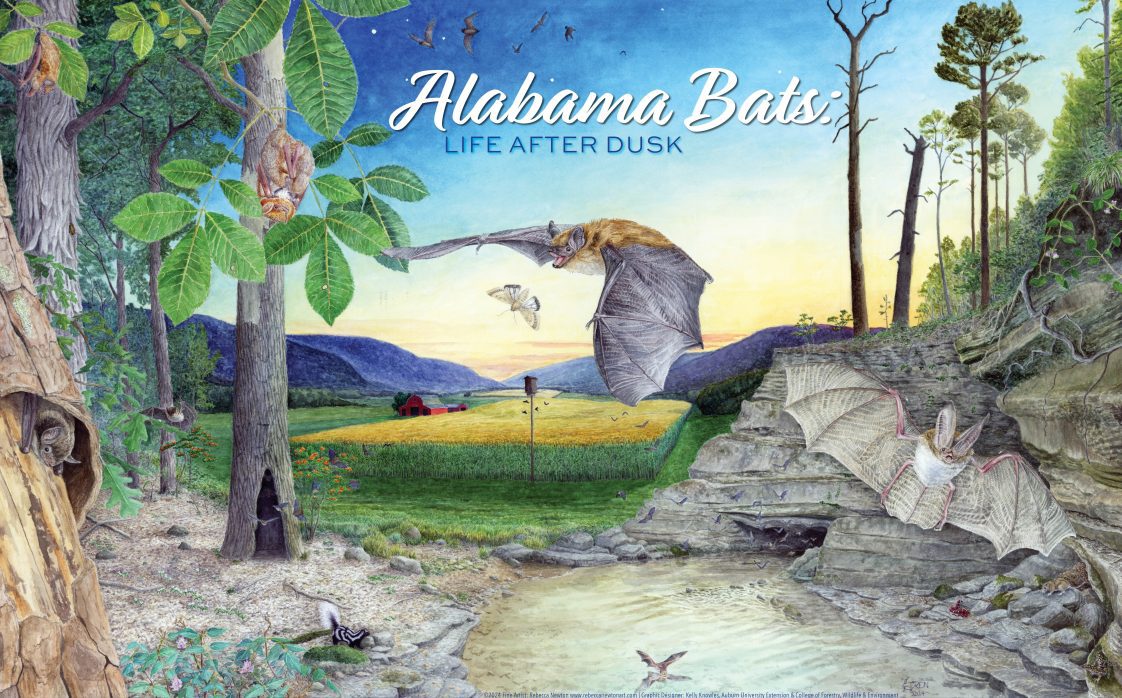
The following numbers and information coordinate with the Alabama bat species, flora, and fauna depicted on the poster below.
1. Tricolored bat (Perimyotis subflavus). Tricolored bats like to roost in clumps of leaves. They also hibernate in caves during the winter. These bats have been heavily affected by white-nose syndrome. More information on white-nose syndrome is available online at www.whitenosesyndrome.org. The tricolored bat is currently under review for listing as an endangered species.
2. Brazilian free-tailed bat (Tadarida brasiliensis). Brazilian free-tailed bats are high, fast flyers of the night sky, and they can congregate in colonies of hundreds to thousands. The natural roosts of these bats in Alabama are probably large hollow trees with an opening at the bottom (see #9). The largest known roost of these bats in Alabama is an abandoned railroad tunnel.
3. Evening bat (Nycticeius humeralis). Evening bats like to roost under the loose bark of trees, such as shagbark hickories and white oaks.
4. Red bat (Lasiurus borealis). Red bat pictured with young. Bats in Alabama give birth to one to four pups (often two) only once per year. Pups cling to their mother to nurse and when she flies to move them to a new roost. When red bats roost, they resemble a dead leaf and hide in clumps of dead leaves during the day. During winter, they may take shelter underneath the leaf litter.
5. Big brown bat (Eptesicus fuscus). Big brown bat pursuing a corn earworm moth. All Alabama bats are insectivores. Bats are the only major predator of the nighttime flying insects that cause major crop damage. One scientific study estimated that the pest control services provided by bats in the United States is worth $23 billion to US agriculture annually. Another study determined bats are worth $1 billion to the global corn crop alone.
6. Morefield’s leatherflower (Clematis morefieldii). Morefield’s leatherflower is an endangered vine. This vine is only known to occur on the slopes of the Cumberland Plateau in Alabama, Georgia, and Tennessee. It is vulnerable to habitat destruction, often due to development.
7. Indiana bat (Myotis sodalis). Indiana bat roosting under pine bark. This bat species is endangered. This bat has the dubious distinction of being among the first species protected when the US Congress passed the Endangered Species Act in 1966. It was in peril due to human disturbance of the caves in which they hibernate. Now, it is suffering under the threat of white-nose syndrome. Indiana bats like to roost under the bark sloughing off dead pine trees (see #23), especially in the spring when mothers gather into a maternity colony to give birth to their young. For the entire range of the species, the southernmost known population was discovered in central Alabama in 2017.
8. Northern long-eared bat (Myotis septentrionalis). Northern long-eared bat gleaning a spongy moth caterpillar. These bats are endangered. This species is highly maneuverable and can pick insects off leaves and twigs. The spongy moth is a nonnative species from Europe that defoliates deciduous trees. The northern long-eared bat was once one of the most common bats in the eastern US. The species was listed as endangered because it has been devastated by white-nose syndrome.
9. Southeastern bat (Myotis austroriparius). Southeastern bat emerging from the basal hollow of a tree. In the summer, this species may congregate in caves in colonies of over a thousand individuals. Smaller colonies may make a hollow tree their home. The southeastern bat hibernates in caves. This is the only species of Myotis bat that usually gives birth to two pups. The others have only one.
10. Cumberland azalea (Rhododendron cumberlandense) and flame azalea (Rhododendron calendulaceum). The Cumberland and flame azaleas are deciduous shrubs that are native to the southern Appalachians, found only in northeast Alabama. They produce brilliant yellow, orange, or red flowers. The two species are easily confused.
11. Barn. Some bats will take shelter from weather and predators in structures made by humans.
12. Corn field. Corn and corn derivatives are in almost everything that people eat. Corn is also often feed to livestock. This is another reason bats are critical to US food production.
13. Bat roost box. Many people like to put up artificial roosts to attract bats and the pest control services that they offer.
14. Gray bat (Myotis grisescens). Gray bats emerging from a cave. These bats are endangered. Alabama is a special place for gray bats. The state features the most important summer gray bat cave on the planet, Sauta Cave, and the most important hibernaculum, Fern Cave. On a summer evening, you can see about 350,000 bats emerge at Sauta Cave National Wildlife Refuge. Fern Cave is home to 1.3 million gray bats in the winter. Gray bats are dependent on caves year-round. They were listed as endangered in 1976 after their numbers plummeted due to humans disturbing them in their caves.
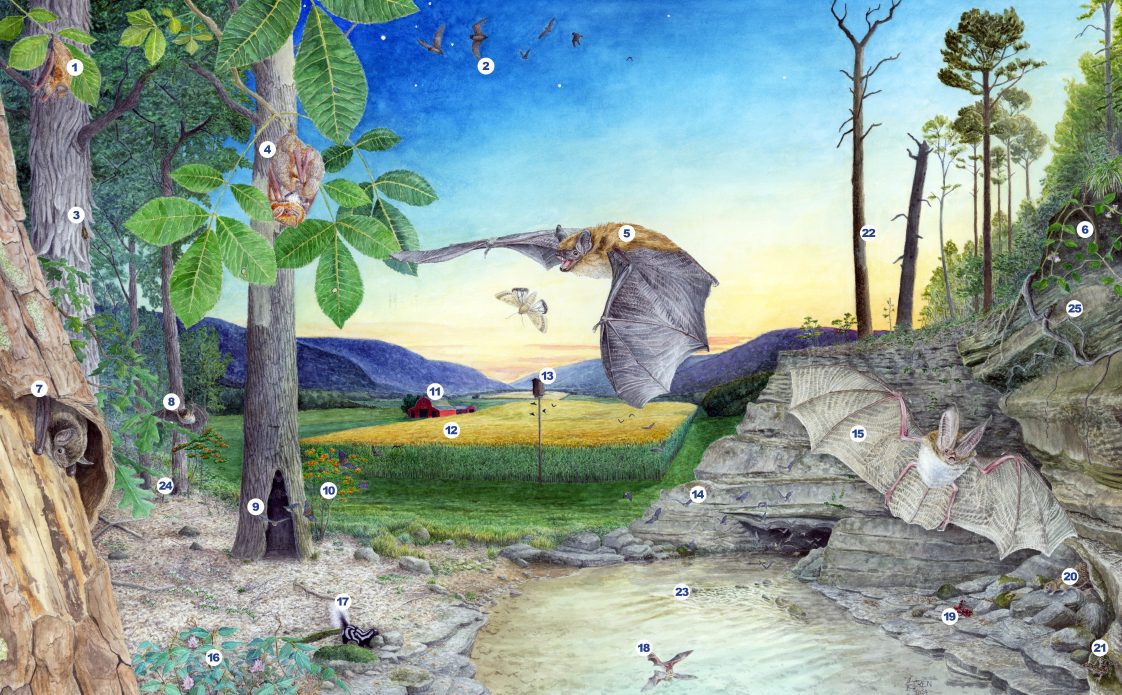
15. Rafinesque’s big-eared bat (Corynorhinus rafinesquii). Rafinesque’s big-eared bats occur in Alabama statewide. These bats have a specialized hunting strategy. Many moths that are the preferred prey of bats have evolved their own ultrahigh frequency sounds to interfere with bats’ echolocation. In turn, big-eared bats use a much lower frequency echolocation call than other bats use to avoid detection by the moths. Their remarkably long ears help them hear these whispering calls. They are also capable of finding caterpillars and can hover in flight to glean them from tree leaves. Big-eared bats’ natural roosts are caves or large, hollow trees, but they are often found in abandoned buildings.
16. Price’s potato-bean (Apios priceana). Price’s potato-bean is a threatened species. It is a vine of the pea family with clusters of showy, greenish-white to pinkish-purple flowers. It is found on the limestone slopes of the Cumberland Plateau in north Alabama and the Black Belt of central Alabama.
17. Eastern spotted skunk (Spilogale putorius). Once common in Alabama, this charismatic little animal is now rare, and few people know of their presence in Alabama. A bit larger than an eastern gray squirrel, the eastern spotted skunk performs a handstand as a warning behavior before spraying any would-be attackers.
18. Seminole bat (Lasiurus seminolus). Seminole bat drinking water. Bats require a source of water for drinking. They drink while flying and only use still or slow-moving water sources that have enough surface area and flight space to swoop in and out.
19. Red milksnake (Lampropeltis triangulum syspila). A brilliantly colored snake primarily found near rock outcrops of the Bankhead National Forest. The eastern milksnake (Lampropeltis triangulum triangulum), a close relative, is found in rock cliffs of northeast Alabama.
20. Allegheny woodrat (Magister neotoma). The allegheny woodrat is a native rat that is approximately the size of an eastern gray squirrel. They live in caves and rock outcrops north of the Tennessee River. They collect acorns and hickory nuts to store for a food supply.
21. Green salamander (Aneides aeneus). The only green salamander in North America, it is expertly camouflaged to hide in moss- and lichen-covered crevices of moist rock faces. They are only found where such features exist.
22. Dead pine snag. Dead trees—also known as snags—are important for over 50 species of wildlife including birds, lizards, snakes, and mammals. Many bats will roost inside or under the bark of snags. Snags should be left standing unless they present a hazard of falling and injuring someone.
23. Stream. Alabama ranks first in the United States for aquatic biodiversity, which includes freshwater fish, mussels, snails, crayfish, and turtles. There are over 132,000 miles of streams and rivers in Alabama. People and wildlife depend on Alabama’s clean water.
24. Streamside management zone (SMZ). Streamside management zones protect the waterway from soil and sediment due to erosion. Trees in the SMZ provide shade to help moderate water temperature and to provide detritus that is an energy source for aquatic habitats.
25. Limestone outcrops/rock faces (right). Limestone outcrops exist where limestone is close to the surface or exposed. Thin layers of soil or soil pockets often exist. This soil pH is basic. These areas rarely have large trees, as there is not much soil. They tend to be dry through the growing season except for late winter or early spring when rains are plentiful.

Written by Nicholas Sharp, Biologist, Alabama Department of Conservation and Natural Resources. Reviewed by Wesley Anderson, Extension Specialist and Assistant Professor, and Mark Smith, Professor, both with the College of Forestry, Wildlife, and Environment at Auburn University.
Appreciation is expressed to the artist, Rebecca Newton.
This project is a partnership between the Alabama Bat Working Group, Alabama Cooperative Extension System, Alabama Forestry Foundation, Alabama Sustainable Forestry Initiative Committee, Alabama Wildlife and Freshwater Fisheries, and Auburn University College of Forestry, Wildlife, and Environment